This week’s throughlines
- Executive power was used to test institutional limits — The week moved from emergency declarations and unilateral policy reversals into direct attempts to control appropriated funds, remove watchdogs, and strip protections from career officials, with courts repeatedly intervening.
- Immigration enforcement widened across law, space, and spectacle — Border emergency powers, school and church enforcement, arrest quotas, city raids, deportation disputes, TPS rollbacks, and Guantánamo planning all pointed in the same direction: a broader and more punitive enforcement system.
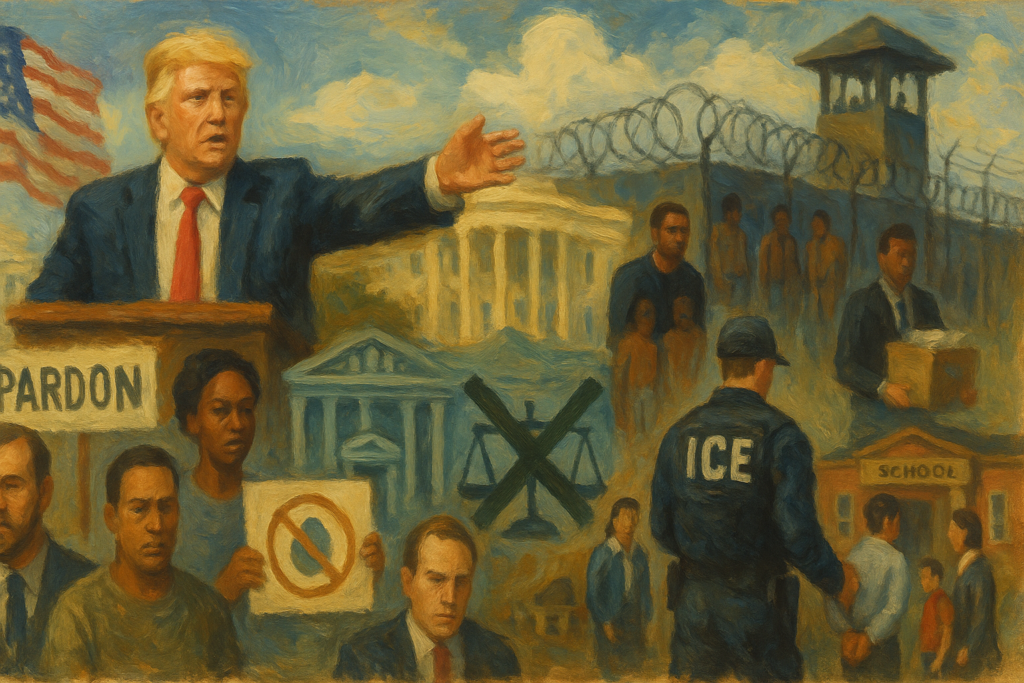
- Accountability for January 6 was reversed and then publicly normalized — Mass pardons and commutations were followed by public appearances, erased records, and legal consequences falling away, turning clemency into a broader statement about political violence and memory.
- The administration targeted the federal bureaucracy and public information systems — Loyalty screening, resignation offers, Schedule F-style guidance, data lockouts, and the removal of DEI and climate references showed a parallel effort to remake both the workforce and the official record.
The second week of the new administration showed how quickly the basic terms of American governance can be rewritten when executive power is used at full stretch. On one front, the White House moved to erase legal consequences for the January 6 attack and to purge those inside government who had investigated it. On another, it tried to seize control over trillions in public money through a sweeping funding freeze, only to be checked by the courts. Around these anchors, the week layered an escalating immigration crackdown, a campaign to politicize the civil service and oversight, and a systematic effort to dismantle diversity and civil-rights infrastructure and to reshape what the public can see and remember.
Over the weekend, the administration followed through on a central campaign promise by issuing mass pardons and commutations for roughly 1,500 people charged or convicted in the January 6 attack on the Capitol. The clemency covered a wide range of conduct, including assaults on police officers. Among the beneficiaries was Stewart Rhodes, the Oath Keepers leader convicted of seditious conspiracy, who quickly appeared at a Trump rally. A federal judge then lifted restrictions on his movements, citing the commutation. Law-enforcement groups and some Republicans warned that wiping away these sentences would embolden future political violence, but the White House framed the prosecutions as examples of “weaponization” of government against its supporters.
At the same time, the administration moved to dismantle pillars of federal civil-rights enforcement that had been built over decades. Trump signed a cluster of orders revoking a 60-year-old executive order that had required federal contractors not to discriminate, disbanding the Equal Employment Opportunity Commission, and broadly targeting diversity, equity, and inclusion programs across the government. Agencies began to comply in concrete ways: the Air Force, for example, removed material on the Tuskegee Airmen and women pilots from training curricula. Officials described these steps as restoring “merit,” but they effectively stripped away tools for challenging discrimination in hiring, contracting, and education.
Immigration policy also shifted sharply over the weekend. Trump declared a state of emergency at the southern border and signed orders expanding enforcement powers, raising arrest quotas, and authorizing Immigration and Customs Enforcement to conduct arrests in schools, churches, and other locations that had long been treated as sensitive. Religious leaders and local officials condemned the move as a violation of sanctuary norms and a threat to community trust, warning that families might avoid schools, hospitals, and houses of worship out of fear of arrest. In Chicago, ICE launched “enhanced targeted operations” with multi-agency raids and aggressive quotas, while in Florida the legislature sidelined Governor Ron DeSantis’s own deportation plan and instead aligned state efforts with the federal crackdown.
Foreign policy and domestic ideology were intertwined from the outset. Over the weekend, incoming Secretary of State Marco Rubio halted almost all foreign aid except military assistance to Israel and Egypt, despite Congress having appropriated the funds. Trump simultaneously ordered the United States out of the Paris climate accords and the World Health Organization, and directed the military to resume deliveries of heavy bombs to Israel. He demanded that NATO allies raise defense spending to 5 percent of GDP and floated the idea of relocating Gaza’s population to other countries. These moves signaled a willingness to override Congress on spending and to withdraw from major international frameworks on climate and health, even as the administration leaned into a more militarized posture abroad.
Inside the federal government, the weekend brought the first wave of moves to weaken internal oversight. Trump fired at least 15 to 17 inspectors general across major departments without providing the notice or reasons required by law. At the Department of Justice, Acting Attorney General James McHenry dismissed prosecutors involved in investigations of Trump, describing them as untrustworthy for implementing the president’s agenda. The public database of January 6 prosecutions quietly disappeared from government websites. Taken together with the pardons, these steps signaled that legal exposure for the president and his allies would be managed through personnel changes and clemency rather than through the courts.
Early reports also pointed to efforts to politicize the civil service. White House teams were said to be screening agency job applicants for loyalty to Trump and enthusiasm for his agenda. A whistleblower lawsuit alleged that incoming appointees had been instructed to collect detailed information on career civil servants and send it to an associate of Elon Musk under the guise of an official personnel request. Alongside these structural changes, the administration engaged in symbolic gestures that blurred the line between public office and personal branding: supporters in Congress filed a bill to add Trump to Mount Rushmore, the president ordered the Gulf of Mexico renamed the “Gulf of America,” and he launched a personal cryptocurrency, $Trump, days before taking office.
By Monday, the focus shifted to control over public resources and the military. An Office of Management and Budget memo ordered agencies to pause disbursement of nearly all federal grants and loans pending review for alignment with Trump’s priorities and new bans on DEI and climate-related spending. The freeze threatened Medicaid reimbursements, education aid, disaster relief, and research funding. Within hours and days, multiple federal judges issued emergency stays, citing the Impoundment Control Act and separation of powers, but agencies and beneficiaries were left in limbo as they tried to determine whether funds would flow.
The administration also moved quickly to reshape the armed forces along ideological lines. Defense Secretary Pete Hegseth announced, and Trump signed, orders eliminating DEI offices in the Defense Department and the Department of Homeland Security, banning service by people with gender dysphoria, ending the use of gender-affirming pronouns, and reinstating thousands of service members discharged for refusing COVID-19 vaccines, with back pay. Officials framed these changes as restoring “readiness,” but they explicitly targeted inclusion policies and public-health mandates, narrowing who could serve and under what conditions.
Elsewhere on Monday, Trump signed orders directing federal agencies to divert more water to southern California and to override state water management if deemed ineffective, weakening endangered-species protections and threatening to attach conditions to federal aid to force state compliance. California officials accused the administration of spreading misinformation about military involvement in water operations, underscoring tensions between federal authority and state environmental policy. In the immigration arena, Quaker congregations in Maryland and other faith groups filed lawsuits challenging the new policy allowing ICE operations in churches, schools, and hospitals, arguing that it violated religious liberty and chilled worship.
Monday also brought the first major legal clash over citizenship. Details emerged of an executive order, signed on Trump’s first day, ending birthright citizenship for children of noncitizens. Lawsuits from at least 22 state attorneys general and affected families argued that the order violated the Fourteenth Amendment’s guarantee of citizenship to all persons born in the United States. A federal judge in Seattle temporarily blocked the policy, but the administration vowed to take the issue to the Supreme Court. At the same time, the Office of Personnel Management issued guidance on a new “Schedule Policy/Career” classification, reviving the logic of the earlier Schedule F plan by stripping tens of thousands of policy-related civil servants of job protections and making it easier to fire them for perceived disloyalty.
On Tuesday, the administration extended its cultural and legal agenda into health care. Trump signed orders directing federal agencies to revoke funding from medical centers providing gender-affirming care to people under 19 and to exclude such care from TRICARE and federal employee health plans. Clinics in multiple states paused treatment for minors amid legal uncertainty. A separate order framed these steps as protecting children from harm and instructed agencies to rescind reliance on professional medical guidelines that support such care. The effect was to use federal funding and insurance rules to restrict medically endorsed treatment for a specific group of young people.
Immigration policy hardened further. In his inaugural address, Trump had announced plans to invoke the Alien Enemies Act of 1798 against undocumented immigrants, falsely claiming they were driving a crime wave. On Tuesday, the administration followed through by revoking deportation protections and Temporary Protected Status extensions for more than 600,000 Venezuelans. At the state level, the Oklahoma Board of Education voted to require citizenship information for school enrollment, despite Supreme Court precedent guaranteeing education regardless of immigration status. These moves stratified legal rights along lines of nationality and status and encouraged local policies that could deter immigrant families from sending their children to school.
Foreign and economic policy were increasingly tied to deportation goals. After Colombia initially refused U.S. military deportation flights, Trump imposed 25 percent tariffs on Colombian products, revoked visas for Colombian officials, and canceled visa appointments. Under pressure, Colombia agreed to accept flights with conditions, and the White House claimed victory as deportations resumed. The administration also threatened tariffs on other partners and previewed new tariffs on Canada, Mexico, and China that would be announced later in the week. Meanwhile, the Interior Department paused approvals for new wind and solar projects on public lands and offshore areas for at least 60 days, extending an earlier wind moratorium to solar, and Trump signed an order eliminating federal-level AI safety concerns, signaling a shift toward rapid deployment of artificial intelligence with minimal oversight.
Courts and advocates continued to respond. As lawsuits against the birthright citizenship order multiplied, a federal judge temporarily blocked its implementation nationwide. Non-profits and state attorneys general filed additional suits to stop the federal funding freeze, arguing that it violated the Impoundment Control Act and would harm programs like school meals and Meals on Wheels. Judges began issuing temporary injunctions, setting up a broader constitutional test over who controls the federal purse.
By Wednesday, the campaign to reshape the civil service moved from guidance to direct pressure. OPM emails titled “Fork in the Road” offered nearly all federal employees deferred resignations with pay through September, warning that those who stayed could face layoffs or reassignment. In parallel, guidance on the new Schedule Policy/Career classification and a separate inducement email from Musk-aligned OPM leadership sought to strip protections and encourage departures. More than 1,100 Environmental Protection Agency employees were placed on probationary status. Lawsuits were filed alleging illegal politicization of the civil service, but the message to career staff was clear: loyalty to the administration would be a condition of job security.
Immigration enforcement was codified in new ways. Trump signed the Laken Riley Act, allowing ICE to detain and deport undocumented immigrants based on certain arrests, even without conviction, and giving state attorneys general standing to sue over federal enforcement decisions. At the same time, he ordered the Pentagon and the Department of Homeland Security to prepare a 30,000-person migrant detention facility at Guantánamo Bay, explicitly tying it to a planned “mass deportation” campaign. Legal and human-rights groups warned that offshore detention would sidestep due-process protections and make conditions harder to monitor.
The purge of diversity programs and public memory intensified midweek. Building on earlier orders, the administration canceled federal diversity programs across agencies, closed DEI offices, and suspended observance of holidays such as Martin Luther King Jr. Day, Holocaust Remembrance Day, Juneteenth, and Pride at the Defense Intelligence Agency. The State Department’s Foreign Service Institute froze more than 1,200 DEI-related courses, and the Internal Revenue Service began deleting DEI language from its handbook. These steps narrowed whose experiences were recognized in public life and weakened institutional tools for addressing discrimination.
Courts, meanwhile, forced the administration’s first major retreat. Following a wave of lawsuits from states, non-profits, and small businesses, multiple federal judges issued stays and restraining orders against the funding freeze, citing confusion and likely illegality. Under mounting pressure, OMB rescinded the memo, and the White House acknowledged the reversal while insisting that related executive orders remained in effect. The episode showed both how vulnerable social programs are to unilateral executive action and how coordinated legal challenges can sometimes compel reversals.
The Justice Department and FBI saw further purges. Reports confirmed that at least nine senior FBI officials and dozens of agents and prosecutors involved in January 6 and Trump-related investigations were ordered to resign, retire, or be fired. The FBI Agents Association warned that the cuts would weaken national security and criminal enforcement. At the same time, the administration closed cases against Trump’s co-defendants in the classified documents probe. In Illinois, Governor JB Pritzker responded in the opposite direction, signing an order barring January 6 participants from state employment and arguing that insurrection was incompatible with public service. Elsewhere, a Louisiana grand jury indicted a New York doctor and her telehealth company for prescribing abortion pills to a minor, directly challenging New York’s shield law, while Disability Rights Oregon sued the city of Grants Pass over anti-camping rules that left disabled unhoused people with no legal place to sleep.
Wednesday also brought proposals that tested constitutional norms more directly. Representative Andy Ogles introduced a constitutional amendment to allow Trump a third presidential term, moving an idea long floated rhetorically into formal debate. Separately, Senator Mike Lee proposed authorizing privateering against drug cartels, reviving a centuries-old practice of licensing private violence. Both ideas drew criticism but underscored a willingness among some lawmakers to revisit basic constraints on executive power and the use of force.
On Thursday, the administration formalized its deregulatory agenda. Trump signed an executive order titled “Unleashing Prosperity Through Deregulation,” requiring agencies to repeal at least ten regulations for every new one and to keep the net cost of rules “significantly less than zero.” The order empowered OMB to enforce these caps and encouraged outsourcing state functions to private contractors. In parallel, the General Services Administration and the Environmental Protection Agency postponed multiple rules under a broader regulatory freeze. The numerical repeal target and negative cost cap signaled that aggressive deregulation would be a standing expectation, regardless of public-health or environmental needs.
The immigration crackdown extended offshore. Building on earlier orders to expand migrant detention at Guantánamo Bay, the administration floated plans to fly undocumented immigrants there directly. Officials framed the move as targeting “the worst criminal illegal aliens,” but details suggested a broader use that could bypass domestic courts. Human-rights advocates and legal experts warned that offshoring immigration detention to a site associated with indefinite military custody would weaken transparency and due-process protections.
The administration also used a tragedy to advance its campaign against diversity initiatives. After a mid-air collision near Washington, DC, Trump and his aides blamed diversity programs at the Federal Aviation Administration for the crash, without evidence. He signed orders rolling back diversity-focused hiring and emphasizing “merit-based” recruitment, publicly accusing prior administrations of lowering standards. Critics noted that investigations had not identified DEI as a factor and warned that scapegoating diversity could distract from real safety issues while reinforcing narratives that equate inclusion with incompetence.
In the Senate, confirmation hearings highlighted efforts to align key security and health institutions with the president’s worldview. Kash Patel, nominated to lead the FBI, refused to say that Trump lost the 2020 election or to rule out investigations of political opponents. Tulsi Gabbard, nominated as Director of National Intelligence, faced questions about past praise of foreign strongmen and how that squared with leading the intelligence community. Robert F. Kennedy Jr., tapped to head the Department of Health and Human Services, defended his vaccine skepticism despite opposition from thousands of physicians. Despite these concerns, Republicans signaled they had the votes to advance at least some of the nominees.
Thursday also underscored the growing entanglement of politics, media, and finance. Trump Media and Technology Group announced a new financial brand, Truth.Fi, planning to invest up to $250 million in cryptocurrencies and related assets. Separately, Meta agreed to pay $25 million to settle Trump’s lawsuit over his suspension after January 6, reportedly as a condition for future cooperation. A federal judge in Rhode Island issued an injunction preventing the administration from impounding funds owed to states, reinforcing earlier rulings that emphasized separation of powers and the need to keep Medicaid and other programs operating while litigation proceeds.
By Friday, the week’s themes converged in the labor and information spheres. The administration fired National Labor Relations Board General Counsel Jennifer Abruzzo and Chair Gwynne Wilcox, along with Equal Employment Opportunity Commission leaders Charlotte Burrows and Jocelyn Samuels, despite statutory protections for their terms. The dismissals left the NLRB without a quorum and effectively paralyzed its ability to decide labor disputes. Former officials called the firings unprecedented and illegal, and Wilcox signaled plans to challenge her removal in court. With the EEOC already disbanded on paper, these moves further weakened independent labor and civil-rights enforcement, leaving workers with fewer avenues to challenge unfair practices.
The campaign to erase certain topics from the federal record continued. The Department of Agriculture and the Forest Service removed climate-crisis content from their websites under a new directive, while the IRS deleted references to “diversity,” “equity,” and “inclusion” from its procedural handbook and took down diversity webpages. Together with earlier changes at the Air Force, State Department, and other agencies, these steps signaled a systematic effort to sanitize official records of equity and climate work, making it harder for the public to understand past commitments or track progress.
The “Unleashing Prosperity Through Deregulation” order, signed the day before, was reiterated as the new baseline: agencies were now formally required to repeal at least ten rules for every new one and to keep the net cost of regulations below zero, with OMB empowered to police compliance and to encourage outsourcing to private contractors. At the same time, reports confirmed that aides to Elon Musk, now influential at OPM and the Treasury Department, had locked career civil servants out of human-resources data systems and pressed for access to sensitive payment infrastructure. David Lebryk, the highest-ranking career official at Treasury, resigned after resisting these demands. Lawsuits and whistleblower complaints alleged that private actors were effectively steering core government systems.
Media and technology companies faced continued pressure. ABC News and Meta both reached settlements in high-profile cases—ABC in a defamation suit, Meta in Trump’s lawsuit over his suspension—while the Federal Communications Commission continued investigations into NPR, PBS, and CBS. The Meta settlement, combined with the earlier Truth.Fi announcement, underscored how litigation and regulatory scrutiny can be used to influence media and platforms that shape public discourse. Amid all this, parts of the administrative state continued their routine work: agencies like the Drug Enforcement Administration, EPA, and the National Archives processed controlled-substance applications, reopened comment periods on environmental rules, and published environmental impact statements, providing some continuity and transparency even as top-level policy shifted rapidly.
Taken together, the week’s developments traced a clear pattern. Through pardons, personnel changes, and structural rewrites, the administration moved to insulate itself and its allies from accountability, to concentrate control over public money and information, and to redefine who belongs and who counts in the eyes of the state. Courts, states, religious congregations, advocacy groups, and some career officials pushed back in targeted ways, winning temporary injunctions and forcing at least one major retreat. But the overall direction was unmistakable: a reordering of institutions—immigration, civil service, labor, media, and memory—around loyalty, exclusion, and executive discretion, with the long-term shape of American democracy increasingly contested in courtrooms, statehouses, and the quieter corners of the federal bureaucracy.