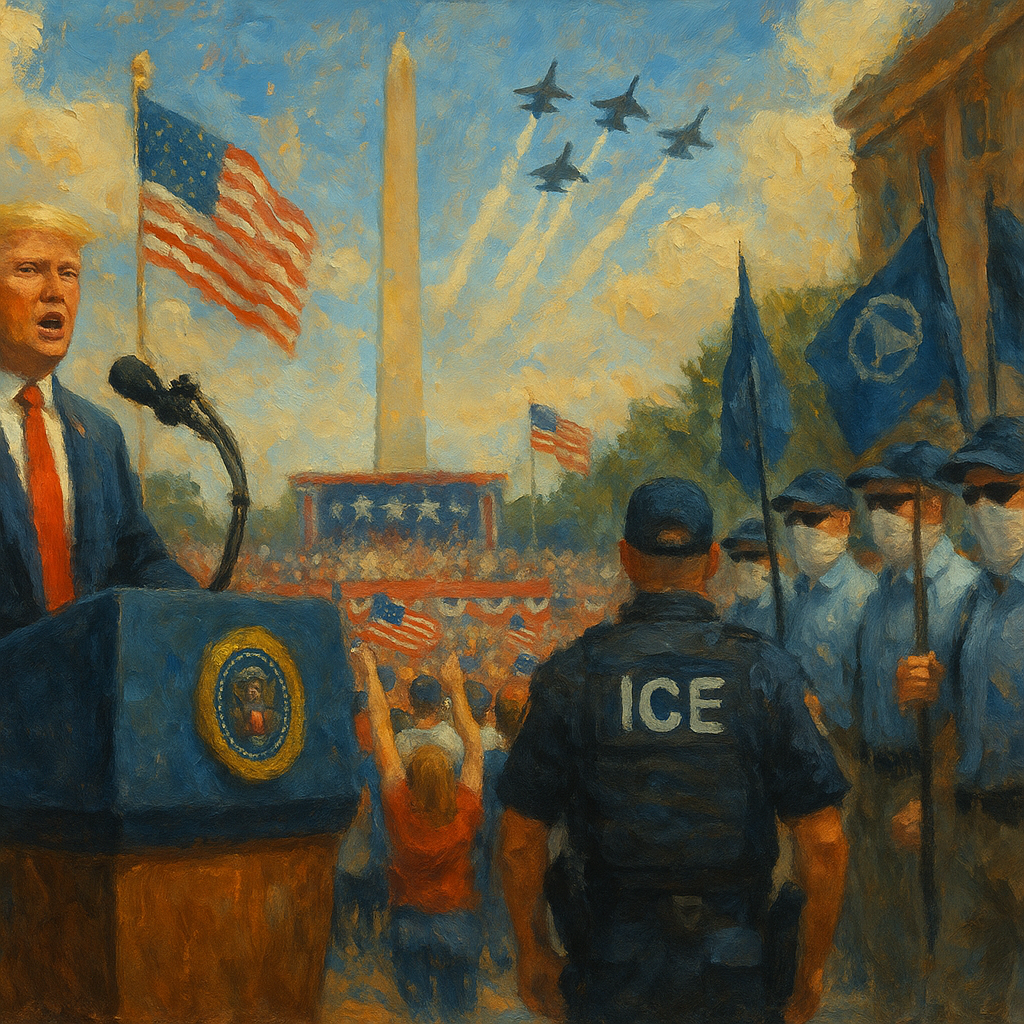
This week’s throughlines
- Election control widened from rhetoric to institutional action — What began as July 4 messaging about voter ID, proof of citizenship, and mail ballots turned into a broader campaign: calls to bypass the filibuster, plans to move the SAVE America Act through reconciliation, Justice Department threats to state election officials, and finally the removal of all remaining Election Assistance Commission members.
- Immigration enforcement hardened and produced a public accountability crisis — The week combined mass arrests, detention expansion, reduced judicial review for TPS, and multiple lawsuits over immigration practices. That arc culminated in the Houston ICE shooting, followed by disputed official accounts, federal investigations, detention of eyewitnesses, and street protests demanding transparency.
- Courts repeatedly checked executive or agency overreach, but only case by case — Judges enforced judgments against Trump, blocked some election-related and branding-related actions, protected medical privacy and campus speech, and heard new suits over retaliation, records, and agency power. The pattern was not one decisive reversal but a steady stream of legal resistance.
- Control over public information and expertise remained a parallel front — The administration and aligned institutions faced scrutiny over secrecy, selective disclosure, and politicized expertise: EEOC decisions moved out of public view, DOJ resisted Epstein-related disclosure, satellite imagery was reportedly withheld under pressure, and by Friday the administration had moved against climate science and broader research independence.
The week began with two lines of pressure that would shape everything that followed: a widening campaign to tighten control over election administration, and an immigration enforcement story that, by midweek, had become a national accountability crisis after a fatal ICE shooting in Houston. Around both, other institutions kept moving. Courts issued a steady series of rulings that constrained some executive actions and enforced judgments against the president, though only case by case. By Friday, the administration had also opened another front, moving to reshape science and environmental policy from the top.
Over the Independence Day weekend, Trump used the holiday itself as a political stage for voting restrictions. At a campaign-style appearance on the National Mall, he called for proof-of-citizenship requirements, voter ID rules, and limits on mail ballots, tying those proposals to the symbolism of July 4. The setting mattered. A national celebration that might once have served as a broadly civic ritual instead became a platform for a specific election agenda aimed at changing who can vote and how votes are cast. That message would not remain ceremonial for long; it set the tone for the week’s later fights over legislation, federal pressure on state officials, and the machinery of election administration itself.
Washington’s holiday events underscored how contested public symbolism had become. Anti-Trump demonstrations shared the city with a Patriot Front march that included Confederate imagery, while official Freedom 250 events were disrupted by severe weather. Trump still delivered a speech framed around patriotism and attacks on socialism. The result was a holiday weekend in which protest, white nationalist spectacle, and presidential pageantry all competed for the same civic ground. The struggle was not only over policy, but over who gets to define patriotism, public memory, and the meaning of national ceremony.
Trump also used the weekend to project personal power more directly. He issued pardons to 11 people, including fraud defendants and Clean Air Act violators, continuing a pattern of clemency for favored figures. The next day he ordered a renovation of the Reflecting Pool tied to the 250th anniversary celebration, extending the weekend’s use of public space and state resources for symbolic purposes. These were different kinds of acts, but they operated in the same register: executive authority used both to erase legal consequences for some people and to shape the physical setting of national commemoration.
At the same time, immigration pressure was already rising before Houston became the week’s central story. Reports described roughly 10,000 ICE arrests over five days. Organizers in North Carolina mobilized against a planned detention facility in Winton, while state lawmakers there overrode a veto on an immigration enforcement bill. Taken together, those developments showed expansion in both scale and infrastructure: more arrests, more detention capacity, and more state-level alignment with federal enforcement. The week’s later crisis did not emerge from nowhere. It grew out of an enforcement environment that was already intensifying.
There were smaller countercurrents over the weekend as well. A federal judge denied Trump more time to pay E. Jean Carroll, and a separate civic-history media project released a stream of programming centered on democracy, civil rights, and public memory. These were not the week’s driving events, but they mattered as reminders that courts and civic institutions were still producing records, rulings, and narratives outside the administration’s preferred frame.
By Monday, the election fight had moved from holiday rhetoric toward procedural change. Speaking at Mount Rushmore, Trump called for ending the Senate filibuster so the SAVE America Act could pass, arguing that Republicans would otherwise keep losing elections. That sharpened the weekend’s message. The issue was no longer only stricter voting rules in the abstract; it was also whether Senate procedure itself should be changed to speed restrictive election legislation through. The SAVE America Act would remain a live thread for the rest of the week, evolving from presidential demand into congressional strategy and then into pressure on election administrators.
Monday also brought a different kind of warning sign from immigration enforcement. Reports said ICE’s internal watchdog had opened investigations into U.S. citizens who criticized the agency, and a new lawsuit alleged that ICE retaliated against protected speech with a warning notice and coercive follow-up. Those developments raised a question that would hang over the week: whether immigration power was being used not only against noncitizens but also against critics, witnesses, and dissenters. When an enforcement agency begins to investigate or punish speech, the line between security authority and political retaliation grows harder to see.
Courts, meanwhile, checked several federal actions on privacy, transparency, and agency power. A judge ordered the Justice Department to produce Epstein-related documents or explain its refusal. Another court blocked DOJ efforts to obtain sensitive records of people who had received gender-affirming care as minors. The Supreme Court, in a separate ruling, allowed Texas to enforce an app age-verification law. The same day, the EEOC canceled a scheduled open meeting after resolving matters by notation vote and rescinded affirmative-action guidance under Title VII, reducing public visibility into its process while rolling back longstanding workplace-equity guidance. None of these developments matched the week’s biggest stories in scale, but together they showed a broader struggle over transparency, rights, and how much government decision-making would remain visible to the public.
On Tuesday, the election push moved deeper into Congress. House Speaker Mike Johnson said he would try to move the SAVE America Act through budget reconciliation, reducing Senate obstacles for the bill. That was a significant step in the week’s sequence. Trump had used the holiday to popularize restrictive voting themes, then demanded a procedural shortcut in the Senate; now congressional allies were looking for a different shortcut to advance the same agenda. The effort was becoming institutional, not just rhetorical.
Tuesday also brought one of the week’s most consequential court rulings on immigration. In a 6-3 decision, the Supreme Court said most Department of Homeland Security decisions on Temporary Protected Status were not subject to judicial review except for constitutional claims. The ruling made it easier for the administration to end protections for large groups of immigrants, including Haitians and Syrians, by narrowing one of the main legal checks on those decisions. It was a doctrinal ruling with immediate practical stakes, and later in the week its social consequences would become clearer.
That same day, the Houston ICE shooting turned immigration enforcement into a concrete accountability crisis. An ICE agent fatally shot Lorenzo Salgado Araujo during what officials described as a targeted operation, though witnesses disputed the official account and said he was not the intended target. Almost immediately, the case raised questions about mistaken identity, use of force, and the absence of body-camera evidence. What had begun the week as a story about rising arrests, detention expansion, and legal authority now had a human center and a contested factual record. Whether federal accountability mechanisms could produce a trustworthy account became one of the week’s central tests.
Tuesday also brought a cluster of lawsuits and rulings that showed how many institutions were turning to courts to resist federal pressure or secrecy. A federal appeals court struck down a key part of Florida’s Stop Woke Act for higher education. New suits challenged alleged sharing of asylum records with Iran, alleged viewpoint-based exclusion from official events, NOAA’s failure to produce records on a possible whale-protection rollback, and HUD conditions on homelessness funding. Trump also extended his familiar fraud rhetoric beyond elections, suggesting after a U.S. men’s soccer loss that an American defeat would be due to rigging. The remark was minor compared with the week’s larger actions, but it reinforced a pattern: distrust cast as a default explanation for unfavorable outcomes.
Wednesday brought the sharpest convergence of the week’s election and immigration stories. The Justice Department sent letters to election officials in all 50 states and the District of Columbia warning of possible criminal consequences if noncitizens were allowed to vote and demanding responses within five days. The letters came despite the lack of evidence for widespread noncitizen voting and amid ongoing legal fights over federal access to voter data. In sequence, they mattered. First came the holiday call for tighter voting rules, then the push to change Senate procedure, then the congressional plan to move the SAVE America Act. Now the federal government was directly warning state election administrators of possible prosecution. The pressure had shifted from messaging and legislation to the officials who actually run elections.
The Houston case widened at the same time. Federal investigators opened inquiries into the shooting, but the controversy deepened as reports said eyewitnesses were in ICE custody and advocates feared they could be deported before testifying. Additional reporting challenged DHS’s account, and the story broadened from a single shooting into a dispute over evidence, witness access, and institutional credibility. An investigation is difficult to trust when the agency involved controls the witnesses, the evidence, and the first public narrative. By Wednesday, that was the core problem in Houston.
Courts continued to provide partial checks. A judge ordered the release of the money Trump owed E. Jean Carroll after the Supreme Court declined to hear his appeal, and the D.C. Circuit refused to restore Trump’s name to the Kennedy Center during appeal. Trump also said he wanted a rehearing after the Court upheld birthright citizenship, while new lawsuits challenged a massive DHS penalty and alleged due-process violations in immigration enforcement. The United Nations called for an investigation into deaths in ICE custody, and reports said U.S. satellite imagery companies had withheld images of damage to U.S. military property in the Middle East under government pressure. These were separate stories, but they shared a theme: public accountability depends on access to evidence, whether the subject is detention, war, or the use of public institutions for personal branding.
Thursday brought the culmination of the week’s election arc. Trump terminated the last remaining members of the bipartisan Election Assistance Commission, leaving the agency without commissioners or a quorum as the midterms approached. This was not an isolated personnel story. It followed the week’s escalating sequence: holiday rhetoric about voting restrictions, demands to bypass Senate obstacles, congressional plans to move the SAVE America Act, and Justice Department threats to state election officials. By emptying the federal agency meant to support election administration, the administration moved from trying to change election rules to disrupting an institution that helps states run elections. The significance lay not only in who was removed, but in what the agency could no longer do.
The Houston shooting also deepened on Thursday. Reports said ICE detained the three eyewitnesses who had been in the van with Salgado Araujo, raising fears they could be removed before giving testimony. Protests grew in Houston, and federal investigators formally opened their review. The Supreme Court’s TPS ruling also showed immediate social consequences as new reporting emphasized that ending protections for Haitians and Syrians could worsen caregiver shortages for elderly and vulnerable people. Elsewhere, the Second Circuit rejected Trump’s bid to delay payment to Carroll, while New Mexico’s attorney general accused DOJ of obstructing the Epstein investigation by withholding records. Smaller but notable scrutiny also fell on White House secrecy and on HHS Secretary Robert F. Kennedy Jr.’s financial ties to a Scientology-linked law firm as the administration discouraged antidepressant use.
By Friday, further reporting made clear that the Election Assistance Commission was not merely weakened but unable to act at the commissioner level. After Trump removed the two Democratic commissioners and the remaining Republican resigned, the agency had no members left. Basic operations could continue, but it could not make new policy decisions. That clarified the week’s election story: federal pressure on state officials had been paired with the disabling of a bipartisan federal support body at a critical moment. Additional reporting also kept the DOJ letters in focus, underscoring that they threatened prosecution over voter rolls and noncitizen voting even though existing law already barred such voting.
The Houston case remained at the center of the immigration story through week’s end. New reporting emphasized that Salgado Araujo was not the target of the operation, that officers lacked body cameras, and that local and federal investigations were underway. Hundreds marched in Houston demanding transparency. The combination of lethal force, mistaken targeting, missing video evidence, detained eyewitnesses, and public protest made the case more than a local tragedy. It became a test of whether federal law-enforcement accountability can function when the agency under scrutiny controls so much of the underlying record.
Friday also broadened the week beyond elections and immigration. Trump appointed climate skeptic Matthew Wielicki to lead the U.S. Global Change Research Program, while broader funding cuts and ideological review pressure on research signaled a deeper effort to control scientific institutions. The administration also announced a rule weakening endangered-species habitat protections. States, meanwhile, kept turning to court, including in a new suit against the Department of Education over planned cuts to school-based mental health grants. These moves showed that the week’s pattern was not confined to voting and enforcement. It also extended to expertise, evidence, and the government’s treatment of environmental and public-health risk.
Taken together, the week showed how pressure on democratic life often advances not through one dramatic break but through sequence: a speech becomes a legislative push, a legislative push becomes a threat to administrators, and a threat to administrators is followed by the disabling of an institution. In immigration, broad enforcement expansion gave way to a single fatal operation whose disputed facts exposed deeper problems of secrecy, witness control, and accountability. Courts still imposed limits, from enforcing judgments to blocking some agency actions, but those limits arrived piecemeal. The larger record of the week was one of executive power pressing at once on election systems, immigration authority, public information, and scientific institutions.