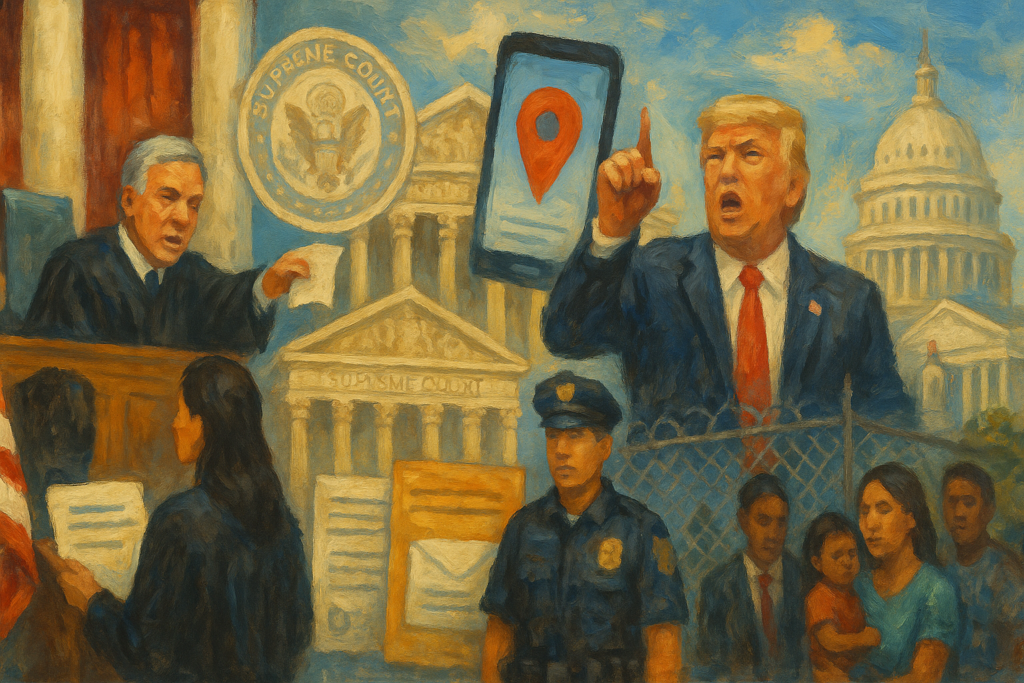
This week’s throughlines
- Courts both constrained and enabled the administration — The judiciary preserved birthright citizenship, mail voting access, Fed independence, and digital privacy, but also allowed the administration to end TPS for Haitians and Syrians and let states exclude trans athletes from girls' and women's sports.
- Immigration policy hardened across institutions — The week moved from anti-birthright rhetoric and a new ICE nomination to the TPS ruling, criminal charges tied to anti-ICE protest, a DOJ crackdown on 'birth tourism,' and a surge of ICE arrests.
- Executive leverage and congressional weakness fed each other — Trump used unrelated legislation to pressure Congress on voting rules, and Republican lawmakers responded with procedural obstruction and retreat on war-powers oversight, showing how presidential demands were reshaping legislative behavior.
- Public resources and national symbols were redirected toward personal, political, or curated ends — From a Trump portrait on a commemorative passport to anniversary spending, park funds, a no-bid ballroom contract, and historical material removed from parks, the administration repeatedly used state symbols, money, and memory institutions in ways that favored political branding and narrative control.
- Conflict-of-interest concerns widened from foreign deals to crypto — Questions about self-enrichment deepened through the week as reporting tied the Trump family to a Kazakhstan mining deal, the Pentagon accepted a gifted plane from Qatar, and financial disclosures showed enormous crypto-related earnings alongside softer SEC enforcement.
The week moved on two tracks at once. Courts imposed real limits in several of the administration’s biggest fights, especially over citizenship, voting, privacy, and the reach of presidential control. But those checks did not slow a broader pattern of executive escalation. As judges drew lines, the White House pressed Congress, widened immigration enforcement, and used public money, public symbols, and public institutions in ways that increasingly served political loyalty, personal branding, or control over the national story.
Over the weekend, that pattern was first visible in Congress. President Trump canceled a planned signing ceremony for a bipartisan housing bill and said he would not approve it unless Congress first passed his proof-of-citizenship voting measure. The demand tied an unrelated piece of governing business to an election-law priority, and congressional allies quickly reinforced the pressure. House hard-liners blocked procedural steps needed for other business, while Senate Republicans retreated from a war-powers effort after White House pressure. The immediate result was not a legislative breakthrough but a demonstration of leverage: the president was using party discipline and unrelated legislation to force movement on voting rules.
At the same time, the Supreme Court handed the administration one of the weekend’s most consequential immigration victories, allowing it to end Temporary Protected Status for more than 350,000 people, mainly Haitians and Syrians. The ruling abruptly changed the legal position of a large population that had been shielded from removal and left many newly exposed to detention or deportation despite continuing instability in their home countries. It also set the tone for the rest of the week’s immigration story. Even where the administration would later lose in court, the judiciary was clearly not moving in only one direction.
The weekend also brought a broader hardening of immigration politics. Stephen Miller renewed calls to end birthright citizenship. Trump nominated Lance Schroyer to lead ICE. The Justice Department brought sweeping charges against anti-ICE activists tied to protests in Minnesota, and North Carolina moved toward closer state cooperation with federal immigration enforcement. These were not isolated actions. They linked rhetoric, personnel, prosecution, and state-level alignment into a larger enforcement campaign that would intensify after later court rulings.
Another weekend thread concerned secrecy and control over public information. Reporting described the National Design Studio operating with unusual opacity and, by Sunday, placing privacy-evasive tracking tools on federal websites, including passport and voter-registration pages. Separately, the Interior Department restricted National Park Service staff from sharing information about deaths and serious injuries, centralizing communication instead. These were different kinds of actions, but they pointed in the same direction: less transparency at the edges of government and more centralized control over what the public could know and how the public could be monitored.
There were also early signs of the week’s self-dealing and symbolic politics. The White House unveiled a commemorative passport featuring Trump’s portrait. Reporting tied a Kazakhstan tungsten deal to Trump family financial interests. And the administration redirected federal college-access money toward campus “civil discourse” programs framed around protest politics. None of these developments stood alone for long. They previewed a week in which public resources and official symbolism would repeatedly intersect with private gain and political messaging.
Monday belonged largely to the Supreme Court, which issued a mixed set of major rulings. The Court preserved birthright citizenship, upheld Mississippi’s grace period for mail ballots that arrive after Election Day if postmarked on time, ruled that geofence warrants are searches under the Fourth Amendment, and kept Federal Reserve Governor Lisa Cook in place while her challenge proceeds. It also agreed to hear a proof-of-citizenship voting case, ensuring that another major election-law fight lies ahead. The rulings touched some of the most basic questions in democratic life: who counts as a citizen, how votes are counted, how much digital privacy people retain, and whether independent institutions can resist direct presidential command.
That same day, the administration escalated its confrontation with California. It invoked emergency powers to restart a long-shuttered oil operation, ordered a federal evaluation of the California Coastal Commission, and withdrew a major offshore-wind grant. California officials signaled that they would fight back in court. The moves showed how emergency authority, oversight mechanisms, and federal funding could be used together to pressure a politically disfavored state on energy policy.
The weekend’s congressional coercion also spilled into Monday’s legislative business. The House failed to move the National Defense Authorization Act after a rules fight tied to the voting bill blocked progress. That failure mattered less for the immediate fate of the defense measure than for what it revealed about Congress itself. Election-related demands were now disrupting routine legislative functions, including one of the chamber’s core annual responsibilities.
Lower courts, meanwhile, continued to act as a quieter but steady check. A multistate lawsuit challenged new Medicaid work requirements. Judges ruled against the administration in disputes involving transportation grants, HUD homelessness funding, and political speech in public space. These cases did not dominate the day, but they reinforced a pattern that would continue all week: even when the Supreme Court set the broadest terms, lower courts remained central to the daily work of limiting or delaying executive action.
Tuesday brought the week’s clearest constitutional rebuke. In a landmark ruling, the Supreme Court struck down Trump’s birthright citizenship order and held that children born in the United States to parents who are unlawfully or temporarily present are citizens at birth. The decision left the order unenforceable and reaffirmed the Fourteenth Amendment’s guarantee. After a weekend in which the Court had allowed the administration to strip protections from hundreds of thousands of TPS holders, this ruling pointed in the opposite direction. It preserved a foundational rule of membership even as the broader immigration system was becoming harsher.
But Tuesday also showed how quickly a legal defeat could be reframed as a new power struggle. After the Court’s recent decisions touching agency independence, Trump claimed he now had authority to remove heads of independent agencies at will. The assertion went beyond what the Court had just done; on the same terrain, the justices had kept Lisa Cook in place and denied a stay in another removal fight involving Copyright Office head Shira Perlmutter. Still, the president’s response made clear that the legal battle over independent agencies was becoming a practical contest over whether institutions designed to be insulated from direct political command could remain so.
The Court also ruled that states may exclude transgender girls and women from female sports teams, a decision likely to shape similar laws nationwide. The ruling narrowed protections for transgender students and gave states wider room to legislate by identity. It was another reminder that the week’s court story was not one of simple resistance to executive or conservative power. The judiciary was checking some assertions of authority while enabling or affirming others with lasting consequences for rights and belonging.
Elsewhere on Tuesday, courts and litigants opened another round of challenges to administration policy. A federal judge blocked the Defense Department from enforcing a restrictive escort rule against New York Times reporters. Several courts vacated the Education Department’s Public Service Loan Forgiveness rule targeting certain employers. New lawsuits challenged anti-DEI conditions on FEMA grants and other administration actions. And FBI Director Kash Patel posted details of arrests in a sealed case before formal disclosure, raising concerns that senior law-enforcement officials were blurring legal process with public spectacle. That episode fed into a separate but related theme that would grow later in the week: disputes over records, disclosure, and the integrity of official process.
On Wednesday, one of the week’s most important voting-rights developments arrived from a lower court. Judge Emmet Sullivan blocked the Postal Service from implementing ballot-mail verification changes tied to a Trump executive order. The order had threatened to pressure states on voter-roll access and to complicate ballot delivery nationwide. Together with Monday’s Supreme Court ruling protecting late-arriving mail ballots that were postmarked by Election Day, the injunction made mail voting a two-part story. One court protected the counting of valid ballots after they were sent; another blocked an administrative route that could have made it harder for those ballots to move through the system in the first place.
Wednesday also showed the administration’s capacity to redirect after losing in court. After the birthright citizenship ruling, Acting Attorney General Todd Blanche announced a crackdown on so-called birth tourism, while ICE reported more than 10,000 arrests in five days as the White House pushed for a pace of 2,000 arrests per day. The message was unmistakable. A constitutional defeat on one immigration front would not produce restraint; it would be answered with intensified enforcement elsewhere. New lawsuits that day, including challenges involving protest access, immigration policy, and alleged retaliatory use of federal power, suggested that many of these fights were now moving into court almost as soon as policy was announced.
Another Wednesday development sharpened the week’s conflict-of-interest story. Trump’s financial disclosure, released by the Office of Government Ethics, showed more than $2.2 billion in family earnings, including major crypto income. The disclosure did not resolve the underlying questions; it made them harder to ignore. As policy decisions affecting crypto and other business interests continued to unfold, the public record now showed the scale of the president’s private financial stake.
Thursday concentrated many of the week’s corruption and public-memory themes into a single day. The Pentagon accepted Qatar’s gifted Boeing 747, and Trump took his first flight on it. The administration also advanced financing for a Kazakhstan mining deal tied to family-linked interests. At the same time, new reporting and disclosures highlighted Trump’s large crypto earnings and the SEC’s retreat from crypto enforcement. The overlap was unusually direct: foreign relationships, regulatory choices, and presidential finances were appearing in the same frame.
Congress and reporters also documented how the 250th anniversary of the nation’s founding was being turned into a political project. A House Democratic subcommittee report accused Trump allies of diverting anniversary resources into Freedom 250 and using the celebration to reward allies and shape national memory. Related reporting alleged donor deception and misuse of funds. What might otherwise have looked like a dispute over event planning instead came into view as a struggle over patronage and historical narrative: who gets the money, who gets the platform, and who gets to define the meaning of the country’s past.
Questions about public knowledge and official records deepened on Thursday as well. An appeals court allowed the administration to keep climate, slavery, and immigration material out of national parks. A Justice Department leak pointed to a hidden Jack Smith report and a missed deadline for releasing Epstein-related files. And a judge rejected the administration’s justification for a no-bid White House ballroom contract. These were separate controversies, but they converged on a common issue: the public account of government action was itself becoming contested terrain, whether in historical interpretation, procurement records, or criminal files.
Thursday’s immigration story was smaller but telling. The Florida Board of Education voted to bar undocumented students from the state’s public colleges and universities, using board authority rather than legislation. The move extended immigration-enforcement logic into higher education and showed how exclusionary policy could spread through administrative channels, not only through Congress or the courts.
Friday was lighter on fresh institutional action, but it tied the week’s threads together. Reporting emphasized the scale of the late-June ICE arrest wave, with roughly 10,000 people detained in five days. At the same time, the Fifth Circuit ruled that immigrants cannot be held more than 90 days without a bond hearing, preserving at least one due-process limit amid the enforcement surge. The week’s immigration picture was therefore sharply divided: the administration kept expanding detention and removal pressure, while courts tried, unevenly, to preserve constitutional or procedural boundaries.
The week’s voting-rights checks also came into clearer focus by Friday. Coverage and legal follow-through underscored the significance of the two mail-ballot rulings: the Supreme Court’s protection of grace periods for ballots postmarked by Election Day, and the federal judge’s order blocking Postal Service restrictions tied to the White House. Together, those decisions protected two practical pathways voters rely on to have ballots counted.
Public-memory fights, meanwhile, moved from reports into visible institutions and spending choices. Several states kept their distance from the Great American State Fair. Confederate flag imagery was removed from North Carolina’s booth. New reporting said the administration had redirected money from libraries and historical groups to a triumphal arch and statuary garden in Washington. What had begun as concerns about anniversary branding and park content now appeared in exhibits, budgets, and public events. The contest over national memory was no longer abstract.
The Justice Department’s transparency problems persisted into the end of the week when it asked for a two-month delay in releasing more Epstein-related files. On its own, that request might have looked procedural. In the context of the week, it fit a broader pattern of delayed disclosure, leaked or mishandled information, and disputes over who controls sensitive records.
Taken together, the week showed a government under simultaneous legal constraint and political acceleration. Courts preserved birthright citizenship, protected mail voting, recognized limits on digital surveillance, and kept some independent authority beyond immediate presidential reach. But the administration answered setbacks with new enforcement drives, pressure on Congress, and a widening use of public institutions for patronage, branding, and narrative control. The result was not a simple story of checks and balances either working or failing. It was a more unsettled picture: institutions still capable of resistance, but forced to respond again and again as executive power searched for other routes.