This week’s throughlines
- Courts repeatedly checked federal election control efforts — From the weekend into midweek, judges allowed challenges to Trump’s mail-voting order, blocked use of federal databases for voter-roll checks, and then struck down proof-of-citizenship and mail-ballot control measures outright.
- Iran policy moved from threats to unilateral dealmaking to a congressional rebuke — Trump and allies opened the week with threats toward Iran and the Strait of Hormuz, then paired a new Iran understanding with sanctions relief, before the Senate passed a war powers resolution to limit further military action without congressional approval.
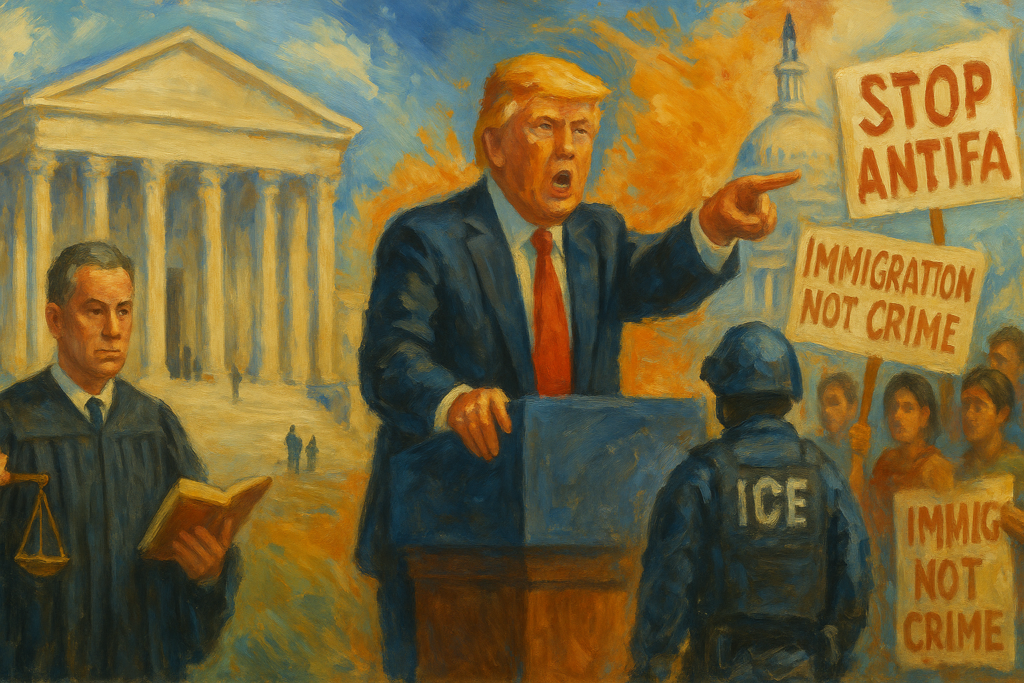
- The administration and allied institutions hardened their posture toward dissent and migrants — Protesters were framed as extremists, anti-ICE defendants received extraordinary sentences, and Trump formally moved to treat antifa as a terrorism target. By week’s end, Supreme Court rulings expanded executive power over asylum, TPS, and deportation.
- Symbolic politics spilled into public institutions and public space — Trump’s unsupported vandalism claims about the Lincoln Memorial Reflecting Pool led to security deployments, fencing, and contracting questions, while separate fights over the Kennedy Center and Texas curriculum showed broader struggles over public memory and civic space.
- Executive control over agencies and intelligence deepened — The administration dissolved USAID, installed William Pulte as acting DNI without normal confirmation, and reportedly began planning intelligence-community firings, reinforcing a pattern of centralizing control over professional institutions.
The week unfolded as a contest between executive escalation and institutional restraint. Federal judges repeatedly blocked efforts to pull election administration toward Washington, even as the White House searched for other levers of control. At the same time, the administration widened its treatment of protest as a security threat, hardened its immigration posture, and turned a troubled renovation at the Lincoln Memorial Reflecting Pool into a story of sabotage and enforcement. By Friday, the pattern was clear: some courts were still drawing lines, but other institutions—especially the Supreme Court and parts of the executive branch—were moving in the opposite direction.
Over the weekend, lower courts opened the week by checking several aggressive federal moves at once. A judge allowed a challenge to the president’s mail-voting order to proceed, signaling that the administration’s attempt to reshape election rules by executive action would face sustained scrutiny. In immigration matters, other judges ordered the release of a lawful permanent resident detained over pro-Palestinian speech and barred most ICE courthouse arrests in New York City. Those rulings protected not only individual litigants but broader principles: access to courts, limits on immigration enforcement inside judicial spaces, and the idea that lawful status and political speech cannot simply be brushed aside. In Georgia, meanwhile, Republicans backed away from a redistricting push after public pressure, a reminder that not every hardening move this week reached completion.
The weekend also brought a volatile mix of diplomacy and threat around Iran. As talks in Switzerland unfolded, the president publicly threatened Iran and floated coercive control over the Strait of Hormuz, while allies such as Senator Lindsey Graham echoed the possibility of force. By Sunday, the administration was pairing that rhetoric with a major sanctions waiver that opened Iranian oil transactions in dollars, even as Iranian officials disputed American claims about inspection concessions. The result was a foreign-policy picture shaped less by stable public process than by abrupt executive signaling, conflicting accounts, and the possibility of military escalation with only limited congressional involvement.
At home, the administration began turning the Reflecting Pool controversy into something larger than a failed public-works story. A donor-linked, no-bid renovation had already drawn scrutiny for cost overruns and visible defects. Rather than answer those questions directly, the president blamed “Antifa” and unnamed vandals for the damage without producing evidence. Arrests and citations followed. What might have remained a contracting and management scandal was recast as a law-enforcement problem, shifting attention from how the project was awarded and handled to who could be blamed for its condition.
That same widening security posture appeared in protest and immigration enforcement. Federal prosecutors in Minnesota charged 15 people while emphasizing alleged “Antifa” ties, the FBI reportedly tried to recruit detained protesters as informants, and Human Rights Watch documented killings, racial profiling, and thousands of detentions in Minnesota’s Operation Metro Surge. Taken together, those developments suggested a blurring of lines between ordinary criminal prosecution, intelligence gathering, and political policing. The president also renewed calls for federal troop deployment in Chicago, despite state resistance and evidence that such deployments do little to reduce violent crime. Even before midweek, the administration was pressing a theory of domestic order that leaned heavily on force, surveillance, and federal intervention.
By Monday, the election fights had broadened. Judge Sparkle Sooknanan blocked the administration from using the SAVE system to check state voter rolls, and related rulings and filings reinforced that federal agencies could not simply repurpose immigration and Social Security data for election policing. At the same time, the administration threatened states with the loss of Homeland Security funds unless they changed election laws. The conflict was no longer about a single order. It had become a larger struggle over whether the federal government could mine its databases, pressure states financially, and use executive power to reshape the mechanics of registration and voting.
Monday also brought a striking move inside the national security bureaucracy. The president canceled a Senate confirmation hearing and installed William Pulte as acting director of national intelligence despite bipartisan opposition and limited relevant experience. Soon after taking office, Pulte reportedly ordered staff to compile a list of roughly 300 people to fire at the National Counterterrorism Center. The immediate significance was procedural as much as personal: a core constitutional check, Senate confirmation, was sidestepped, and the intelligence apparatus was put on notice that loyalty and purge politics could matter more than expertise or continuity.
The Reflecting Pool story escalated further on Monday when National Guard personnel were stationed around the site and citations were issued to people who touched the water. A major public monument was being turned into a guarded security zone even though the administration still had not substantiated its sabotage claims. Questions about the renovation itself did not disappear, but they were increasingly crowded out by a visible enforcement response. Elsewhere, the Senate overwhelmingly passed a bipartisan housing bill aimed at lowering costs, showing that ordinary legislative problem-solving was still possible. Yet even there, the administration’s broader domestic direction pointed elsewhere, toward narrower health and social support policies. New campaign-finance filings added another background theme: Republican-linked groups were funding supposedly progressive super PACs in Democratic primaries, while AI-focused money poured into a New York House race, underscoring how candidate selection was being shaped by opaque and concentrated funding before general-election voters had much say. The president also threatened the press over Iran coverage, calling reporters “treasonous” and suggesting their work could be folded into a lawsuit—a warning shot at scrutiny in matters of war and diplomacy.
Tuesday brought competing institutional signals. In the Senate, lawmakers passed a war powers resolution requiring congressional approval for further military action against Iran. It was a bipartisan rebuke to unilateral presidential war-making and a direct assertion of Congress’s constitutional role. The vote came as the Pentagon sought tens of billions more for the conflict and public skepticism grew. For a moment, at least, Congress appeared willing to reclaim some authority over decisions that can carry the country into war.
Courts, meanwhile, continued to check immigration enforcement and executive defiance. A federal judge vacated ICE and immigration-court courthouse-arrest policies and a detention hold-room waiver, while the D.C. Circuit revived the Boasberg contempt dispute over deportation flights. Another federal court slowed Justice Department pressure on Wisconsin voter rolls, extending the week’s pattern of judicial resistance. These were not final settlements of the underlying fights, but they reinforced a basic point: immigration enforcement, election administration, and compliance with court orders remain subject to judicial review even when the executive branch tries to move quickly or aggressively.
Tuesday also showed what the administration’s anti-protest posture could mean once it reached a courtroom. Federal judges in Texas imposed prison terms ranging from decades to a century on anti-ICE protesters, with prosecutors and officials framing the cases through terrorism and “antifa” language. The sentences were far harsher than those given to many January 6 defendants and became an early test of the administration’s effort to criminalize protest as domestic extremism. At the Reflecting Pool, workers began building a fence as arrests and citations continued, making the restriction of civic space physically visible. Smaller developments pointed in the same direction: the Supreme Court blocked a Rastafarian prisoner’s damages suit over forced shaving, narrowing a path to redress, and the National Park Service said it would void park passes altered with stickers over the president’s face, tightening control over expression in public spaces.
Wednesday was the week’s sharpest point of confrontation. The president formally declared “antifa” a major terrorist organization despite lacking clear legal authority to designate domestic groups that way, then issued a national security memorandum directing broad protest investigations and maximum prosecutions. The move did not come out of nowhere. It followed days of protest-related indictments, informant recruitment, and severe sentencing. What had been rhetoric was now formal policy, with the potential to expand surveillance, prosecution, and intimidation under the language of national security.
On the same day, the courts delivered some of the week’s strongest rebukes to federal election control. Three federal judges blocked key parts of the administration’s election agenda, including proof-of-citizenship registration requirements and federal control over mail-ballot delivery. Yet the administration kept searching for alternate routes. The Postal Service advanced a rule that would require states to hand over mail-ballot request data and could withhold election mail from noncompliant states. The central conflict of the week came into focus here: judges were limiting direct executive control over elections, while the administration looked for administrative and logistical tools to reimpose it.
Wednesday also brought major immigration victories for the administration from the Supreme Court. The Court allowed the government to end Temporary Protected Status for Haitians and Syrians and upheld the “metering” policy that lets officials turn back asylum seekers before they reach U.S. soil. A separate ruling broadened government discretion over green card holders accused of crimes involving “moral turpitude.” These decisions moved in the opposite direction from the lower-court rulings earlier in the week. They reduced protections for migrants, refugees, and lawful permanent residents, and they showed that while some judges were checking executive overreach, the highest court was also giving the administration stronger legal footing in immigration.
The Reflecting Pool dispute widened into an oversight fight on Wednesday. Senator Richard Blumenthal demanded records on the project’s contracting and management as pressure mounted for evidence behind the sabotage claims. The administration still had not produced proof, even as fencing and security remained in place. The story was no longer just about a monument. It had become a test of transparency, public contracting, and the use of security powers to manage a politically useful narrative.
Thursday extended the week’s major fights rather than replacing them. The Supreme Court’s immigration rulings dominated advocacy and coverage, and new reporting highlighted a possible Health and Human Services plan to deport unaccompanied migrant children, as well as the fact that most children in deportation proceedings lack legal representation. The Court’s decisions did not stand alone; they fed into a broader system in which vulnerable migrants faced fewer protections and weaker access to counsel. At the same time, the president repeated that he would withhold his signature from the bipartisan housing bill until Congress passed the SAVE America Act, keeping proof-of-citizenship voting rules at the center of an otherwise unrelated domestic policy fight. After repeated court defeats, the administration was using one of the levers still available to it: holding a popular bill hostage to restrictive election demands.
Congress’s effort to check war powers also weakened on Thursday. After the earlier Senate vote, Republicans rejected a later Iran measure following direct pressure from the president, even as the White House sought $87.6 billion in new funding for the conflict. The reversal showed how fragile congressional resistance remained. A chamber could assert itself one day and retreat the next when party discipline and presidential pressure intervened. Elsewhere, the Reflecting Pool story kept widening. A National Park Service court filing formally alleged vandalism at the pool, while separate reporting showed Park Service funds had been diverted to a White House granite walkway the president had claimed to fund personally. Together, those stories deepened questions about public money, public narratives, and the use of agencies to support presidential image-making. Reporting also drew renewed scrutiny to expanded Park Police pursuit rules after multiple fatalities, including bystanders and young drivers who would not have been subject to pursuit under earlier standards.
Friday was lighter on singular institutional clashes, but it consolidated the week’s deeper themes. The Supreme Court’s immigration turn continued to expand in practical effect. TPS losses for Haitians and Syrians remained central, the asylum turnback ruling stood, and the Court’s broader discretion for excluding or deporting green card holders accused of crimes involving moral turpitude sharpened the sense that protections were narrowing not only for asylum seekers but also for lawful permanent residents. By week’s end, immigration hardening was no longer a set of isolated rulings. It was a governing direction.
The Texas protest sentences, too, became the week’s clearest warning about criminalizing dissent. Further reporting and reaction underscored the severity of the decades-long terms imposed on anti-ICE activists under a framework that cast protest activity as terrorism. The significance lay not only in the punishments themselves but in the chain that produced them: executive rhetoric, prosecutorial framing, and judicial outcomes reinforcing one another. Friday also showed how administrative power was being used in less dramatic but still consequential ways. Federal health officials ordered funded programs to move away from overdose prevention and toward “parental authority” messaging, threatening funding consequences for noncompliance, while the EEOC prepared to discuss rescinding affirmative-action guidance. In Texas, the state board of education approved a statewide reading list requiring Bible passages and advanced curriculum changes that downplayed non-European history and omitted many negative parts of U.S. and Texas history. And in campaign-style remarks, the president escalated his language further, describing Democrats as “communists” and “godless communists,” casting ordinary electoral competition in terms of existential cultural threat.
Taken together, the week showed how democratic strain can spread across institutions in different ways at once. Courts can block executive attempts to seize new control over elections, yet the same week can bring Supreme Court rulings that narrow immigrant protections, a White House that treats protest as a security problem, and a Congress that struggles to sustain its own authority over war and legislation. The most revealing stories were not only the headline rulings but the patterns connecting them: public spaces turned into enforcement zones, unrelated bills used as leverage for voting restrictions, dissent recast as terrorism, and administrative power used to reshape policy without new laws. What emerged was not a single decisive break but a cumulative picture of how pressure on democratic life is applied—through courts, agencies, police powers, public narratives, and the steady testing of institutional limits.