This week’s throughlines
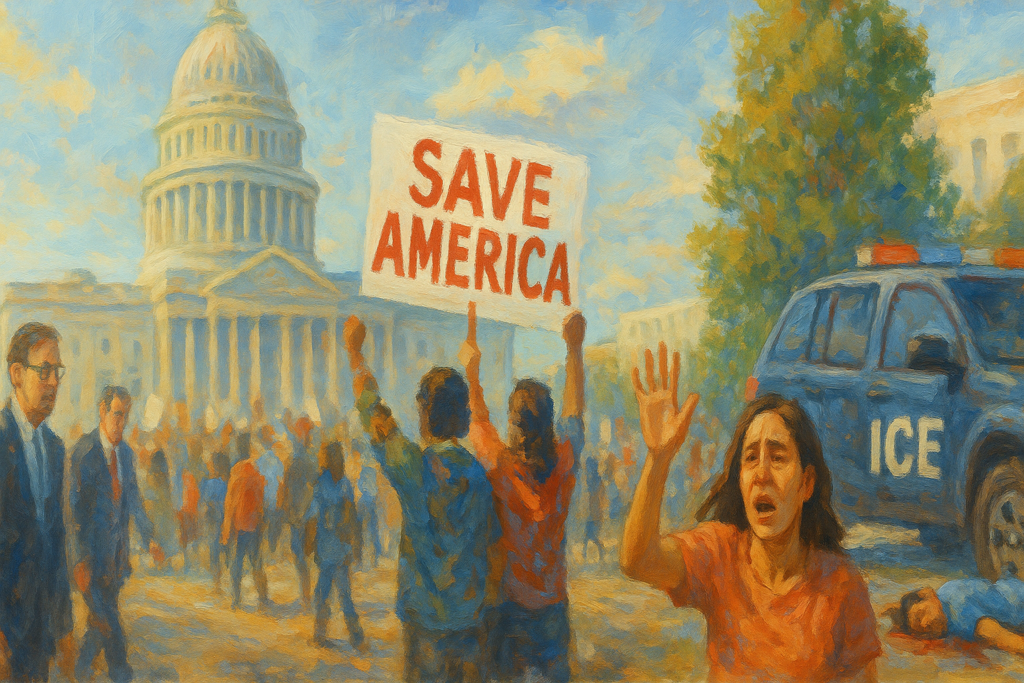
- Election administration moved from political rhetoric into direct federal pressure — The week began with the purge of the Election Assistance Commission and DOJ threats to state election officials, then expanded into grant leverage, demands for voter-roll access, revived 2020 election claims, and House efforts to move the SAVE America Act through must-pass legislation.
- ICE violence triggered backlash, limited restraint, and rapid political reversal — After fatal ICE shootings in Texas and Maine, DHS and ICE moved to pause many vehicle stops under public pressure, but the White House quickly pushed back while arrests continued to surge and new deaths, detention concerns, and accountability demands mounted.
- Pressure on independent scrutiny widened across media, courts, and agencies — The administration subpoenaed reporters, formalized a leak crackdown, threatened broadcasters, and pursued politically charged investigations, while courts and litigants repeatedly challenged settlements, sanctions, secrecy, and viewpoint-based policies.
- Executive unilateralism extended beyond domestic politics into war powers and public space — Trump used proclamations and announcements to shrink national monuments, assert broad authority over Iran-related military and trade actions, and reshape symbolic federal space around the White House with new barriers and construction plans.
The week opened with a sharp shift from election rhetoric to direct pressure on the machinery of election administration. Over a few days, the administration moved against the federal body that helps states run elections, warned state officials they could face prosecution over voter-roll practices, and pressed Congress to advance new voting restrictions through unrelated legislation. At the same time, immigration enforcement became a national flashpoint after two fatal ICE shootings of men who were not the intended targets of operations. A temporary retreat by the agency was quickly overridden from above. Running alongside both stories was a widening campaign against independent scrutiny: subpoenas to reporters, a formal anti-leak task force, and threats aimed at broadcasters. Courts offered some resistance, but mostly as partial brakes in a week defined by executive pressure spreading across several institutions at once.
Over the weekend, the most consequential election development came from Washington. President Trump fired the remaining members of the federal commission that assists states with election administration, citing a recent Supreme Court ruling on presidential removal power. The commission is not the body that counts votes, but it has long served as a technical and coordinating institution for the states. Removing its remaining members weakened one of the few federal entities designed to support election administration at some distance from day-to-day partisan combat. The firings did not stand alone. They came as Trump intensified his demand that Congress move the SAVE America Act and signaled he was willing to hold up unrelated governance, including a bipartisan housing bill, to force Senate action on that voting measure.
That same opening stretch brought a second line of election pressure, this time from the Justice Department. Letters went to election officials in every state and in Washington warning of possible criminal consequences tied to noncitizen voting and demanding quick explanations of voter-list maintenance. The letters introduced a coercive posture toward state and local election administrators before any new federal law had passed. In practical terms, the message was that ordinary election management could now carry the threat of federal investigation or prosecution if it did not align with the administration’s priorities. Taken together with the purge of the election-assistance body, the weekend established the week’s central pattern: weakening independent election infrastructure while increasing direct political leverage over the officials who actually run elections.
Immigration enforcement also moved to the foreground immediately. In Houston, an ICE agent fatally shot Lorenzo Salgado Araujo even though he was not the intended target of the operation. On the same day, Houston officials repealed a local ordinance that had limited police cooperation with ICE after funding pressure from Texas officials. The two developments were different in kind, but they pointed in the same direction. One showed the human cost of aggressive enforcement tactics; the other showed how local restraints on those tactics could be stripped away under financial and political pressure. For immigrant communities, the effect was to make enforcement feel both more dangerous and less bounded by local checks.
The administration’s confrontation with the press also widened over the weekend. Federal prosecutors subpoenaed New York Times reporters in a leak investigation tied to reporting on security concerns involving Trump’s Qatari-gifted aircraft. That step went beyond pursuing leakers inside government and reached directly into newsroom source relationships. Trump also spent the weekend attacking the press and preemptively casting future election coverage as suspect. The combination mattered. It suggested that pressure on the media would not be limited to public denunciation; it would also involve legal process and the threat of punishment for reporting on sensitive government matters.
Courts, meanwhile, offered a mixed picture. A federal judge dismissed the Proud Boys seditious conspiracy case at the Justice Department’s request, effectively ending one of the most serious January 6 prosecutions and reducing one avenue of accountability for the attack on the Capitol. In a separate matter, Judge Kathleen Williams voided a settlement arrangement involving Trump and the Justice Department over leaked tax returns, finding the case lacked a proper legal basis and sanctioning lawyers tied to the deal. One ruling marked a retreat from accountability; the other showed that courts could still reject legally defective arrangements that benefited the president. That contrast would recur through the week: judicial checks existed, but they were uneven and often reactive.
By Monday, the immigration story had intensified. ICE agents in Maine shot and killed Johan Sebastián Durán Guerrero, who also was not the target of the operation. Coming so soon after the Houston shooting, the second killing transformed what might have been treated as an isolated tragedy into a pattern demanding public explanation. Protests followed, lawmakers called for an investigation, and the Department of Homeland Security suspended most non-urgent vehicle stops while it reviewed tactics. It was a rare public retreat by an agency that had spent months expanding enforcement. The pause did not amount to a broader policy reversal, but it showed that back-to-back deaths had created enough pressure to force at least a temporary acknowledgment that something had gone wrong.
Monday also brought a more formal turn in the administration’s campaign against leaks and the press. Defense Secretary Pete Hegseth announced a joint Pentagon-Justice Department task force to identify and prosecute leaks to the media. After the subpoenas to Times reporters, the new task force signaled that the administration was building a standing enforcement structure rather than handling leaks as isolated episodes. Such a structure can affect more than classified-information disputes. It raises the cost of internal dissent, deters whistleblowing, and puts journalists and sources on notice that routine reporting on national security matters may now carry greater legal risk.
Elsewhere on Monday, Trump used executive proclamations to sharply reduce Bears Ears and Grand Staircase-Escalante national monuments, opening removed lands to extraction and dismantling stewardship structures tied to Bears Ears. The move revived a long-running conflict over presidential power, public lands, and tribal participation in federal land management. He also lurched through another unilateral announcement on foreign policy, first declaring that the United States would take control of the Strait of Hormuz and impose a cargo fee, then quickly backing away amid backlash and practical objections. The reversal did not settle the matter so much as preview a week in which high-stakes military and trade postures would be announced and revised through presidential declaration.
On Tuesday, that foreign-policy volatility hardened into a more direct assertion of unilateral war power. Trump formally notified Congress that U.S. strikes on Iran had resumed and claimed authority to continue operating within the War Powers Act timeline. He also shifted from the abandoned Hormuz fee idea toward a renewed blockade posture. Senate Democrats responded by blocking movement on the defense authorization bill in protest of the administration’s hostilities. The clash underscored a familiar constitutional problem: military escalation and trade coercion were being driven primarily by presidential action, while Congress was left to react through procedural resistance rather than shared decision-making.
Tuesday was also one of the week’s clearest days of judicial counterpressure. Judge James Boasberg stayed a State Department policy targeting noncitizens involved in misinformation, fact-checking, and content-moderation work, finding likely viewpoint discrimination. Mahmoud Khalil sued Trump officials and allied groups over alleged retaliation for pro-Palestinian advocacy. Other plaintiffs, including public health, conservation, tribal, and local groups, filed challenges to administration actions on vaping enforcement, endangered species, and teen pregnancy funding. These cases did not amount to a unified judicial front. But they showed that courts remained one of the few places where challenged policies could still be slowed, narrowed, or publicly tested.
The immigration backlash widened on Tuesday beyond the two shootings themselves. As the temporary pause on vehicle stops took effect, new reporting described a tuberculosis outbreak at the Aurora detention center, a year of crowd-control weapon misuse against anti-ICE protesters, and another death tied to an ICE operation in Florida. The week’s immigration story was no longer only about mistaken-target killings. It had expanded into a broader examination of detention conditions, protest policing, and the cumulative harms of an enforcement system under pressure to produce ever-higher arrest and removal numbers. Even a minor congressional hearing that day, in which Justices Elena Kagan and Amy Coney Barrett asked for more security funding amid rising threats, fit the larger atmosphere of institutional strain.
Wednesday became the week’s turning point. House Republicans passed a spending measure carrying the SAVE America Act, using budget procedure to advance restrictions on mail voting and voter identification. That was the legislative expression of the pressure campaign that had begun with the purge of the election-assistance commission and the Justice Department letters to state officials. Instead of moving election rules through a stand-alone debate, the House attached them to a must-pass funding vehicle. The method mattered as much as the substance. It showed how changes to voting rules can be pursued by tying them to the ordinary functioning of government, increasing pressure on lawmakers to accept them as part of a larger package.
The same day, the White House overrode the restraint that had followed the two ICE shootings. After DHS and ICE had moved to halt most vehicle stops, Trump insisted the tactic remain available, and the pause was reversed. The reversal came as another detainee died in ICE custody and public outrage over the Houston and Maine killings continued to grow. The message from above was unmistakable: even after multiple deaths and a brief internal retreat, political leadership preferred to preserve aggressive enforcement tools rather than accept a meaningful limit on them. At the same time, the administration’s pressure on the media widened further. FCC Chair Brendan Carr suggested that stations could risk their licenses if they declined to air Trump’s speech, while the leak investigation involving the Qatari-gifted plane continued and the subpoenas to Times reporters remained active. Pressure was now reaching both print reporters and licensed broadcasters.
Wednesday also sharpened the fight over the Justice Department itself. At his confirmation hearing for attorney general, Todd Blanche faced questions about purges, January 6, and his handling of politically sensitive matters. He was also accused of withholding Epstein-related records despite court pressure. The dispute was larger than one nomination. The attorney general’s office sits at the center of whether federal law enforcement operates with some independence or as an instrument of presidential loyalty. Blanche’s hearing turned that abstract concern into a concrete one, with senators and witnesses arguing over secrecy, favoritism, and the department’s willingness to resist political demands.
By Thursday, the week’s election and media themes had fused into a single national spectacle. Trump announced the declassification of election-security intelligence, then used a primetime address to revive claims about the 2020 election and press for passage of the SAVE America Act. He also called for revoking ABC and NBC licenses for not airing his speech. At the same time, DHS Secretary Markwayne Mullin said states would have to adopt federally demanded election-security measures to receive grants and warned of penalties for noncompliance. What had begun as firings and warning letters had become a coordinated pressure campaign using disputed fraud claims, intelligence disclosure, funding leverage, and threats against broadcasters. The administration was not merely arguing for new election rules; it was trying to bend state officials, Congress, and media institutions toward that goal all at once.
Immigration enforcement continued to expand even as tactics were adjusted. ICE issued guidance prioritizing methods other than traffic stops, suggesting internal uncertainty about how far to retreat after the shootings. But arrests reached record levels as the administration pushed toward mass-deportation targets. In other words, one controversial tactic was being modified while the overall scale of enforcement kept growing. Thursday also brought another reminder of the administration’s reliance on exceptional powers: Trump extended the national emergency on transnational criminal organizations for another year, keeping extraordinary authorities in place. Former pardon attorney Liz Oyer testified that Blanche had used the department for political favors, deepening concerns raised the day before about whether DOJ leadership was being shaped around loyalty rather than impartiality.
Friday closed the week by making the election pressure campaign even more explicit. Mullin repeated unsupported claims about noncitizen voting, threatened to withhold federal grants from states that resisted federal election demands, and warned election officials about possible prosecution if they refused to turn over voter rolls. By then, the sequence was clear. First came the removal of the federal officials who helped states administer elections. Then came criminal warnings from DOJ. Then Congress was pressed to move voting restrictions through spending legislation. Finally came direct threats involving money, records, and prosecution. The cumulative effect was to move election administration away from a cooperative federal model and toward one shaped by intimidation from the center.
The week’s immigration controversies also kept spreading. Reports said deportation flights continued despite a judge’s orders. ICE arrested Chinese human rights lawyer Wu Shaoping while his asylum claim was pending. An off-duty Geo Group employee was arrested after shooting a woman who had protested outside an ICE facility. Lawmakers called for an investigation into the officer involved in the Maine shooting. By Friday, the story had widened from two fatal operations to a larger struggle over detention, deportation, asylum, protest-related violence, and compliance with court orders. The administration’s enforcement drive was no longer being judged only by its stated goals, but by the methods used and the institutions it was willing to strain or ignore.
Friday also brought smaller but telling examples of executive disregard for ordinary boundaries. Trump began construction of a helipad on White House grounds without seeking congressional approval or standard reviews, and Treasury announced plans for a commemorative coin bearing his likeness. In Seattle, a panel of federal judges appointed Roger Rogoff as U.S. attorney after a Trump interim appointee’s term expired, only for Rogoff to be quickly fired. That episode highlighted a direct struggle over who controls federal prosecutors when statutory limits and judicial appointment powers collide with executive insistence on loyalty.
Seen as a whole, the week was not one story but several linked ones. Elections, immigration, media, courts, and war powers each involved different institutions and legal questions. What connected them was method. Independent bodies were weakened or bypassed; state and local officials were threatened; agencies were pushed toward political ends; and ordinary oversight was treated as an obstacle rather than a safeguard. Courts still imposed some limits, and public backlash still forced occasional retreats. But the stronger pattern was cumulative: pressure moved outward from the presidency into the systems that count votes, enforce laws, inform the public, and check executive power.