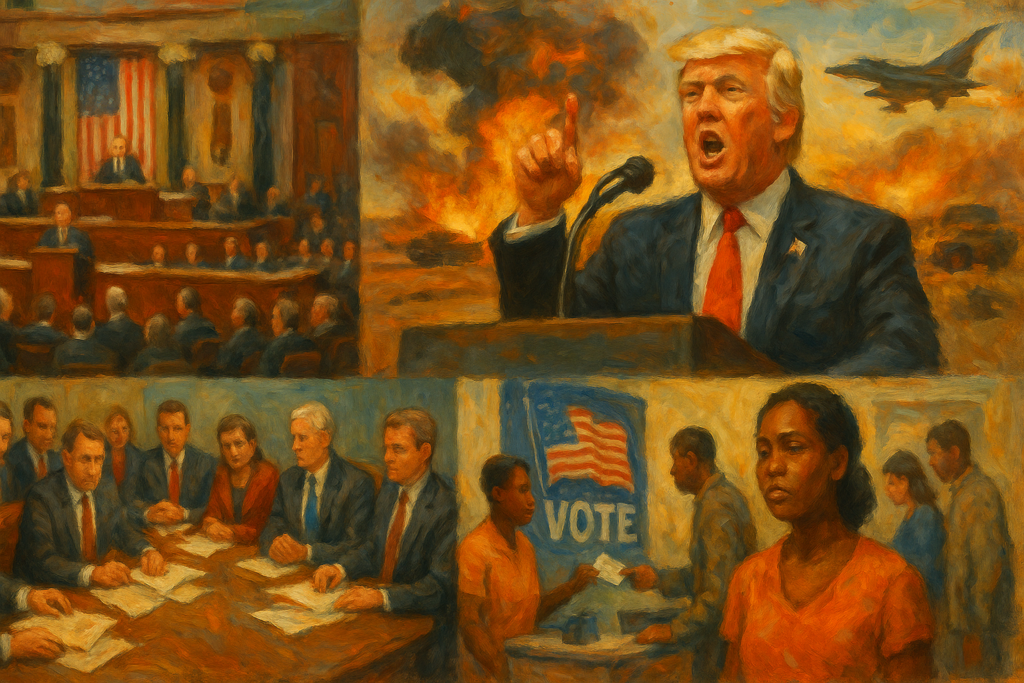
This week’s throughlines
- Congressional checks on war-making weakened as the Iran conflict widened — The week opened with failed war-powers votes and emergency workarounds, then moved into disputes over war aims, casualty reporting, and the mounting financial cost of the conflict.
- The push for restrictive federal voting rules intensified from pressure campaign to House passage — Trump escalated demands that Congress pass the SAVE America Act, tied unrelated legislation to it, and pressed the Senate to change its rules after the House advanced the bill.
- Immigration enforcement expanded while oversight and due-process safeguards weakened — DHS watchdog offices were cut back as ICE detained a journalist, targeted Somali communities and immigrant workers, and later faced court scrutiny over quotas, surveillance tools, and blocked inspections.
- Courts repeatedly checked unlawful appointments, secrecy, and coercive federal actions — Judges voided Kari Lake’s tenure at USAGM, ruled Pam Bondi appointees unlawful, blocked some funding freezes, and forced continued review of several contested administration actions.
The week unfolded under the shadow of a fast‑moving war in Iran that Congress had largely declined to control. As the administration leaned on emergency powers to fund and expand the conflict, lawmakers struggled to reassert their role, even as the domestic agenda turned toward sweeping voting restrictions, intensified immigration enforcement, and deep cuts to health and environmental protections. Across these fronts, courts, states, and local governments alternated between checking and enabling executive power, while billionaire money and corporate interests threaded through the major fights.
Over the weekend, Congress faced its first major test on the new Iran war and stepped back. Senate and House Republicans blocked parallel war powers measures that would have required explicit authorization for continued military action, leaving the president wide latitude to continue bombing. The administration moved quickly to exploit that space, seeking an extra $50 billion for the campaign through emergency authority and bypassing Congress to rush a $650 million bomb sale to Israel. These maneuvers allowed the White House to deepen a major conflict and expand arms transfers with minimal legislative oversight, setting the tone for a week in which the executive branch would drive war policy while Congress tried belatedly to catch up.
At the same time, the administration worked to shape how the war was perceived at home. It blocked a joint bulletin from the FBI, the Department of Homeland Security, and the National Counterterrorism Center that would have warned local authorities about heightened domestic threats tied to the Iran conflict. Instead, the White House pushed stylized combat videos on social media, and Trump falsely claimed that Iran had “surrendered” and apologized, even as hostilities continued. By limiting sober threat information while amplifying triumphalist imagery, the administration made it harder for local officials and the public to assess real risks and to evaluate the costs and trajectory of the war.
The conflict’s economic effects surfaced almost immediately. The Iran campaign rattled global oil markets, prompting the administration to temporarily ease some sanctions on Russian oil in an effort to increase supply. Diesel prices in the United States surged past $4.50 per gallon, and an Iranian drone and missile strike on Bahrain’s Sitra refinery forced the state oil company there to declare force majeure, tightening global supply further. These developments foreshadowed the week’s recurring theme: foreign policy decisions in the Gulf translating into higher fuel and goods prices for households and businesses at home.
Beyond the battlefield, the weekend also revealed quieter but consequential shifts inside federal agencies. Court records showed that DHS had sharply reduced staff and access at its civil rights and detention oversight offices, and had limited complaint channels to English‑only online forms. Thousands of complaints about detention conditions and abuses went uninvestigated, and senior officials reportedly described these watchdogs as “internal adversaries.” In immigration enforcement, ICE detained Estefany Rodriguez Florez, a Colombian journalist with a valid work permit, during a traffic stop without presenting a warrant, drawing condemnation from Hispanic journalist groups. An analysis also showed ICE had ordered 2,500 conspicuously marked vehicles that agents now refused to use, underscoring a pattern of spending on visible enforcement theater rather than on transparent, rights‑respecting practices.
Even as federal oversight was hollowed out, the courts signaled that some institutional boundaries still held. A federal judge ruled that Kari Lake had unlawfully served as acting head of the U.S. Agency for Global Media without Senate confirmation, voiding her mass layoffs, language cuts, and a partnership with a partisan outlet. The decision restored the prior structure at Voice of America and related networks, underscoring that appointment rules still constrain who can run key public media institutions. In environmental policy, however, the Trump EPA repealed the greenhouse gas “endangerment finding” that had underpinned federal climate regulations, complicating efforts by states like Vermont and California to hold major emitters accountable. The weekend closed with a reminder of longer democratic struggles: at Jesse Jackson’s funeral in Chicago, former presidents linked his civil‑rights legacy to current threats to voting, policing, and representation, situating the week’s conflicts in a broader historical arc.
By Monday, attention shifted sharply to voting rules and the domestic costs of war. Trump announced that he would not sign any legislation until Congress passed the SAVE America Act, a sweeping bill that had cleared the House and would require documentary proof of citizenship and stricter voter ID rules nationwide. Critics warned that the bill could disenfranchise millions of eligible voters, particularly women whose legal names differ from their birth certificates and naturalized citizens who may not have ready access to original documents. The threat to veto all other bills turned the president’s constitutional check into a lever to narrow the electorate, setting up a week‑long standoff over whether basic governance would be held hostage to restrictive voting rules.
At the same time, Democrats in the Senate tried to claw back some control over the Iran conflict. In response to the GOP’s weekend blockade, they filed new war powers resolutions that would force withdrawal from the Iran campaign absent explicit authorization and demanded public hearings with key cabinet officials. Reports circulated that Congress could use appropriations bills to restrict war funding, even as the Election Assistance Commission quietly sought experts to update voting system guidelines. These moves reflected an institutional effort to reassert oversight over both war and elections, though they remained largely procedural in the face of an executive branch already acting under emergency authorities.
Immigration enforcement and oversight remained in tension. Further court filings on Monday detailed how DHS’s cuts to civil rights and detention watchdogs had left thousands of complaints uninvestigated. On the ground, ICE launched “Operation Buckeye,” targeting Somali Americans in Ohio, and intensified a crackdown on immigrant truck drivers, removing about 9,500 drivers over English‑language rules and closing hundreds of driving schools. These actions strained supply chains and deepened fear in immigrant communities. In contrast, Columbus’s city council moved to bar local police from aiding federal immigration enforcement without explicit approval, illustrating how local governments can try to shield residents from federal overreach even as national agencies grow more aggressive.
Other institutions also pushed back on executive economic power. The Supreme Court invalidated most of Trump’s tariffs as exceeding his authority under emergency economic law, reaffirming Congress’s constitutional role over taxation. A trade court judge ordered Customs to stop collecting the tariffs and begin refunding affected companies, potentially returning up to $175 billion. Consumers then filed lawsuits against firms like FedEx and EssilorLuxottica, alleging they planned to keep tariff‑related surcharges rather than pass refunds back. Meanwhile, Trump framed rising oil prices as “a very small price to pay” for safety, even as critics highlighted the war’s billion‑dollar‑a‑day cost and the Congressional Budget Office reported $1 trillion in federal borrowing over five months. The Commerce Department logged sluggish GDP growth, tying economic headwinds to war‑related disruptions and underscoring how the costs of foreign policy choices were being shifted onto future budgets and ordinary consumers.
On Tuesday, the president’s rhetoric about Iran underscored how energy and regime change were intertwined in his approach. In a phone interview, Trump said the war could be nearing completion but warned he would respond with overwhelming force if Iran interfered with oil shipments in the Strait of Hormuz. He also claimed to have someone in mind to replace Iran’s new Supreme Leader. By openly tying military escalation to oil flows and hinting at hand‑picking another country’s leadership, he blurred the line between national defense and regime engineering, with little formal debate or constraint from Congress.
Elsewhere, state‑level battles over democratic rules intensified. In Utah, the GOP‑controlled legislature passed a rule blocking many voters from withdrawing signatures from a petition to repeal Proposition 4, the state’s anti‑gerrymandering law, just before the withdrawal deadline. Republicans announced they had gathered enough signatures to put the repeal on the November ballot and, earlier in the year, had expanded the state supreme court from five to seven justices. A federal panel, however, rejected a GOP bid to block a more competitive congressional map from taking effect. The combination of changing petition rules midstream and expanding the court during redistricting fights illustrated how incumbents can tilt the playing field against direct democracy and judicial independence, even as federal courts occasionally intervene.
The judiciary also continued to police politicized appointments. A federal judge ruled that three prosecutors installed by Trump ally Pam Bondi to lead New Jersey’s attorney general’s office had been appointed illegally without Senate confirmation, echoing the earlier ruling on Kari Lake’s tenure at U.S. international media. Separately, the DC Bar filed an ethics complaint against DOJ Pardon Attorney Ed Martin for threatening to blacklist Georgetown Law graduates over its diversity policies, raising concerns about using federal hiring power to coerce academic institutions. These actions showed professional and legal norms still operating as a check on efforts to staff justice institutions with loyalists.
Money and influence loomed large over tax and social policy debates. Campaign finance filings revealed that Sergey Brin and Eric Schmidt had contributed tens of millions of dollars to committees opposing California’s proposed Billionaire Tax Act, which would fund education, food assistance, and healthcare. The California Business Roundtable also received over a million dollars from Schmidt to fight the measure. These state‑level efforts unfolded against a national backdrop in which 300 U.S. billionaire families supplied 19 percent of all federal campaign money in 2024. Biden reiterated proposals to raise taxes on incomes above $400,000 and to impose a 25 percent tax on wealth over $100 million to shore up Social Security and Medicare, while Trump pledged to extend his 2017 tax cuts that heavily favor the wealthy and corporations and was reported to be courting $1 billion from oil executives. In this environment, tax policy—central to deciding who pays for war, social programs, and debt—was being shaped in a landscape dominated by the very fortunes that would be most affected.
Immigration enforcement controversies continued as well. ICE’s crackdown on immigrant truck drivers removed thousands from the roads and shuttered 550 driving schools, disrupting a critical industry. At the same time, two teenage mariachi musicians detained with their family were released after bipartisan backlash, illustrating how public pressure can sometimes temper harsh enforcement. Judges in Oregon and Minnesota would soon intervene in other detention cases, signaling growing judicial unease with ICE practices. The uneven pattern—aggressive crackdowns on workers, selective relief under political pressure, and sporadic judicial pushback—highlighted how immigration power was being applied inconsistently, with rights protections often dependent on visibility and advocacy.
By Wednesday, the fight over voting rules and war powers converged in the president’s messaging. Trump again insisted he would not sign any other legislation until the SAVE America Act reached his desk, pressing Senate leaders to change rules to force a vote on banning most mail voting and requiring proof of citizenship to register. He simultaneously claimed to have been briefed on Iranian terrorist “sleeper cells” inside the United States and said authorities knew where most were located. By linking sweeping voting restrictions to claims of hidden enemies on U.S. soil, the administration framed the bill as a security measure rather than a limitation on access to the ballot, normalizing extraordinary limits on the franchise under the banner of national defense.
New details also emerged about who had pushed for the Iran war. At a press conference, Trump disclosed that his son‑in‑law Jared Kushner was among the advisers who convinced him to initiate combat operations. Kushner receives substantial payments from Middle Eastern governments, including Saudi Arabia and the UAE, which had lobbied for a harder line on Iran. The revelation raised fresh questions about whether private financial ties and allied interests influenced the decision to go to war, underscoring the difficulty of separating national strategy from the business relationships of those closest to the president.
Dissent against war spending and enforcement took more organized forms. Groups like the National War Tax Resistance Coordinating Committee reported growing numbers of Americans refusing to pay federal income taxes to protest the wars in Iran and Gaza and the funding of ICE. Large turnouts at training sessions suggested that tax resistance was gaining traction as a form of civil disobedience, directly challenging the state’s fiscal authority and signaling deep mistrust in how public money was being used. Inside the Pentagon, meanwhile, Defense Secretary Pete Hegseth tightened control over war imagery by banning press photographers from Iran war briefings after “unflattering” images were published and suggesting outlets seek more restrictive credentials if the ban hurt their business. He publicly attacked CNN’s reporting and implied the network would improve under new ownership. Coming on top of earlier briefings marked by ideological rhetoric and downplayed casualties, these moves narrowed the information available to the public and pressured media organizations to soften scrutiny.
The influence of concentrated wealth on elections became even clearer midweek. New figures showed that 300 billionaire families had provided 19 percent of all federal campaign contributions in 2024, and Elon Musk alone had donated $20 million to Republican campaigns ahead of the 2026 elections. In Ohio, GOP gubernatorial candidate Vivek Ramaswamy launched a $10 million ad blitz, far outspending his Democratic opponent. When campaigns depend so heavily on a small pool of wealthy donors and self‑funders, candidates’ incentives can tilt toward elite priorities, even as issues like homelessness in cities such as Los Angeles and housing affordability in San Francisco underscore the unmet needs of those with little political money to spend. In Congress, House Speaker Mike Johnson declined to censure Republicans who had made openly Islamophobic remarks, saying he had only spoken to them about their “tone.” The refusal to impose consequences for such rhetoric signaled a tolerance for bigotry in public life at a moment when Muslim communities were already under heightened suspicion due to war‑related security claims.
On Thursday, the concrete costs of the Iran war came into sharper focus. In a closed‑door briefing, Pentagon officials told top lawmakers that the conflict had already cost at least $11.3 billion in munitions in its first six days, not counting troop deployments or equipment replacement. Around the same time, the Pentagon revised its estimate of U.S. troop casualties from fewer than a dozen to roughly 140 wounded and seven killed, after media scrutiny. Lawmakers expressed frustration that the higher casualty numbers had not been proactively disclosed, and reports indicated the Pentagon was preparing a $50 billion request to replenish depleted missile stockpiles. The combination of rapidly mounting costs and initially understated casualties made it harder for Congress and the public to judge whether the campaign’s aims justified its human and financial toll.
To cushion the domestic economic impact of the war, the administration turned again to Russian oil. It broadened sanctions relief so that all countries, not just India, could purchase Russian oil loaded by March 12, following earlier steps to suspend some sanctions. The change allowed Russia to sell roughly 128 million barrels at elevated prices, delivering a significant financial boost to Moscow even as it continued its war in Ukraine. The move illustrated how U.S. efforts to stabilize fuel prices at home could translate into windfalls for another adversarial state, complicating the broader sanctions regime and raising questions about the long‑term strategic trade‑offs of using energy policy to manage the domestic fallout of war.
Domestically, regulatory policy continued to tilt toward industry. A new GOP‑backed farm bill advanced with provisions that would delay pesticide safety reviews, give manufacturers more influence over endangered species protections, and create uniform labeling rules that would act as a liability shield against state‑level lawsuits. The bill would also give the Department of Agriculture veto power over some EPA health safeguards. Public health and environmental groups warned that these changes would shift the regulatory system toward manufacturers at the expense of farmworkers and nearby communities exposed to harmful chemicals. In Michigan, a new gas tax to fund road repairs took effect just as fuel prices were already rising due to the Iran conflict and global supply disruptions, adding to economic strain in a key swing state. Tensions over war dissent also escalated inside government: during a Senate Armed Services Committee hearing, Senator Tim Sheehy physically confronted a protester, breaking the protester’s arm. His claim that he was trying to de‑escalate the situation did little to blunt concerns that physical force was being used against peaceful dissenters in the halls of power.
Friday brought some of the week’s most consequential domestic decisions. The House approved the SAVE America Act, the sweeping voting bill that Trump had spent days tying to all other legislation. The measure requires documentary proof of citizenship, tightens voter ID rules, criminalizes certain registration errors, and mandates that states submit their voter rolls to DHS. Voting‑rights advocates warned that these provisions could disenfranchise millions of eligible voters, especially women whose legal names differ from their birth certificates, naturalized citizens who may lack ready documentation, and low‑income voters who struggle to navigate complex paperwork. By routing voter rolls through a federal security agency, the bill also blurred the line between election administration and immigration enforcement, raising the prospect that fear of deportation or surveillance could deter eligible voters in mixed‑status communities.
At the same time, the administration enacted the One Big Beautiful Bill Act, cutting more than $1 trillion from Medicaid and other health programs in what observers described as the largest federal healthcare rollback in U.S. history. The law is expected to jeopardize access to care for millions, lower vaccination rates, and reduce emergency treatments and medication access, even as the government spends heavily on the Iran war and defense. In environmental policy, the administration capped a year of deregulatory moves by weakening or delaying dozens of air pollution rules, including limits on soot, mercury, and vehicle emissions, and by forcing fossil fuel plants to operate longer. Public health experts warned that these changes would increase asthma cases and hospitalizations for respiratory illnesses, trading cleaner air and long‑term health for higher corporate profits.
Courts offered mixed responses to the week’s enforcement trends. In Oregon, a federal judge halted warrantless ICE arrests statewide after a class‑action suit revealed that agents were using a quota‑driven app to target people without probable cause. In Minnesota, Judge Katherine Menendez ordered the release of an Ecuadorian asylum seeker who had been detained for 50 days with his toddler despite a court order barring their transfer out of state. Both rulings sharply criticized ICE’s disregard for legal limits and reinforced constitutional protections for non‑citizens and citizens alike. In Texas, however, a jury convicted nine anti‑ICE protesters of providing support for terrorism and other charges stemming from a demonstration at the Prairieland detention center. Prosecutors portrayed the group as an antifa cell planning an ambush on law enforcement, and civil liberties advocates warned that using broad anti‑terror statutes against domestic protesters could chill dissent and blur the line between protest and terrorism.
The week’s regulatory story closed with further evidence of corporate influence over policy. Records showed that top EPA officials had met with Bayer’s CEO in June 2025 to discuss litigation over its glyphosate weed killer, shortly before the administration urged the Supreme Court to hear and support Bayer’s position. The sequence raised concerns that regulatory and legal strategies were being shaped in close coordination with a major corporate litigant, tilting the legal playing field against individuals and communities seeking redress for harm. In the cultural sphere, Trump announced that Ric Grenell would step down as head of the renamed Trump Kennedy Center, to be replaced by operations executive Matt Floca. Grenell’s tenure, marked by controversial branding changes and little arts experience, had drawn backlash from the arts community. The leadership change at a major cultural institution underscored how control over public memory and symbolism has become another arena for political contest.
Taken together, the week’s events traced a pattern of expanding executive power in war and domestic policy, contested unevenly by Congress, courts, states, and local governments. Congress initially ceded formal control over the Iran conflict, then tried to reassert war powers as costs and casualties mounted. The House advanced a voting bill that would narrow access to the ballot while the president used his veto threat to force action, even as state‑level actors in Utah and Arizona revisited redistricting and settled elections. Immigration enforcement grew more aggressive just as DHS oversight offices were dismantled, prompting judicial interventions in some cases and terrorism convictions in others. Health and environmental protections were rolled back at the same time that war spending and billionaire political giving surged, raising questions about whose interests public policy serves. In this landscape, democratic governance appeared less as a settled framework than as an ongoing struggle over who decides on war and peace, who gets to vote, who is protected by the law, and whose voices and resources carry the most weight.