This week’s throughlines
- The Iran conflict moved from unilateral launch to failed congressional restraint — Trump announced and expanded military action against Iran without prior authorization, while intelligence claims behind the action came under dispute. Congress tried to reclaim its role through war powers resolutions, but both Senate and House votes failed, leaving the executive with broad room to continue.
- Homeland Security turmoil escalated from oversight fights to a cabinet firing — DHS faced hearings over immigration enforcement, spending, obstruction, and rhetoric, while watchdogs and lawmakers described blocked oversight and possible misconduct. The pressure culminated in Noem's firing, but her replacement signaled policy continuity rather than a reset.
- Election pressure widened through federal surveillance, legislation, and state rule changes — The week linked federal law enforcement and immigration agencies more closely to election politics, while Congress and state officials advanced new barriers around registration, voting access, and election administration.
- Legal and economic coercion spread across institutions and private actors — The administration used legal and economic leverage against disfavored actors, from law firms and a former president to AI companies and sanctuary jurisdictions, while also trying to insulate DOJ lawyers from outside discipline.
- Courts kept checking executive action, especially on tariffs and detention oversight — Judges and appellate courts repeatedly intervened in disputes over tariffs, ICE oversight, detention conditions, and federal funding conditions. But those rulings often triggered new executive maneuvers or appeals rather than settling the underlying conflicts.
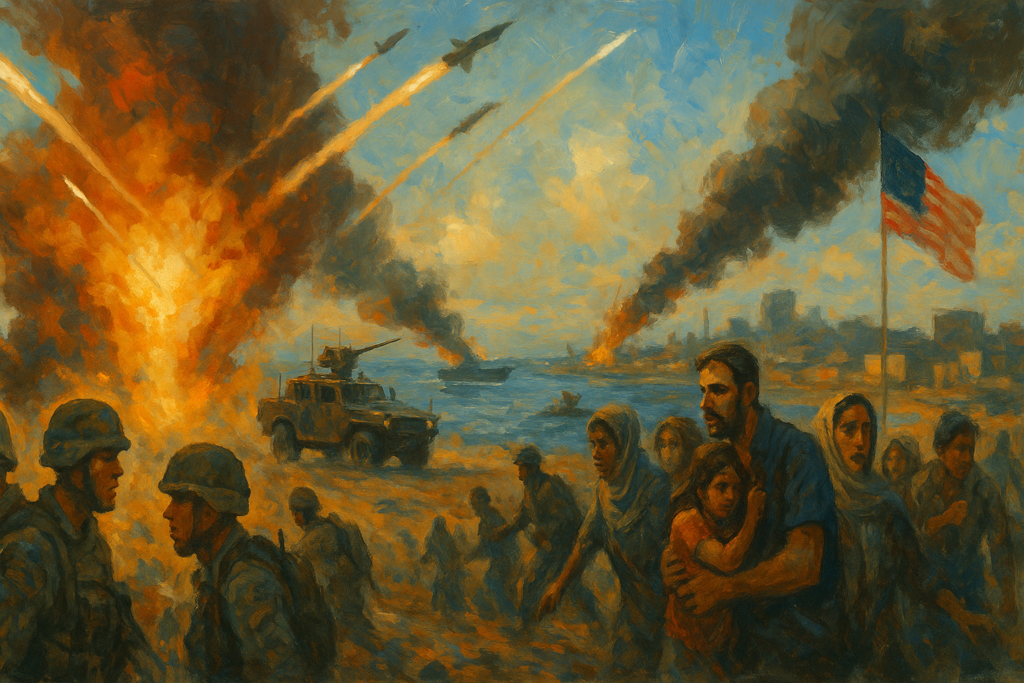
The week opened with the United States entering a major new war without a vote in Congress. Over the weekend, President Trump announced and executed Operation Epic Fury, a large-scale U.S.–Israeli assault on Iran that included strikes on multiple cities and Islamic Revolutionary Guard Corps facilities and the killing of Supreme Leader Ali Khamenei and other senior officials. Trump described the campaign as “massive and ongoing,” aimed at dismantling Iran’s military and encouraging regime change, and warned that Americans should expect U.S. casualties. The operation went forward without congressional authorization or a clear legal rationale, even as Iran retaliated with missile and drone attacks on Israel and U.S. bases, friendly-fire incidents were reported, and early American deaths began to come in.
As the bombs fell, the international reaction was immediate and volatile. In Pakistan, protests in Karachi turned violent as demonstrators tried to storm the U.S. consulate, leaving multiple people dead and injured. Inside Iran, authorities imposed a near-total internet blackout, cutting connectivity to a fraction of normal levels and making it nearly impossible for outside observers to verify casualties or damage. The blackout shielded both the Iranian government and the attacking coalition from independent scrutiny of the human cost. At the same time, the Pentagon quietly narrowed press access, rolling out new rules that sharply restricted traditional news organizations while credentialing a MAGA-branded press corps. Media lawyers warned that the rules could criminalize routine reporting, effectively steering coverage of the new war toward ideologically friendly outlets just as the need for independent information grew most acute.
On the home front, the weekend also brought moves that reshaped domestic power over immigration and the economy. The Department of Homeland Security issued a memo directing agents to identify anyone who had registered or voted before becoming a U.S. citizen, despite the rarity of such cases. Framed as an election-integrity measure, the directive fit into a broader narrative casting suspicion on immigrant voters and raised fears that naturalized citizens would be singled out ahead of the midterms. Meanwhile, businesses and lawyers scrambled to respond to a recent Supreme Court ruling that had declared Trump’s earlier “liberation day” tariffs unlawful. Companies rushed to file refund claims estimated at $175 billion, and law firms, hedge funds, and AI firms positioned themselves to profit from processing and financing those claims, underscoring how unilateral trade actions can boomerang through courts and markets. In Congress, the first stirrings of resistance to the Iran campaign appeared as lawmakers began organizing a war powers response. Democratic leaders and a handful of Republicans called for Congress to reconvene and backed a Khanna–Massie resolution to constrain unauthorized hostilities, questioning both the objectives and the legal basis of Operation Epic Fury.
By Monday, the administration moved to formalize what was already underway. Trump released an edited video declaring the start of “major combat operations” in Iran. Behind closed doors, Pentagon briefers told members of Congress that intelligence assessments showed Iran had not planned to attack U.S. forces absent Israeli action and that there was no imminent threat justifying the strikes. Despite this, the operation continued, already costing American lives. The State Department raised travel advisories and authorized departures from several Gulf posts as Iran’s retaliation spread across the region, but hundreds of thousands of Americans remained scattered across the Middle East with limited guidance. At sea, the conflict effectively choked off traffic through the Strait of Hormuz. Shipping data showed hundreds of vessels idled as major carriers suspended transits, and oil prices spiked sharply. Officials acknowledged there was no plan in place to cushion U.S. consumers from higher fuel costs, setting the stage for record gains in crude prices and rising gas prices at home.
Congress, meanwhile, edged toward but did not yet enact a war powers check. In the Senate, Tim Kaine and Rand Paul led a bipartisan push for a resolution requiring authorization for further hostilities with Iran. In the House, leaders scheduled a vote to block additional authorization under the War Powers Act, citing reports of civilian casualties, including a bombed girls’ school. These efforts represented one of the few formal tools available to lawmakers to reclaim their constitutional role over war, but the votes were still days away and their prospects uncertain. While Washington debated, state-level power was being reshaped in other ways. In Florida, Governor Ron DeSantis and his allies advanced a cluster of bills and orders: designating the Council on American-Islamic Relations a “foreign terrorist organization,” proposing HB 1471 to let officials label nonprofits as terrorist groups, HB 945 to create a state counterintelligence unit, and a bill to limit anonymous complaints against law enforcement. A separate education bill threatened to strip funding from campuses that supported diversity, equity, and inclusion programs or student activism. Together, these measures concentrated discretionary power in the executive and law enforcement while chilling advocacy, journalism, and campus speech in one of the country’s largest swing states.
New reporting on Monday also illuminated the financial backdrop to the administration’s hard line on Iran. Investigations detailed how Saudi Arabia’s sovereign wealth fund had invested $2 billion in Jared Kushner’s firm despite internal objections, financed a $7 billion Trump-branded development in the kingdom, and how the United Arab Emirates had poured hundreds of millions into Kushner-linked ventures. These deep personal business ties coincided with Saudi and Emirati lobbying for a tougher U.S. stance on Iran, raising questions about where national interest ended and private enrichment began. At the same time, Homeland Security Secretary Kristi Noem faced a bruising Senate hearing. Lawmakers from both parties grilled her over immigration raids that had killed two U.S. citizens in Minnesota, allegations that DHS misled inspectors general, and a $220 million ad campaign that prominently featured Noem and benefited a politically connected firm. Republican Senator Thom Tillis called for her resignation and vowed to hold nominations until questions were answered, exposing how a powerful domestic security agency could be used for political self-promotion and aggressive enforcement with limited internal accountability. In Washington’s symbolic politics, the Department of Education hung a large banner of the late far-right commentator Charlie Kirk alongside historical education figures, describing them as “heroes,” signaling an official effort to rewrite educational narratives and normalize a particular ideological project.
Tuesday shifted attention to the rules of democratic participation and the machinery of enforcement. The House passed the SAVE America Act, a sweeping bill requiring documentary proof of citizenship—such as passports or birth certificates that exactly match current legal names—to register to vote. Analysts warned that up to 69 million women who changed their surnames after marriage, as well as many disabled and low-income voters, could lack matching documents. Disability-rights advocates also flagged new barriers for voters needing assistance. Coming on the heels of DHS’s weekend memo targeting naturalized citizens over past voting activity, the bill pointed toward a cumulative tightening of access to the ballot under the banner of integrity. At the same time, Kristi Noem returned to Capitol Hill, this time before the Senate Judiciary Committee, to defend an aggressive ICE operation in Minnesota. She refused to retract her description of two Minnesotans killed by federal agents as “domestic terrorists,” denied the existence of arrest quotas, and faced renewed questions about transparency and spending. Court filings revealed that roughly 400 federal agents remained deployed in Minnesota—more than double normal staffing—despite official statements that operations were winding down, and that agents had used disguises, such as posing as environmental canvassers, to conduct arrests. These revelations underscored how immigration enforcement could blur into political theater while leaving serious questions about lethal force and oversight unresolved.
Beyond Minnesota, documents showed DHS had quietly spent over $690 million buying warehouses in multiple states to convert into detention centers capable of holding up to 10,000 people each, with total planned spending between $38 and $45 billion. Most people currently in ICE detention have no criminal conviction. Building out industrial-scale detention capacity signaled a normalization of mass confinement as a policy tool and raised serious questions about due process and human rights. In the legal realm, the Justice Department reversed course on a key separation-of-powers issue. After initially signaling it would drop an appeal, DOJ asked the D.C. Circuit to continue defending Trump-era executive orders that sought to penalize law firms representing clients or causes Trump opposed. A district court had already blocked the orders as unlawful. Reviving the defense of these measures threatened the independence of the bar and access to representation in politically sensitive cases. Abroad, the personalization of U.S. power took another step when First Lady Melania Trump, appointed by her husband, chaired a UN Security Council session while the U.S. held the rotating presidency—an unprecedented move that blurred the line between official diplomatic roles and the president’s family. Meanwhile, regulators and law enforcement struggled to keep up with a new frontier: prediction markets on war. Authorities in Israel charged two individuals with using classified military intelligence to bet on Polymarket, while separate reporting showed suspicious accounts making nearly $1 million by betting on a U.S. strike on Iran just before it happened, and another case detailed manipulation of a Ukraine war map used to settle bets. Turning war and intelligence into speculative assets invited insider trading and created perverse incentives around conflict.
On Wednesday, Congress confronted the question of war powers directly and chose not to act. The Senate voted 47–53 against Senator Tim Kaine’s resolution requiring Trump to obtain congressional approval before continuing air and naval operations against Iran. Most Democrats supported the measure; most Republicans opposed it. The defeat left Operation Epic Fury proceeding without new statutory constraints and underscored Congress’s reluctance or inability to assert its constitutional role over war even as the conflict escalated and U.S. casualties mounted. While federal lawmakers stepped back, state and local authorities moved to test the limits of federal power in other arenas. In Minnesota, Hennepin County Attorney Mary Moriarty opened a criminal investigation into federal officers, including senior Border Patrol official Gregory Bovino, for alleged misconduct during Operation Metro Surge. A parallel state investigation examined use of force and Bovino’s remarks. DHS asserted federal immunity, but prosecutors set up an online portal to collect evidence, probing whether local authorities could hold federal agents accountable for civil rights violations when Washington resisted scrutiny.
The federal government also repurposed existing law in ways that raised new civil-liberties concerns. Prosecutors charged 39 people, including former CNN anchor Don Lemon, under the Freedom of Access to Clinic Entrances (FACE) Act for protesting at a Minnesota church whose pastor also serves as an ICE field office leader. The statute was originally designed to protect access to abortion clinics, not shield religious institutions from protests over government-linked clergy. Using it in this context blurred the line between protecting access and suppressing dissent. In response to similar protests elsewhere, lawmakers in Oklahoma, New York, and other states introduced bills to expand penalties for disrupting religious services and to create protest-free buffer zones around houses of worship, especially when those venues hosted politically charged events. These measures risked carving out broad zones where protest was effectively banned. Meanwhile, a partial federal shutdown over DHS funding continued as Congress deadlocked over immigration enforcement conditions. Democrats sought reforms such as body cameras and limits on arrests near schools and hospitals; Republicans resisted, and DHS operations largely continued under growing budgets and surveillance powers. Against this backdrop of conflict and clampdowns, agencies like the CDC, FCC, EPA, FDA, DEA, and National Archives quietly advanced technical actions—from renewing scientific advisory boards and proposing stormwater permits to adjusting drug safety guidances and correcting records notices—reminding observers that the machinery of governance kept turning even amid crisis.
Thursday brought decisive movement on several of the week’s central arcs. In the House, lawmakers followed the Senate’s lead and rejected a war powers curb on the Iran conflict. A bipartisan Massie–Khanna resolution that would have required withdrawal from hostilities with Iran absent congressional authorization failed 212–219. Only two Republicans supported it; four Democrats opposed. With both chambers declining to act, practical checks on unilateral war-making shifted away from Congress toward courts, markets, and public opinion. At the Justice Department, Attorney General Pam Bondi moved to insulate her own lawyers from outside scrutiny. DOJ proposed a rule requiring state bar associations to pause investigations into DOJ attorneys until the department completed its own review and instructed DOJ staff not to share nonpublic information with bar proceedings. Bondi also issued a memo directing DOJ employees to “zealously advance, protect and defend” Trump’s interests. Allowing DOJ to police its own lawyers before outside bars could act weakened one of the few independent checks on federal legal misconduct, especially when the department openly aligned itself with the president’s personal and political agenda.
At DHS, the political pressure that had been building all week finally produced a change at the top. Trump fired Kristi Noem as Homeland Security secretary after weeks of controversy over lethal raids, misleading inspectors general, and the $220 million-plus ad campaign featuring her. He simultaneously announced Senator Markwayne Mullin of Oklahoma as her replacement via social media, ahead of any Senate confirmation process, and reassigned Noem as a special envoy for a new “Shield of the Americas” initiative. The shake-up showed that even powerful and controversial officials could be removed when they became politically costly, but the choice of a like-minded hardliner as successor suggested continuity in policy rather than reform. On the economic front, the combined impact of war and trade policy came into sharper focus. U.S. crude prices logged their largest weekly gain on record, gas prices climbed to their highest level since 2024, and the Dow fell sharply as markets digested the Iran conflict and the Strait of Hormuz disruption. At the same time, Trump imposed new 15 percent global tariffs under a different statute despite the Supreme Court’s earlier ruling against his prior scheme, and a trade court ordered Customs to begin refunding billions in illegal tariffs with interest. Democratic-led states prepared fresh lawsuits to block the new duties, underscoring an ongoing tug-of-war between executive trade power, judicial enforcement, and state-level resistance.
The human cost of immigration policy also came into focus on Thursday. Two separate deaths in ICE custody came to light: Haitian asylum seeker Emmanuel Damas died after allegedly being denied timely care for severe tooth pain at an Arizona facility, and Mexican national Alberto Gutiérrez Reyes died in California after reported failures to treat diabetes and high cholesterol. Local officials and the Mexican government demanded investigations into conditions and medical care in ICE detention, raising fundamental questions about the government’s duty of care toward people it holds and the oversight of private contractors. In state legislatures, Kansas lawmakers overrode the governor’s veto to enact new anti-trans legislation, while similar bills advanced in Missouri, adding to a growing patchwork of state laws restricting transgender people’s rights and access to services. In Florida, the politics of memory and honor continued to shift as lawmakers moved to rename a road alongside Florida International University for Charlie Kirk on the same day racist and antisemitic group chats from FIU College Republicans were leaked. Community leaders condemned the chats and called for resignations, but the renaming effort proceeded, suggesting a deliberate effort to double down on honoring a polarizing figure despite local outrage. In the technology sector, the federal government’s leverage over AI firms was on display. After being designated a “supply chain risk” and threatened with the loss of its business over its refusal to support mass surveillance and autonomous weapons, Anthropic resumed negotiations with the U.S. military over acceptable uses of its AI systems. CEO Dario Amodei publicly accused rival OpenAI of misleading the public about its own defense work and praise for the administration. The episode showed how security designations and contract threats could be used to pressure AI firms on ethics, while companies contested each other’s narratives about government ties.
By Friday, the legal and diplomatic ambiguities of the Iran war had deepened. Trump publicly claimed that he needed to be personally involved in choosing Iran’s next leader after Khamenei’s death, likening his role to what he described as his influence in Venezuela. He also called Israel’s president a “disgrace” and demanded an immediate pardon for Prime Minister Benjamin Netanyahu, which President Isaac Herzog rejected, citing Israel’s rule of law. Asserting personal authority over foreign succession and judicial processes challenged norms of national sovereignty and judicial independence abroad and signaled an expansive view of presidential power. Reports also emerged that U.S. forces had sunk an Iranian vessel, the Dena, in international waters near Sri Lanka during a ceremonial naval parade, allegedly leaving survivors to drown. Officials disputed whether the ship was armed, but critics argued that if the United States was at war, the attack could constitute a war crime; if it was not, it could amount to murder. Striking a ship in international waters under ambiguous legal authority heightened the risk of international legal action and further escalation.
On the economic and legal front, courts and states continued to push back on Trump’s tariff strategy. Trade Judge Richard Eaton ordered Customs to refund illegal tariffs with interest to all affected importers, not just those who had sued, while Democratic attorneys general and governors from 24 states announced new lawsuits against Trump’s latest 15 percent tariffs. These moves built on the Supreme Court’s earlier ruling that his prior tariff scheme exceeded statutory authority and showed that judicial and state-level actors remained active counterweights when the executive pushed trade powers beyond legal limits. At the Justice Department, transparency and neutrality were again at issue as DOJ released additional Epstein-related documents, including FBI memos describing unverified allegations that Trump and Jeffrey Epstein assaulted a woman in the 1980s. DOJ said the files had been mistakenly categorized as duplicates. The allegations remained uncorroborated, but their handling—following congressional subpoenas and criticism over redactions and accidental disclosure of survivors’ names—highlighted how the management of politically sensitive archives affects both accountability for elite wrongdoing and public trust in the department’s impartiality.
Courts also weighed in on immigration enforcement tactics. A federal judge in Oregon issued a preliminary injunction against ICE’s practice of detaining people without warrants or probable cause, often based on racial profiling. The ruling, following similar decisions in Colorado and Washington, D.C., found that the tactics systematically violated federal law and constitutional rights. The injunction reinforced due process protections for immigrants and set a precedent that could constrain ICE operations in other jurisdictions, even as DHS expanded its detention infrastructure. In the realm of voting rights, the MAGA-led North Carolina Board of Elections advanced new rules that civil-rights groups described as “voter-elimination” measures. Organizations like the Southern Coalition for Social Justice mobilized public comments and legal analysis to oppose the changes. Layered on top of the new federal documentation requirements in the SAVE America Act and DHS’s scrutiny of naturalized citizens, the state rules pointed toward a compounded set of barriers to voting, especially for marginalized communities.
Not all developments pointed toward restriction. In North Carolina, three anti-trans members of the General Assembly lost their primaries to progressive Democrats, signaling voter backlash against recent waves of anti-LGBTQ+ legislation in the state and suggesting that lawmakers could be punished at the ballot box for targeting marginalized groups. In Durham, local organizing by the Durham Rising Movement secured a tangible economic gain as Duke University and its hospital system announced they would raise their minimum wage to $20 per hour starting July 1, affecting thousands of workers. And in the background of the week’s more dramatic conflicts, the federal government continued to deepen its reliance on private technology platforms and data-driven management. The Centers for Medicare and Medicaid Services quietly migrated Medicare’s internal systems to Oracle’s cloud platform, affecting data for 70 million Americans, without major congressional hearings. Separately, TSA sought approval to collect real-time airport wait-time data, and the Census Bureau invited comments on an internet-based field test for the Current Population Survey. These moves expanded the role of private tech infrastructure in core public services, with limited public debate about privacy, security, and accountability.
Taken together, the week traced a pattern of expanding executive power abroad and at home, unevenly checked by other institutions. Operation Epic Fury proceeded without congressional authorization, even as lawmakers declined to assert their war powers and the president claimed a personal role in shaping another country’s leadership. Courts and states pushed back more effectively on tariffs and some immigration practices, ordering refunds and blocking warrantless arrests, while state and federal actors simultaneously tightened voting rules, broadened security powers, and repurposed laws to constrain protest. The firing of Kristi Noem showed that political costs could still force changes in leadership, but her replacement by a like-minded hardliner suggested continuity in policy. Amid war, economic shocks, and institutional strain, local organizing and routine regulatory work offered reminders that democratic life is not only contested in headline crises but also in the quieter decisions that govern who can vote, who can speak, who is detained, and who benefits from the nation’s wealth and power.