This week’s throughlines
- The tariff fight shifted from judicial defeat to executive workaround — After the Supreme Court ruled Trump’s earlier tariffs unlawful, the administration quickly announced new global tariffs under a different statute, creating a weeklong cycle of legal defeat, defiance, market uncertainty, and refund demands.
- Immigration enforcement intensified while courts, whistleblowers, and local actors pushed back — The administration expanded detention and deportation pressure, but the week also brought court rulings, testimony, lawsuits, and local organizing that exposed or constrained enforcement practices.
- Transparency battles deepened around politically sensitive records — A judge blocked release of Jack Smith’s documents report while the DOJ faced growing scrutiny over missing or withheld Epstein materials tied to allegations involving Trump, prompting congressional inquiries and public pressure.
- The State of the Union became a stage for both presidential narrative control and visible dissent — Boycotts, alternative events, silent protests, and retaliatory removals turned the annual address into a concentrated display of polarization, message discipline, and the policing of dissent.
- Federal power was used selectively against disfavored institutions and jurisdictions — The administration and allied agencies targeted universities, Minnesota’s Medicaid funding, and media companies, while regulatory and procurement decisions raised recurring questions about favoritism and political leverage.
The week opened with a rare and emphatic rebuke from the Supreme Court, and an equally swift act of defiance from the White House. From there, the days unfolded as a study in how power is asserted and resisted: through tariffs and trade law, immigration raids and health funding, sealed court records and doctored videos, state laws on identity, and draft plans to centralize control over elections themselves.
Over the weekend, the Supreme Court ruled 6–3 that President Trump’s global tariffs under the International Emergency Economic Powers Act were unconstitutional. That statute allows presidents to act in genuine national emergencies, but the Court held that Trump’s sweeping use of it to impose broad, peacetime tariffs usurped Congress’s explicit constitutional authority over trade and duties. The decision should have reset the legal landscape: billions of dollars in tariffs collected under an unlawful regime, and a clear signal that emergency powers have limits. Instead, within hours, Trump and his trade advisers announced a new 10 percent global tariff, quickly floating an increase to 15 percent, this time invoking a different law—the 1974 Trade Act—meant for balance‑of‑payments crises. Trump publicly claimed the Court’s ruling actually gave him “far more powers and strength,” attacked the justices as serving foreign interests, and insisted he needed no congressional approval. House Speaker Mike Johnson acknowledged there was no appetite in Congress to codify the tariffs, but the administration pressed ahead. Trading partners, including the European Parliament, responded by pausing trade‑deal approvals, and governors like Illinois’s J.B. Pritzker began demanding refunds for the billions their residents had paid under the now‑illegal tariffs, even sending symbolic invoices to the White House.
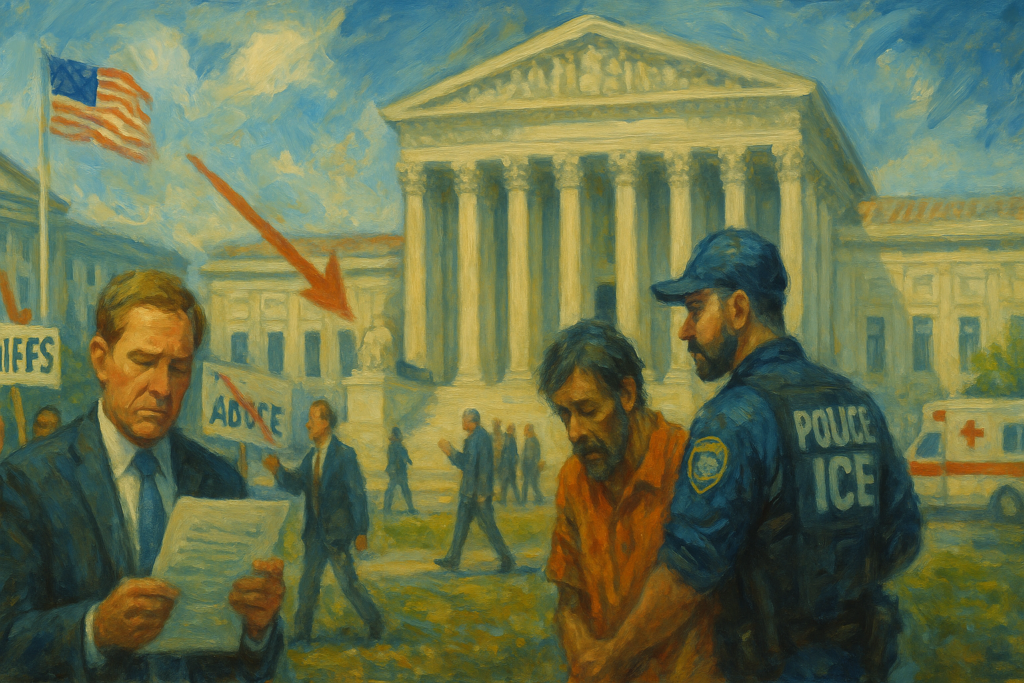
At the same time, immigration enforcement hardened on multiple fronts. Over the weekend, ICE was ordered to sharply increase daily detentions through new arrest quotas, and the administration moved to terminate Temporary Protected Status for Yemeni nationals despite ongoing conflict in their home country. Individual cases showed what this meant in practice: a long‑time Algerian resident was detained outside a Michigan mosque despite pending appeals, and a British tourist with a valid visa was shackled and held for six weeks over a paperwork issue. A Freedom of Information Act lawsuit forced the Department of Homeland Security to release data showing that 77 percent of people placed in deportation proceedings in 2025 had no criminal convictions, undercutting repeated claims that enforcement was focused on “the worst of the worst.” The numbers suggested that quotas and TPS rollbacks were driving a broad dragnet rather than targeted public‑safety work.
Civil liberties questions surfaced in other corners of the justice system. Several protest‑related prosecutions collapsed when judges in Minneapolis and Los Angeles dismissed assault charges against immigrants and demonstrators after video evidence contradicted officers’ sworn accounts. A broader review noted a pattern of Department of Justice defeats in such cases, hinting at overreach in policing dissent. In a separate development, the Fifth Circuit Court of Appeals lifted an injunction on a Louisiana law requiring the Ten Commandments to be displayed in every public school classroom. The law could now take effect while the court deferred a final ruling on whether it violates the First Amendment’s separation of church and state, moving a major church–state test directly into public education.
Congress and states also maneuvered around oversight and environmental protections. House Republicans subpoenaed Bill and Hillary Clinton for closed‑door depositions about Jeffrey Epstein, a move Democrats described as an effort to redirect attention from Trump’s own ties to Epstein. In environmental policy, Republicans expanded use of the Congressional Review Act—a tool that allows Congress to overturn recent agency rules—to target decisions at agencies like the EPA and Interior. They advanced a resolution to undo a 20‑year mining moratorium near Minnesota’s Boundary Waters, prompting opposition from Senator Tina Smith and descendants of Theodore Roosevelt, who warned that lifting the moratorium would benefit foreign mining companies and cause lasting ecological damage. Meanwhile, a partial shutdown at the Department of Homeland Security briefly threatened to suspend TSA PreCheck and Global Entry. After backlash from airlines and travelers, DHS reversed course on PreCheck but kept Global Entry frozen, leaving frontline workers without full pay and key mobility services entangled in funding fights as Trump prepared his State of the Union address.
By Monday, the immigration story moved from policy to training and resistance. Former ICE instructor and lawyer Ryan Schwank testified before Congress that the agency had slashed legal‑training hours and was instructing new deportation officers to enter homes without warrants, effectively teaching them to violate the Fourth Amendment’s protections against unreasonable searches. Schwank said he resigned in protest, framing the problem as systemic rather than a matter of a few bad actors. At the state and local level, pushback grew: the New Mexico Senate passed a bill banning ICE detention centers in the state, and activists in North Carolina organized campaigns to block planned ICE facilities by pressuring landlords and local officials. The gap between federal enforcement culture and local expectations of constitutional rights widened visibly.
Transparency battles also began to sharpen. The Department of Justice’s long‑awaited release of the “Epstein files”—records mandated by the Epstein Files Transparency Act, which requires disclosure of federal investigative materials related to Epstein and his associates—revealed extensive ties between Epstein and major universities, prompting resignations and internal reviews across academia. But investigative reporting quickly found gaps. FBI interview memos and notes involving a woman who had accused Trump of sexually abusing her as a minor were missing, despite the law’s requirements. NPR and others documented unexplained breaks in the Bates numbering of the documents, suggesting pages had been removed or withheld. House Democrats on the Oversight Committee began preparing inquiries into whether DOJ had improperly withheld politically sensitive material, raising the question of whether transparency laws were being honored in full or selectively.
Alongside these headline fights, quieter governance work continued. The Election Assistance Commission opened public comment on draft national standards for post‑election audits, a step toward more consistent checks on election results across states. The Federal Communications Commission ordered a hearing to investigate whether a Texas radio licensee had misrepresented its ownership and allowed unauthorized foreign control, underscoring ongoing concerns about who ultimately controls broadcast outlets. Agencies like the FDA and CDC issued routine notices on data collection and health surveys. These technical actions rarely make front pages, but they shape the infrastructure of elections, public health, and communications that democratic systems rely on.
Tuesday’s centerpiece was Trump’s State of the Union, which blurred the line between constitutional ritual and campaign rally. From the House rostrum, Trump painted a rosy picture of the economy despite persistent inflation and ongoing scandals, and announced a “war on fraud” to be led by Vice President J.D. Vance. He singled out immigrants—especially Somalis—as supposed perpetrators of tens of billions of dollars in fraud, without presenting evidence, and coupled that rhetoric with threats against Iran over its nuclear and missile programs. Inside the chamber, dissent was tightly policed. Capitol Police removed Representative Al Green after he silently held a sign reading “BLACK PEOPLE AREN’T APES,” a response to a racist video Trump had shared about the Obamas. Aliya Rahman, a disabled guest of Representative Ilhan Omar, was arrested for standing silently in the gallery. Outside, at least 40 Democrats boycotted the speech and joined a People’s State of the Union on the National Mall, offering an alternative narrative about the country’s direction. Viewership for Trump’s address fell to one of the lowest modern totals, while alternative broadcasts drew millions, underscoring a fractured information environment in which no single speech defines the national story.
Elsewhere on Tuesday, the struggle over information control took a more formal turn. U.S. District Judge Aileen Cannon, who had previously dismissed Special Counsel Jack Smith’s criminal case over Trump’s handling of classified documents at Mar‑a‑Lago, permanently barred the Justice Department from releasing Volume Two of Smith’s report. She criticized the report as unauthorized now that the case was closed. In a notable break from past practice—where special counsel reports, such as those by Ken Starr or Robert Mueller, were made public—DOJ did not oppose the motion, aligning with Trump’s lawyers in keeping the report from Congress and the public. The decision meant that a detailed account of a former president’s handling of classified material would remain sealed, limiting both oversight and public understanding.
The tariff confrontation also escalated. Building on the weekend’s defiance, Trump insisted that the Supreme Court’s ruling had somehow expanded his authority and threatened higher duties on countries that “play games” with the United States. The administration leaned on Section 122 of the 1974 Trade Act, a provision intended for genuine balance‑of‑payments emergencies, to justify the new 10 percent global tariff, even though the U.S. faces no such crisis. House Speaker Johnson admitted there was no legislative support for this agenda, while governors in states like New York began formally requesting multibillion‑dollar refunds for tariffs now deemed unlawful. The episode tested not only the Court’s authority but also the practical enforceability of its decisions when an administration is determined to push the edges of statutory language.
Media and technology became another front in the week’s power struggles. Senate Democrats led by Richard Blumenthal opened an investigation into whether the FCC and CBS’s parent company, Paramount, had blocked Stephen Colbert from airing an interview with Texas Democratic candidate James Talarico. Lawmakers sought records on whether FCC Chair Brendan Carr had engaged in partisan censorship to benefit the administration and whether Paramount had suppressed content to curry favor during a major merger bid. The inquiry raised the specter of regulators and media conglomerates coordinating to shape political speech, with implications for both free expression and the independence of broadcast licensing.
On Wednesday, the administration’s “war on fraud” rhetoric translated into concrete punishment for a state. Vice President Vance announced a freeze of roughly $259 million in federal Medicaid reimbursements to Minnesota, citing fraud concerns. The halt affected programs serving about 1.2 million residents, including low‑income families, people with disabilities, veterans, and children. State officials argued the move was political retaliation tied to Minnesota’s large Somali population and its scrutiny of federal immigration operations. Their claims were bolstered by a Bush‑appointed federal judge who documented nearly 100 instances of ICE ignoring judicial directives in Minnesota, and another judge who noted that most people brought before his court had lawful status. A separate lawsuit alleged that observers documenting ICE activity were being labeled “domestic terrorists.” Together, these developments showed federal health dollars being used as leverage in an immigration fight, with vulnerable patients caught in the middle.
The Epstein transparency fight intensified midweek. House Democrats on the Oversight Committee formally opened an investigation into whether DOJ had illegally withheld Epstein‑related materials involving allegations against Trump. Media reports had already highlighted missing FBI “302” interview forms and internal memos about flagging sensitive records. In response, DOJ announced a review of its document‑tagging and release process, promising to publish improperly categorized materials if legally required. Additional reporting from outlets like the New York Times identified specific missing interviews and raised questions about whether the Epstein Files Transparency Act was being honored in spirit or only selectively. The core issue was straightforward: Congress had passed a law requiring disclosure of federal records about Epstein and his associates, and there was growing evidence that politically sensitive portions of that record were being held back.
Environmental policy took a sharp turn as well. The administration repealed the EPA’s “endangerment finding” for greenhouse gases—the legal foundation, dating back to a 2009 Supreme Court decision, that obligates the agency to regulate pollutants that endanger public health and welfare. Without that finding, the federal basis for many climate regulations weakens dramatically. At the same time, the administration rolled back approvals and incentives for offshore wind and other renewable projects, with one analysis linking the changes to nearly 173,000 lost or delayed clean‑energy jobs. The EPA moved to repeal stricter 2024 emission standards for coal‑ and oil‑fired power plants and granted exemptions to dozens of coal plants from mercury and air‑toxics rules. In Congress, the push to reopen mining near the Boundary Waters continued, while a federal judge in Oregon rebuked the administration for abandoning a salmon‑protection agreement on the Columbia and Snake Rivers. The pattern favored fossil fuel and mining interests over climate and public‑health goals, with long‑term consequences that will outlast any single administration.
Foreign policy rhetoric added another layer of concern. Just hours before Trump’s State of the Union threats that Iran would “never” be allowed nuclear weapons, Secretary of State Marco Rubio and the CIA director briefed the bipartisan “Gang of Eight” congressional leaders on Iran. Afterward, Senate Majority Leader John Thune said Trump was preparing to defend U.S. interests against a nuclear Iran, contradicting earlier claims that the administration had already neutralized Iran’s program. Subsequent comments from Trump about the potential need for military force, and calls from activists for a new war‑powers resolution, underscored fears that the groundwork was being laid for possible strikes without clear congressional authorization.
Thursday brought the transparency and information‑control issues into even sharper relief. New reporting from NPR and the New York Times, combined with congressional depositions, showed that DOJ’s Epstein release had omitted more than 50 pages of FBI interviews and notes from a woman who accused Trump of sexually abusing her as a minor. A memo from Deputy Attorney General Todd Blanche instructed agents to flag certain categories of materials, including 302s, after a congressional transparency deadline had passed. House Democrats accused DOJ of a cover‑up, while the department insisted that withheld documents were privileged or duplicates. Taken together with Judge Cannon’s sealing of Jack Smith’s report, the pattern fed a broader narrative that the justice system was shielding Trump and other elites from full scrutiny, even when Congress had passed specific transparency mandates.
Civil rights were tested in Kansas, where SB 244 took effect. The law requires all state IDs, including driver’s licenses, to list “sex at birth” and bans transgender people from using bathrooms in public buildings that match their gender identity. It also allows private citizens to sue trans people they encounter in restrooms for $1,000 in damages. Enacted by a Republican supermajority over the governor’s veto and without a grace period, the law immediately invalidated many existing licenses and sharply curtailed transgender Kansans’ ability to navigate daily life—driving, voting, accessing services—on equal terms. It joined a broader wave of state‑level measures that regulate identity and public participation through documentation and access to space.
Technology and military power intersected in a different way when the Pentagon threatened to cancel a $200 million contract with AI firm Anthropic and label the company a “supply chain risk” unless it removed safety precautions from its AI model and granted the military unfettered access. Such a designation could effectively bar other defense vendors from using Anthropic’s products. CEO Dario Amodei refused, citing ethical concerns about enabling autonomous weapons and mass domestic surveillance. The standoff highlighted how government demand can shape the trajectory of powerful technologies, and how corporate decisions about safety constraints can become matters of national policy.
Within the civilian bureaucracy, partisan loyalty tests surfaced in contracting. The Department of Homeland Security awarded a $250,000 public‑relations contract to American Made Media Company, a Republican consulting firm tied to former Trump campaign officials, after a rushed 31‑hour bidding window that required bidders to demonstrate loyalty to Trump policies. The award appeared to violate procurement norms that bar political tests for contractors and demand impartial competition, blurring the line between public communications and campaign work.
The White House’s own use of technology to shape narratives came under scrutiny when its official TikTok account posted an AI‑generated video falsely depicting NHL player Brady Tkachuk insulting Canadians. Tkachuk publicly denounced the clip as fake. On the same day, the FCC promoted its “Pledge America” campaign, encouraging broadcasters to air patriotic content tied to the nation’s upcoming 250th anniversary. In isolation, each move might seem minor; together, they illustrated how deepfakes and regulatory “nudges” can be deployed to influence what audiences see and trust, especially when combined with broader efforts to pressure media and tech platforms.
Friday closed the week with a stark illustration of the human cost of immigration enforcement. In Buffalo, New York, investigators examined the death of Nurul Amin Shah Alam, a nearly blind Rohingya refugee who had been in custody for a year. Border Patrol agents released him from a county holding center and dropped him about five miles from his home without notifying his family or attorney. He spoke no English and was later found dead on the street. Officials described the drop‑off as a “courtesy ride,” but homicide detectives opened a probe. The case showed how cavalier release practices and the absence of basic safeguards for vulnerable people in custody can turn administrative decisions into matters of life and death.
Democratic institutions faced a different kind of threat in the form of a draft executive order circulated by right‑wing activists. The draft proposed declaring a national emergency over alleged Chinese interference in the 2020 election and granting Trump sweeping control over voting processes nationwide. It would ban mail‑in ballots and voting machines and centralize authority in the White House, sidelining state election officials who traditionally administer elections under the Constitution’s allocation of power to the states. Legal experts immediately called the plan unconstitutional, noting that emergency powers cannot be used to override the basic structure of federalism and state control over election administration. Even as a draft, the document showed how emergency rhetoric could be used to justify attempts to federalize and manipulate elections.
At the state level, North Carolina’s newly constituted Board of Elections, led by members aligned with Trump’s movement, began developing rules premised on the unfounded claim that noncitizens are voting in significant numbers. Framed as protecting “election integrity,” the proposed rules would tighten voter‑eligibility checks in ways that could make it harder for eligible citizens to register and vote. Public comments were invited, but the underlying premise—that noncitizen voting is a widespread problem—has been repeatedly debunked. The move echoed past voter‑suppression tactics that use exaggerated or false claims of fraud to justify new barriers to the ballot.
The administration’s “war on fraud” narrative against Somali immigrants also escalated. Following the State of the Union, Trump and Vice President Vance continued to claim, without evidence, that Somali immigrants had defrauded taxpayers of $19 billion, even as Trump himself carried a fraud conviction. In California, ICE raids on fast‑food workplaces triggered walkouts and contributed to a reported 5 percent decline in private‑sector jobs in parts of Los Angeles after National Guard deployment. The California Fast Food Workers Union responded with a “Constitutional Pledge,” urging employers to keep ICE out of private areas of their businesses unless agents presented judicial warrants. The episode showed how fraud rhetoric could be weaponized to justify enforcement that destabilizes both families and local economies, and how workers and employers might use constitutional principles to push back.
Finally, the week’s concerns about AI and surveillance reached into everyday workplaces. Burger King announced a pilot of an AI chatbot, “Patty,” connected to employee headsets in 500 U.S. restaurants, with plans to expand nationwide. Powered by OpenAI, the system tracks whether workers use phrases like “please” and “thank you” and assists with menu and order management. The company said the tool was for operational support, not individual evaluation, but its design effectively introduced continuous algorithmic monitoring into a low‑wage workplace. As with the Pentagon–Anthropic dispute and the White House deepfake, the rollout raised questions about how data and algorithms are being used to extend both corporate and state power over information and labor.
Taken together, the week’s events traced a consistent pattern: legal limits were tested at the edges of trade law, immigration enforcement, transparency statutes, and election administration, while new technologies and state laws reshaped who is visible, who is monitored, and who can participate. Courts, Congress, state governments, and civil society all pushed back in different ways—through rulings, investigations, legislation, and protest—but the underlying contest was the same: whether the rules and records that structure democratic life will be bent to serve those in power, or enforced to protect the equal standing of the governed.