This week’s throughlines
- Immigration enforcement widened and became more openly political — The administration moved from tactical pauses to renewed raids, mass-arrest targets, courthouse arrests, ideological visa screening, and explicit focus on Democratic-run cities.
- Los Angeles became the week’s main test case for federal force — ICE raids, anti-raid protests, troop deployments, protest prosecutions, and court rulings turned Los Angeles into the clearest site of conflict over immigration enforcement, protest rights, and state-federal power.
- Courts remained a major counterweight, but with uneven results — Judges blocked or narrowed several administration actions involving NIH grants, passports, Harvard, migrant legal services, and detention, while appellate rulings also preserved federal troop control and slowed some challenges.
- Public memory and official information were increasingly contested — The week included symbolic and institutional moves affecting civil-rights memory, Juneteenth observance, public-health expertise, Voice of America, and renewed election disinformation.
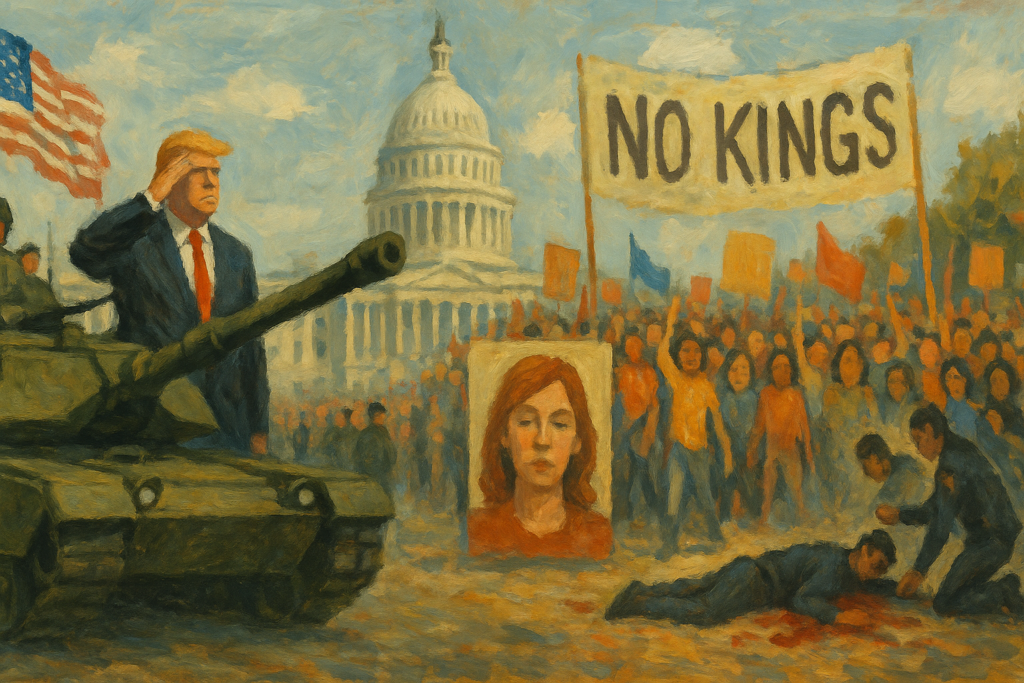
The week unfolded under two competing images. In Washington, Donald Trump marked his 79th birthday with a rare, $40 million military parade, complete with troops and armored vehicles and underwritten in part by major defense and tech firms. Across the country, more than 5 million people joined over 2,000 “No Kings” protests, invoking the American Revolution to oppose what they saw as abuses of presidential power. The contrast between a leader-centered display of military might and a decentralized, largely peaceful civic mobilization set the tone for days of conflict over authority, dissent, and the boundaries of executive power.
Over the weekend, the protests were mostly orderly and patriotic in tone, with marchers carrying flags and quoting founding-era language about kings and tyranny. In Los Angeles, however, police used teargas and foam rounds to disperse demonstrators outside a federal building, signaling a willingness to treat protest as a public-order problem rather than a protected right. In Salt Lake City, a volunteer “peacekeeper” opened fire during a protest, killing one person and wounding another. Isolated amid the larger mobilization, these incidents nonetheless foreshadowed how state force and private violence might intersect with mass dissent in the months ahead.
The weekend also brought a stark escalation in political violence. In Minnesota, state Representative Melissa Hortman, the House Speaker, and her husband were shot and killed at their home by a gunman impersonating a police officer. State Senator John Hoffman and his wife were wounded in the same attack. Authorities identified Vance Boelter as the suspect and, after a manhunt, charged him with multiple counts of murder, attempted murder, stalking, and firearms offenses. A manifesto and target list pointed to political motives tied to abortion and party affiliation. Minnesota’s congressional delegation issued a bipartisan statement condemning the killings as incompatible with democracy, underscoring that the safety of elected officials had become a live question rather than an abstraction.
At the same time, the administration pressed forward with a hard-line immigration agenda that blended enforcement with symbolic reversals. Earlier executive orders to defund and prosecute so-called sanctuary jurisdictions framed the weekend’s posture. A long-contested order seeking to end birthright citizenship for children of undocumented parents moved closer to Supreme Court review, challenging a constitutional principle that has defined American citizenship for more than a century. Under directives from adviser Stephen Miller, ICE dramatically increased arrests of non-criminal immigrants, setting daily quotas and conducting sweeps at retail chains. Symbolic moves reinforced the message: the Martin Luther King Jr. bust was removed from the Oval Office, and the Navy was ordered to strip Harvey Milk’s name from a ship. A new expansion of the travel ban and the continued detention of a Palestinian activist highlighted how immigration and civil-rights policy were being used to redefine who belongs and who is honored in national memory.
Even amid these expansions of executive authority, there were early signs of institutional resistance. A federal judge rebuked Trump’s unilateral federalization of California National Guard units deployed in Los Angeles, ordering control returned to Governor Gavin Newsom. An appeals court quickly stayed the ruling, allowing Trump to retain control while litigation continued, but the case underscored that command of state military forces during domestic deployments remained contested. In Congress, Representative Thomas Massie introduced a bipartisan resolution to reassert legislative war powers, while the American Bar Association and nonprofit coalitions filed suits challenging executive orders aimed at law firms and the termination of Justice Department violence-prevention grants. They argued that the orders were designed to intimidate legal advocates and harm vulnerable communities, testing whether courts would treat such moves as legitimate policy or as retaliation.
The weekend also showed how the new political climate was reshaping corporate behavior. Target rolled back its diversity, equity, and inclusion initiatives, reversing years of branding as a leader on LGBTQ inclusion. The move, widely read as a response to the administration’s transactional posture toward business, drew backlash and boycotts but also signaled to other firms that commitments to equity could be reconsidered when political winds shifted.
By Monday, the courts were more clearly asserting themselves in the realm of civil rights and scientific funding. Federal judges ruled that the administration’s termination of hundreds of NIH grants was “void and illegal,” ordering restoration of over $1 billion in research funding that had disproportionately affected projects focused on racial and LGBTQ communities. Another court blocked the EPA’s cancellation of $600 million in environmental justice grants, and a separate ruling found NIH’s termination of DEI-related grants discriminatory. Together, these decisions forced the administration to reinstate key streams of scientific and community funding, preserving some infrastructure for equity-focused work even as other parts of the bureaucracy were being reshaped.
At the same time, trade and finance policy tilted further toward executive deals and donor interests. Trump signed an executive order implementing a U.S.–U.K. Economic Prosperity Deal that reshaped tariffs and quotas in autos and aerospace, consolidating trade authority in the White House. The SEC dropped a major enforcement case against Binance after the exchange listed a Trump family cryptocurrency, and the administration broadly loosened crypto regulations, pausing or ending a dozen fraud cases. Congress responded by passing a joint resolution overturning an OCC bank-merger rule, and Democrats introduced an “End Crypto Corruption” bill to bar federal officials from profiting from crypto ventures. The pattern suggested a blurring of lines between public regulation and private gain, with enforcement decisions tracking the financial interests of those in power.
Inside the federal bureaucracy, Monday also brought quieter but significant changes. The Department of Veterans Affairs issued new guidelines stripping explicit protections against discrimination based on political beliefs, marital status, and union activity for veterans and staff. The EPA adjusted pesticide and residue rules in ways that favored registrants, while the CDC and other agencies issued a flurry of technical data-collection notices. These moves pointed toward a more politicized and industry-friendly governance model, in which neutral civil-service protections and evidence-based regulation gave way to loyalty tests and lobbying. In public health, the head of CDC’s Covid and RSV hospitalization surveillance resigned, citing a lack of confidence that data would be used objectively in vaccine policy. Former members of the federal vaccine advisory committee, previously fired by HHS Secretary Robert F. Kennedy Jr., warned that their removal and CDC staffing cuts were undermining the vaccine program’s success. These developments foreshadowed deeper cuts and firings later in the week and marked an early stage in the politicization of scientific governance.
On Tuesday, immigration enforcement became more openly partisan and economically selective. Trump used social media to order ICE to focus mass deportations on Democratic-run cities he labeled “Democrat Power Centers,” explicitly tying enforcement to partisan geography. After briefly pausing raids in agriculture, hotel, and restaurant sectors due to economic fallout and protests, the administration reversed course and ordered raids to resume, even as donor-linked firms in those industries benefited from exemptions. A senior ICE directive formalized the halt for some employers while raids intensified elsewhere, and DHS reversed guidelines that had shielded farms and hospitality businesses. Enforcement thus became a tool not only of immigration policy but of political punishment and economic favoritism.
The week’s earlier revelations about crypto policy deepened on Tuesday as leading Democrats opened inquiries into Trump’s cryptocurrency dealings, including a dinner for top purchasers of a Trump-branded memecoin. Reports that the administration had loosened crypto enforcement and paused multiple fraud cases, combined with the SEC’s dismissal of its lawsuit against Binance after the listing of a Trump family token, fueled concerns that financial regulators were being steered to favor politically connected platforms. Senate Democrats’ “End Crypto Corruption” bill, introduced in response, underscored how questions of regulatory capture were moving from the margins to the center of legislative debate.
The Minnesota assassination remained a central thread. In the days after the killings, right-wing media figures and influencers falsely portrayed the suspect as a left-wing assassin and blamed Democrats, despite evidence of his right-leaning politics and support for Trump. Senator Mike Lee amplified these narratives on social media, labeling the killer a “Marxist” and attacking Minnesota’s governor before deleting his posts without apology. The claims reached tens of millions of views, illustrating how disinformation now routinely follows political attacks, complicating public understanding and potentially inflaming further violence.
Congress, meanwhile, tried to reassert some of its constitutional roles. A bipartisan group led by Representatives Thomas Massie and Ro Khanna and Senator Tim Kaine introduced war-powers resolutions to block unauthorized U.S. military action in Iran, seeking to reclaim legislative authority over war. Democrats on the House Judiciary Committee released a report estimating that Trump’s pardons had cost taxpayers over $1.3 billion in lost fines and restitution, framing clemency as a financial as well as ethical issue. In California, the Assembly passed AB 1178, a bill that could narrow public access to police personnel records by allowing undercover status to limit disclosure, raising alarms among transparency advocates. At the federal level, DHS prepared guidance that would soon require 72 hours’ notice for congressional visits to immigration detention facilities, foreshadowing direct clashes over oversight.
By Wednesday, the Supreme Court weighed in on two fronts with long-term implications. In one decision, the Court upheld Tennessee’s ban on gender-affirming medical care for minors, ruling that it did not constitute sex-based discrimination. The ruling effectively validated similar laws in more than 20 states and narrowed the scope of equal-protection arguments available to transgender youth and their families. In another case, the Court allowed fossil fuel companies and Republican-led states to challenge California’s long-standing waiver to set stricter vehicle emission standards than federal limits, overturning a lower court’s standing ruling. That decision invited new attacks on state-led climate regulation and weakened a key tool California and allied states had used to drive national emissions standards.
On the ground, immigration crackdowns intensified, particularly in Los Angeles and other communities already shaken by protests. ICE raids in the Los Angeles area swept swap meets, suburbs, and Home Depot parking lots, detaining day laborers and even U.S. citizens amid accusations of racial profiling and denial of access to lawyers and members of Congress. In Lake Worth Beach, Florida, raids on grocery stores, churches, and schools devastated a largely Guatemalan community, with local advocates reporting widespread deportations and self-deportation orders. In Oregon’s Willamette Valley, ICE detained vineyard manager Moises Sotelo-Casas outside a church and transferred him without notifying family or counsel. These operations, reaching into workplaces, churches, and schools, illustrated how enforcement could destabilize entire communities and chill protest, especially as oversight mechanisms were being narrowed.
Executive power also reached further into industry, disaster aid, and gun oversight. Trump announced that he had secured a special class of stock giving him permanent veto power and board influence over U.S. Steel, an unprecedented personal hold over a major corporation. He suggested withholding $40 billion in wildfire disaster aid from California over Governor Newsom’s stance on military deployments in Los Angeles, using relief funds as leverage in a federal–state dispute. Separately, the Justice Department moved to cut two-thirds of staff responsible for inspecting federally licensed gun dealers, threatening enforcement of background-check and sales rules. These actions concentrated economic and regulatory power in the presidency and signaled a willingness to use both disaster aid and enforcement capacity as political tools.
The legal struggle over control of troops in Los Angeles deepened. A federal judge ruled that command of National Guard troops and Marines deployed to the city should return to Governor Newsom, finding Trump’s unilateral deployment improper. Defense Secretary Pete Hegseth suggested he might not comply, and the Ninth Circuit quickly stayed the ruling, allowing Trump to maintain control over California’s Guard units as litigation continued. The dispute went to the heart of federalism and civil–military relations, raising questions about how protests and emergencies would be policed when state and federal authorities disagreed.
Courts also continued to wrestle with immigration and civil-rights enforcement. A federal judge held Florida Attorney General James Uthmeier in contempt for continuing to enforce a blocked state immigration law, ordering bi-weekly reports on arrests. Another judge ordered the administration to restore legal services for families separated under the prior “zero tolerance” policy, enforcing a settlement the government had violated. A federal appeals court rejected Trump’s bid to have Justice Department lawyers represent him in the E. Jean Carroll defamation case, drawing a line between personal and official legal defenses. And a judge temporarily blocked mass firings at the Education Department’s Office for Civil Rights. These rulings showed courts trying to enforce boundaries between lawful enforcement and political retaliation, even as some state officials openly defied orders.
The midweek also saw further erosion of institutional support for racial equity and public memory. West Virginia’s governor ended state-sponsored Juneteenth events and declined to make it a paid holiday, following earlier legislation dismantling DEI programs. Amazon and Verizon withdrew support for Juneteenth festivals and rolled back DEI commitments, with Verizon’s move reportedly tied to securing FCC approval for a merger. At the Pentagon, Defense Secretary Hegseth ordered a “passive approach” to Juneteenth messaging, and reports noted that celebrations were being reduced or canceled nationwide. In parallel, the Government Accountability Office concluded that the administration had illegally frozen funds for libraries, archives, and museums that Congress had already appropriated, while more than 600 employees at Voice of America and the U.S. Agency for Global Media received layoff notices. Together, these developments weakened both the symbolic and institutional infrastructure that preserves and communicates democratic history.
On Thursday, the president directly challenged the other branches in the realm of technology regulation. Trump signed an executive order extending by 90 days the enforcement delay of a law requiring TikTok’s divestiture from its Chinese owner, despite Congress having set a firm deadline and the Supreme Court having upheld the statute. The order barred the Justice Department from enforcing the Act or penalizing noncompliance during the extension and asserted exclusive executive authority over enforcement, preventing states or private parties from acting. By unilaterally suspending a law that had survived judicial review, the president signaled that executive preference could override both Congress and the courts in regulating major platforms.
Oversight of immigration detention was further constrained. DHS issued new guidance requiring members of Congress to give 72 hours’ notice before visiting immigration detention centers, contradicting a 2024 law that allows unannounced visits. The department also claimed that ICE field offices at 26 Federal Plaza in Manhattan were not covered by the statute and denied entry to Representatives Dan Goldman and Jerry Nadler despite prior requests. Lawmakers and advocates denounced the policy as an attempt to obstruct oversight of detention conditions. The 72-hour rule offered a concrete example of how structural changes can weaken the ability of legislators to uncover abuses and ensure compliance with law.
The administration also highlighted an earlier executive order that had canceled all 30,000 scheduled asylum appointments at the U.S.–Mexico border that migrants had secured through the CBPOne app. Families who had followed the legal process were left stranded in dangerous conditions in Mexican border cities, with shelters reporting sharp drops in occupancy as people dispersed or gave up. Nullifying legally obtained appointments undermined trust in official channels and pushed desperate people toward irregular crossings, signaling that even compliant migrants could be summarily shut out.
Beyond the border, surveillance and ideological screening expanded for foreign students and journalists. The State Department rolled out new rules requiring foreign students and visiting scholars to unlock their social media accounts for review before receiving F, M, or J visas, instructing diplomats to screen for hostility toward U.S. citizens, culture, or institutions and for certain political positions. In a related case, Australian writer Alistair Kitchen was denied entry and deported after questioning about his coverage of student protests and his views on Israel and Palestine. These measures risked turning border controls into tools for ideological vetting, with chilling effects on academic exchange and press freedom.
Courts and communities continued to push back against some uses of immigration power. A federal judge temporarily blocked the administration from tying federal transportation grants to state cooperation with immigration enforcement, preserving state policy autonomy. In California, federal prosecutors moved to dismiss charges against a Los Angeles protester accused of assaulting border agents during anti-raid demonstrations, after he alleged brutal treatment and rights violations. Yet ICE simultaneously detained Moises Sotelo-Casas outside a church and conducted raids on a Los Angeles garment factory that left undocumented students and families in fear, prompting community support efforts. Meanwhile, Trump revived election denialism, again declaring the 2020 election fraudulent and demanding a special prosecutor, keeping doubts about past results alive as a political resource.
Friday capped the week with further assertions of executive control over energy, public health, and information. Invoking a national energy emergency, the administration directed the Department of Energy to keep two aging Michigan coal plants—JH Campbell and Monroe—operational beyond their planned closure dates, despite state law requiring 100 percent clean energy by 2040. Critics warned that the move lacked local support, could cost ratepayers hundreds of millions of dollars, and was driven more by ideology and fossil-fuel interests than by grid reliability. Using emergency powers to override state climate policy and market decisions centralized control over energy infrastructure and locked in higher-emission generation against local preferences.
Public health capacity came under further strain. The CDC retracted $11.4 billion in Covid funding that had supported surveillance, testing, and vaccination at multiple levels of government, and earlier in the spring had fired officials overseeing bird-flu response, leading to sharply reduced testing of exposed people. The government canceled a $766 million contract with Moderna for H5N1 vaccine development and imposed new placebo-testing requirements likely to slow approvals. Coming on top of earlier resignations and firings of vaccine advisors, these steps raised alarms about the country’s readiness for future outbreaks and illustrated how politicized decision-making was thinning the scientific infrastructure needed for rapid response.
The dismantling of U.S. international broadcasting accelerated. The administration moved ahead with terminating 639 employees at Voice of America and its parent agency, USAGM, part of a broader reduction of 1,400 positions since March. Officials justified the cuts by calling the agency dysfunctional and biased, but critics described the move as a near-dismantling of a service that once reached 360 million people weekly. Shrinking VOA’s footprint reduced the government’s capacity to provide independent news abroad, potentially ceding information space to authoritarian and state-aligned outlets.
The week’s coverage also returned to the Supreme Court’s longer arc on guns and climate. In addition to allowing challenges to California’s emissions waiver, analysts revisited the Court’s 2010 McDonald v. Chicago decision, which struck down handgun bans and expanded Second Amendment protections nationwide. They linked that ruling to divergent state gun-control regimes and varying child firearm death rates, underscoring how past and present Court decisions constrain local efforts to regulate both guns and pollution. In the immigration sphere, courts offered some protection against targeted measures: a federal judge temporarily blocked the administration from removing Harvard University from the Student and Visitor Exchange Program, which would have barred it from admitting international students, and another ordered the release on bail of Palestinian activist Mahmoud Khalil, finding that his prolonged ICE detention appeared punitive for his campus activism rather than grounded in genuine security concerns. Finally, Trump renewed attacks on Federal Reserve independence, calling Chair Jerome Powell “dumb” and “destructive” after the Fed declined to cut interest rates, continuing a pattern of personalizing disputes over monetary policy.
Taken together, the week’s events traced a deepening clash between concentrated executive power and the institutions meant to check it. Mass protests and bipartisan condemnations of political violence coexisted with an assassination of a legislative leader and a flood of disinformation about the attack. Courts restored some civil-rights and scientific funding and blocked certain immigration conditions, yet the Supreme Court narrowed protections for transgender youth and opened new avenues to challenge state climate rules. Immigration enforcement shifted from general policy to explicitly targeting political geographies and donor-linked industries, while oversight of detention was structurally weakened. Public health and media infrastructures were hollowed out even as the presidency asserted unprecedented control over corporations, energy plants, and digital platforms. In this landscape, democratic life depended not only on formal checks and balances but on the resilience of communities, professions, and institutions struggling to maintain norms of accountability, equal protection, and truthful public memory.