This week’s throughlines
- Los Angeles became the week's central battleground — Immigration raids in Los Angeles escalated into protests, denials of congressional access, threats against demonstrators, surveillance deployments, and a major court fight over federal control of the California National Guard.
- Immigration enforcement widened from raids to quotas, speech policing, and data use — The administration pushed record arrest numbers, demanded more daily arrests, targeted immigrants for political speech, expanded surveillance, and linked public-benefits data to deportation enforcement.
- Retaliatory use of state power spread across institutions — The week brought investigations into Biden and his pardons, criminal scrutiny of Democratic speech, charges against a member of Congress, pressure on universities, and renewed attacks on public media and independent expertise.
- Courts remained the main counterweight, but relief was uneven and often temporary — Judges blocked or narrowed actions on deportations, election rules, civil-service restructuring, and National Guard deployment, while appeals and stays kept many conflicts unresolved.
- Control over public memory and information kept advancing — The administration and aligned officials moved to reshape history, media, and official knowledge through Confederate renaming plans, public-media cuts, website censorship, book removals, and pressure on cultural institutions.
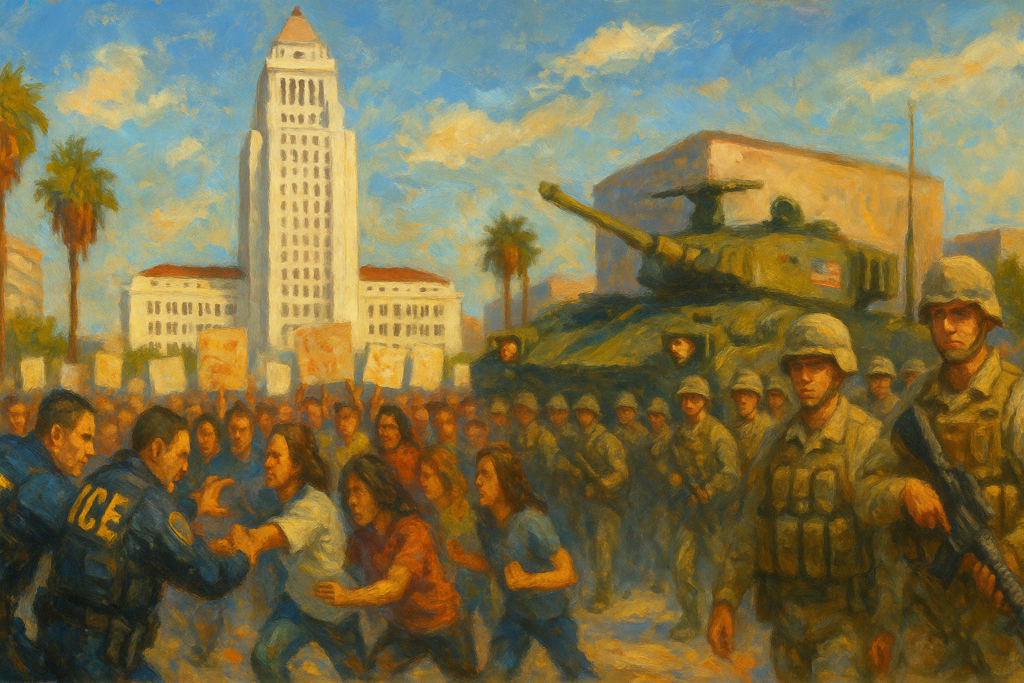
Los Angeles was the stage on which this week’s struggle over federal power, immigration enforcement, and the right to protest played out. What began as aggressive raids in immigrant neighborhoods and workplaces quickly drew in the National Guard, active-duty Marines, state officials, and federal courts. As the week unfolded, similar contests over authority and narrative appeared in universities, newsrooms, libraries, and election rules, while civil society prepared for mass “No Kings” protests against militarization and executive overreach.
The weekend opened with sweeping immigration raids across Los Angeles. Federal agents in military-style gear hit workplaces, day-labor sites, and community spaces, using armored vehicles and flash-bang grenades. More than 100 people were arrested, and civil-rights groups documented cases in which detainees were denied food, water, and medicine. Among those taken into custody was David Huerta, president of SEIU California, who had been observing a raid. The scale and tactics of the operation—raids at churches and community centers, heavily armed teams in residential streets—marked a shift toward paramilitary-style immigration enforcement in one of the country’s largest cities and sent fear through immigrant communities already wary of contact with authorities.
Protests formed almost immediately around key raid sites and detention facilities. As crowds grew, President Trump signed orders activating and federalizing thousands of California National Guard troops for deployment in Los Angeles, doing so without the consent of Governor Gavin Newsom. It was the first such unilateral move in decades. Defense Secretary Pete Hegseth publicly warned that active-duty Marines at Camp Pendleton could be mobilized if unrest continued. Trump and his allies described the demonstrations as violent riots and an attack on U.S. sovereignty, even as local officials, including Mayor Karen Bass, insisted that protests were largely peaceful. California leaders denounced the deployments as unconstitutional and inflammatory, arguing that using state military forces to police civilian protests crossed long-standing civil-military boundaries.
Beyond California, the administration pressed ahead with a broader enforcement campaign. ICE reported arresting more than 2,200 people in a single day nationwide, drawing heavily from monitoring programs that had previously been reserved for people not deemed public-safety threats. In New York City, officials expanded GPS monitoring and digital surveillance of immigrants, depressing business in affected neighborhoods as residents stayed home. In Chicago, ICE detained people during routine check-ins, raising questions about whether federal agents were circumventing state sanctuary laws and about the reliability of assurances given to those who voluntarily reported to authorities. The line between civil immigration control and criminal-style policing grew increasingly blurred.
Even in the first hours after the Guard order, legal and political pushback began to form. California’s attorney general prepared challenges to the federalization of the Guard, arguing that the president had exceeded his authority. Every Democratic governor signed a joint statement condemning the deployment as an abuse of power. At the same time, the administration asked the Justice Department to investigate statements by Democratic politicians critical of ICE, signaling a willingness to scrutinize political speech. The clash between federal rhetoric, media scrutiny, and coordinated state opposition set the stage for a week-long confrontation over who controls armed forces on American streets.
The weekend also saw the administration continue its efforts to shape national memory. Trump promoted a planned “National Garden of American Heroes” filled with statues and pointed to earlier orders aimed at reinstating removed monuments. These cultural projects, framed as restoring “truth” to American history, sat alongside moves to favor celebratory narratives of the past and to marginalize more critical or inclusive accounts. They foreshadowed later fights over Confederate base names, museum leadership, and book bans that would surface as the week went on.
By Monday, the Los Angeles crisis had moved into the courts. California filed suit to rescind Trump’s federalization of its National Guard, arguing that deploying state troops to police protests violated state sovereignty and exceeded federal authority. Governor Newsom publicly demanded that the order be rescinded and dared the administration to arrest him if he refused to comply. Trump escalated his language, describing the protests as a “Migrant Invasion” and an “insurrection against the laws and sovereignty of the United States,” while Hegseth again raised the prospect of mobilizing Marines. The Los Angeles Police Department, however, described the demonstrations as peaceful, underscoring the gap between local assessments and federal justifications for military involvement.
Courts elsewhere began to draw lines around immigration powers. A federal court in Texas ruled that Trump’s use of the Alien Enemies Act to deport migrants to El Salvador was illegal, requiring the administration to give affected individuals time to challenge their designation. In Florida and Oregon, lawmakers and legal nonprofits criticized and sued over immigration arrests at courthouses, arguing that such tactics undermined due process by deterring victims and witnesses from appearing in court. These actions showed that judges and some legislators were not prepared to accept the administration’s most expansive theories of enforcement.
At the same time, the administration widened its use of legal and financial tools against the press and other institutions. The Justice Department reversed a Biden-era policy and authorized subpoenas for journalists’ records in leak cases deemed to “undermine” Trump’s agenda, broadening surveillance of reporters. ABC News fired its chief political correspondent, Terry Moran, after a critical post about senior adviser Stephen Miller, amid reports of administration pressure. Press and civil-liberties groups warned that federal officers in Los Angeles were targeting journalists covering protests, a concern that would be borne out later in the week.
Universities, professional bodies, and public broadcasters also came under pressure. The Department of Education threatened to revoke federal funds from schools teaching about systemic racism. Trump moved to pull grants from the American Bar Association after it criticized administration policies, and he targeted Harvard with grant freezes and challenges to its tax-exempt status over its refusal to alter admissions and hiring to favor conservative viewpoints. In Congress, House Republicans advanced a bill to defund NPR and PBS, while Trump issued an order to cut their funding, prompting First Amendment lawsuits. These moves used federal money and regulation to punish disfavored institutions, blurring the line between neutral governance and political patronage.
Immigration enforcement increasingly reached into the realm of speech. USCIS announced it would monitor immigrants’ social media for “antisemitic activity,” with the potential to revoke visas over pro-Palestine statements. ICE arrested immigrants for pro-Palestine speech, and a French scientist was denied entry after officials found messages critical of Trump on his phone. The State Department revoked visas for hundreds of international students involved in campus protests, though a judge partially blocked the move. Tying immigration status to political expression and activism turned immigration law into a tool for viewpoint-based punishment, with clear implications for free speech.
On the ground in Los Angeles, local institutions tried to shield residents from the fallout. The school district announced a security plan to protect students and families from immigration enforcement at graduations, including safety perimeters and virtual viewing options. Newsom formally requested that the Guard deployment be rescinded and delivered a prime-time address condemning militarization while urging peaceful protest. These steps illustrated how local leaders can buffer communities from federal actions, even as they highlighted the depth of conflict between different levels of government.
Tuesday broadened the conflict from the streets to campuses and laboratories. A cluster of executive orders and agency actions targeted higher education and research. The administration banned federal funds for grants using certain gender-related terms, froze billions in grants to Harvard, and threatened to cut funding to universities that allowed what it called “illegal protests,” leading to major losses at institutions such as Columbia. Federal agencies stopped funding projects that used disfavored terms, affecting more than 1,000 scientific grants, and intervened in the Fulbright Program to block DEI-related projects. Academic freedom and protest rights were tied directly to federal funding, conditioning institutional survival on ideological compliance.
Public and international media faced coordinated restructuring. Trump’s order to defund NPR and PBS, coupled with a House rescissions bill, pushed both organizations into court to argue that the moves violated the First Amendment. The administration also moved to dismantle the U.S. Agency for Global Media, which oversees Voice of America, though a judge partially blocked the effort. The FCC, under Chairman Brendan Carr, opened investigations and lawsuits against CBS and other outlets over content disfavored by Trump. Together with the new DOJ subpoena policy, these steps narrowed the information environment at a moment when independent coverage of government actions was especially critical.
Scientific and health advisory systems were not spared. Health and Human Services Secretary Robert F. Kennedy Jr. dismissed all 17 members of the CDC’s Advisory Committee on Immunization Practices, calling for a “clean sweep,” and began appointing new members, including figures known for controversial vaccine views. The administration accused medical journals of political bias and suggested restricting government scientists’ ability to publish in certain outlets. These moves raised alarms about the independence of scientific advice and the integrity of vaccine policy, with potential long-term consequences for public trust in health guidance.
Cultural symbols and historical narratives remained contested terrain. At Fort Bragg, Trump announced plans to restore the names of Army bases honoring Confederate generals, reversing prior efforts to remove such symbols. In Washington, he had already removed Kennedy Center leadership for being “too woke,” prompting cancellations and declining ticket sales. These actions, combined with the “heroes” garden initiative, signaled a broader attempt to align cultural and military symbols with a particular historical narrative. In contrast, a federal judge blocked Trump’s executive order requiring proof of citizenship to vote in federal elections, ruling that the Constitution does not grant the president specific powers over election rules. That decision, echoing an earlier injunction in Washington, D.C., underscored judicial skepticism toward unilateral executive changes to voting eligibility.
In Florida, the fight over what students can read intensified. The State Board of Education threatened Hillsborough County’s superintendent with criminal prosecution if he did not permanently remove 55 books labeled as “pornography,” even though they did not meet legal obscenity standards. The threat followed failed legislative attempts to mandate similar removals and came amid campaigns by groups such as Moms for Liberty to purge books on race, LGBTQ issues, and sex education, including reporting librarians to law enforcement. Criminalizing resistance to book removals weaponized state power against educators and narrowed the range of ideas available in schools.
By Wednesday, the militarization of Los Angeles had become more concrete and costly. The Pentagon confirmed that 700 active-duty Marines had been deployed to the city to protect federal property and personnel, alongside thousands of federalized National Guard troops. A Pentagon comptroller told Congress that the combined deployments would cost an estimated $134 million. Legal experts noted that activating Marines without invoking the Insurrection Act raised constitutional questions, and California’s lawsuit over the Guard federalization moved forward. The presence of active-duty troops on city streets, at significant expense, blurred civil-military boundaries and diverted resources from other missions.
On those same streets, journalists and protesters faced force. Reporters covering the protests, including CNN’s Jason Carroll and an Australian journalist, reported being shot with rubber bullets and pepper balls and briefly detained. Separate footage showed officers shooting a woman with a “less lethal” round at close range near her home. Press groups condemned the attacks, and the LAPD announced an investigation into excessive force. These incidents followed earlier warnings that federal officers might be violating journalists’ First Amendment rights and underscored the risks of covering public demonstrations in a heavily militarized environment.
Elected officials who tried to exercise oversight over immigration enforcement also encountered force. At a DHS press conference in Los Angeles, FBI agents forcibly removed and handcuffed Senator Alex Padilla as he attempted to question Homeland Security Secretary Kristi Noem about enforcement tactics; he was later released without charges. The Justice Department announced the indictment of Representative LaMonica McIver for allegedly impeding officers during a detention-center protest, and attorneys for Newark Mayor Ras Baraka pursued a lawsuit over his earlier arrest at a detention facility. These cases fueled claims that federal law enforcement was being used to intimidate lawmakers and mayors engaged in oversight, raising concerns about the health of checks and balances.
Elsewhere in the federal government, environmental and ethical issues surfaced. The EPA advanced plans to roll back power-plant greenhouse gas limits and weaken mercury and air toxics standards, aligning with fossil-fuel interests. Reporting detailed how the administration had delayed or altered economic and climate data, including a USDA deficit report and a congressionally mandated climate assessment, while cutting staff at statistical agencies. Critics argued that these moves hollowed out evidence-based policymaking. In Congress, Representative Mark Green announced he had accepted a private-sector job but would remain in office through a key reconciliation vote without disclosing his future employer, prompting ethics concerns. In the federal prison system, attorneys for R. Kelly alleged that Bureau of Prisons officials tried to recruit an inmate to murder him, based on a sworn statement from a terminally ill prisoner, raising serious questions about inmate safety and abuse of authority.
Immigration raids continued to spread into sensitive spaces. ICE and allied agents conducted operations at Ventura County farms, detaining workers and alarming local officials who said the actions created chaos without improving safety. Agents detained a man in a church parking lot at gunpoint after refusing to show a warrant, and TikTok star Khaby Lame was held over visa issues before leaving the United States voluntarily. These incidents showed how enforcement now reached into workplaces, religious spaces, and the lives of global cultural figures, with potential to erode trust in public and religious institutions.
Thursday brought the first major court ruling against Trump’s troop deployment in Los Angeles. U.S. District Judge Charles Breyer held that the federalization of California’s National Guard to police protests exceeded statutory authority and violated the Tenth Amendment, ordering control returned to Governor Newsom. Within hours, however, a Ninth Circuit panel stayed the restraining order pending an emergency hearing set for June 17, temporarily restoring Trump’s control. The rapid back-and-forth illustrated both judicial willingness to check executive overreach and how quickly those checks can be suspended on appeal, leaving legal limits on domestic troop use contested and fragile.
In environmental policy, Congress and the president jointly moved to strip California of key clean-car authorities. Trump signed a resolution blocking the state’s rule to ban new gas-powered cars by 2035 and overturning EPA waivers that had allowed California to set stricter vehicle pollution standards. Two additional Congressional Review Act resolutions disapproved related EPA rules. California and ten other states sued, arguing that the federal action undermined their climate and air-quality efforts. The move centralized environmental policy in a deregulatory federal government and weakened state-led climate initiatives, complementing the EPA’s broader rollbacks of power-plant emissions limits.
As attention turned toward the June 14 military parade in Washington, states braced for nationwide “No Kings” protests planned for June 13. Texas activated thousands of National Guard troops and state police; Missouri and Texas deployed Guard units; South Carolina and Virginia warned that any violence or disruption would be met firmly; and a Florida sheriff threatened lethal force against protesters who harmed officers. Representative Anna Paulina Luna claimed, without evidence, that China was funding the protests and called for a committee investigation. Preemptive militarized responses and foreign-interference claims risked framing domestic dissent as a security threat before the protests had even begun.
Cultural and educational control efforts widened. Florida’s education authorities continued to pressure districts to remove books, while right-wing groups pushed bans on materials about race and LGBTQ issues. The Department of Defense ordered DEI-related books removed from the Naval Academy and Department of Defense Education Activity schools, and the Departments of Veterans Affairs and State banned pride flags in offices and consular posts. These actions followed earlier federal website censorship of DEI and gender terms and coincided with the Southern Baptist Convention’s endorsement of a resolution to overturn same-sex marriage. Coordinated restrictions on books, flags, and curricula narrowed the range of identities and histories that could be openly acknowledged in public institutions.
Scientists and economists warned of longer-term risks. More than 90 NIH scientists signed a letter opposing administration policies they said undermined the agency’s mission and public health. The World Bank projected that U.S. growth would fall sharply in 2025, citing Trump’s trade war as a key factor. Combined with earlier reports of data suppression and environmental rollbacks, these warnings suggested that short-term political gains might be coming at the expense of public health and economic stability. Amid this turbulence, the U.S. Election Assistance Commission quietly continued its technical work, announcing a July data summit at MIT and scheduling a committee meeting on updated voting system standards—routine but essential tasks that undergird election integrity regardless of high-profile political fights.
By Friday, the militarization of Los Angeles had reached a new threshold. For the first time since their deployment, U.S. Marines detained a civilian, Marcos Leao, outside the Wilshire Federal Building before handing him to DHS. The incident occurred as thousands of federalized Guard members and Marines continued to patrol the city over state objections, and as legal challenges to the deployments moved toward higher courts. Active-duty troops directly detaining civilians is a rare step in modern American history, underscoring how far military involvement in domestic enforcement had gone in just a few days.
Across the country, “No Kings” protests mobilized against raids, militarization, and the planned military parade. Organizers expected millions to join demonstrations at roughly 2,000 sites, funded in part by a Walmart heiress. The protests aimed to oppose mass deportations, defiance of court orders, and the use of military displays for personal glorification. Trump supporters called for boycotts of Walmart in response. Several governors had already activated Guard units or issued stern warnings, setting the stage for tense confrontations and testing how much space remained for mass dissent in a heavily policed environment.
Other developments on Friday showed how executive power was reshaping civil-rights enforcement and data privacy. Reports confirmed that the acting chair of the Equal Employment Opportunity Commission, Andrea Lucas, had ordered the agency to stop processing gender-identity discrimination claims and to classify them as lowest priority. The EEOC dismissed several pending cases and removed the “X” gender marker from intake forms. Seventy members of Congress sent a letter demanding enforcement of civil-rights protections for transgender and nonbinary people, but for now the main federal workplace-discrimination agency had effectively stepped back from protecting those groups. Separately, new reporting revealed that the administration had transferred personal data, including immigration status, for millions of Medicaid enrollees to DHS, where it was being used to support ICE’s mass deportation campaign. Privacy advocates warned that repurposing health data for enforcement could deter vulnerable populations from seeking care and erode trust in public programs.
There were also small but notable instances of institutional resistance. The Smithsonian’s governing board rejected Trump’s claim that he had fired Kim Sajet, director of the National Portrait Gallery, for being “too woke,” asserting that personnel decisions rest with the institution’s leadership, not the president. In the courts, a federal judge in Massachusetts issued another injunction against parts of Trump’s proof-of-citizenship voting order, echoing earlier rulings that the president had overstepped his authority and risked disenfranchising voters. And in economic and environmental policy, Trump signed orders modifying a prior block on Nippon Steel’s acquisition of U.S. Steel—allowing the deal to proceed if a national-security agreement is reached—and consolidating federal wildfire prevention and response programs, while Congress enacted the Aerial Firefighting Enhancement Act to bolster aerial firefighting capacity. These actions showed how executive orders can reshape strategic industries and disaster response even as other branches push back on more overt power grabs.
Taken together, the week traced a clear arc: from paramilitary-style immigration raids in Los Angeles to the federalization of the National Guard, the deployment of Marines, and the first direct detention of a civilian by active-duty troops; from courthouse arrests and social-media monitoring to the use of health and education data for enforcement; from monument plans and Confederate base names to book bans, pride flag prohibitions, and the quiet halting of gender-identity discrimination cases. Courts and some institutions pushed back, blocking certain deportation tools, limiting executive control over elections, and occasionally resisting cultural interference. But the overall picture was of an executive branch testing the outer edges of its authority across multiple fronts, while states, judges, civil servants, and protesters scrambled to define how much power any administration can wield over streets, classrooms, airwaves, and the stories a nation tells about itself.