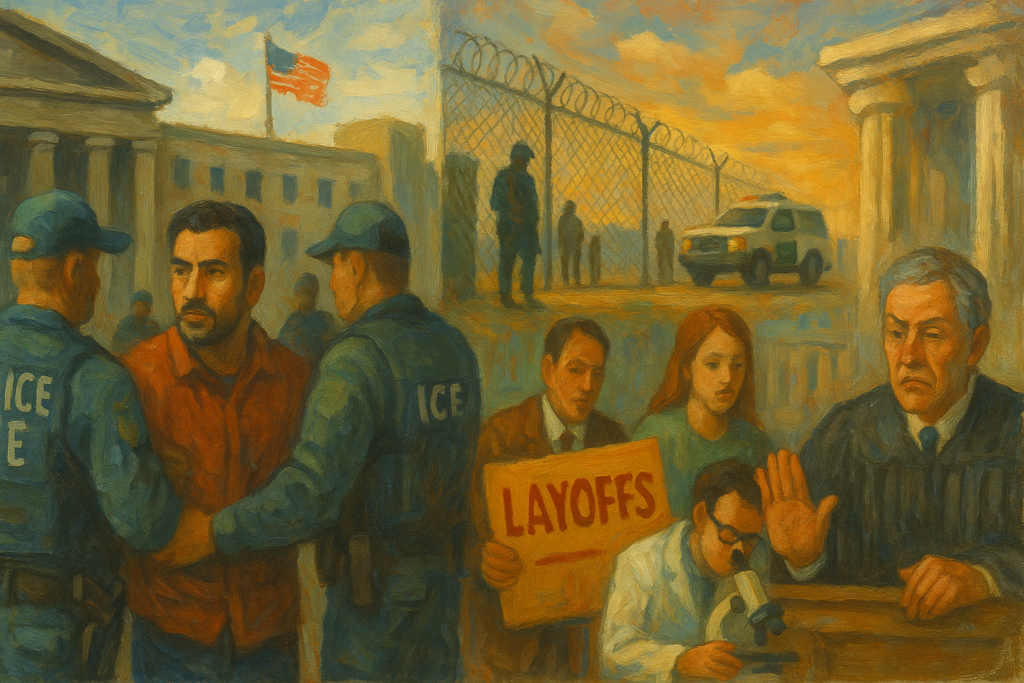
This week’s throughlines
- Federal power was used to pressure universities and campus dissent — The week began with the cutoff of $400 million to Columbia and escalated into demands tied to restoring funds, student discipline, a terrorism-related investigation, room searches, and immigration action against protest-linked students.
- Immigration enforcement moved further into speech, status, and local resistance — Mahmoud Khalil’s detention became the clearest case of immigration power being used against political activism, while the administration also resumed family detention, subpoenaed a migrant shelter, repurposed an asylum app, and signaled broader emergency-style powers.
- The administration’s campaign to shrink and redirect the federal state accelerated — Agency spending controls, buyouts, layoffs, office closures, lease terminations, and plans to privatize services all pointed in the same direction: weakening the civil service and shifting operational control upward and outward.
- Courts became the main brake on executive retaliation and administrative overreach — Judges blocked deportation, ordered DOGE records released, halted punishment of Perkins Coie, demanded evidence for canceled climate grants, and ordered fired federal workers reinstated.
- Trade and economic policy fed market instability while Congress weakened checks — Tariff threats and implementation rattled markets, and House Republicans moved to make Trump’s tariff emergency harder for Congress to challenge.
This week unfolded along three intertwined lines. Immigration law was used not only to police borders but to target political speech and broad categories of noncitizens. Federal agencies and the education system came under structural attack through mass layoffs, civil-rights rollbacks, and deep cuts to research and social programs. And an escalating trade and information conflict—centered on tariffs and the growing power of Elon Musk’s government role—sent markets reeling even as courts and watchdogs began to push back.
Over the weekend, the administration moved aggressively to consolidate executive power inside the federal government. A central piece was the expanding role of the Department of Government Efficiency, or DOGE, a new unit led by Elon Musk and presented as a cost-cutting operation. DOGE gained authority to sign off on Environmental Protection Agency spending and to drive deep downsizing across agencies, including cuts that degraded basic services for U.S. staff abroad. Treasury officials framed this as part of a broader project to shrink and privatize federal services, and early reports surfaced of mass layoffs of probationary civil servants ordered weeks earlier. Because DOGE is tied to a single private figure and operates with limited transparency, its growing control over budgets and operations blurred the line between public authority and private influence.
At the same time, Trump used direct executive power to override judicial limits and reward political allies. He ordered transgender women in federal custody transferred to men’s prisons despite prior court rulings blocking such moves, and he issued pardons for January 6 participants. Together, these actions signaled a willingness to defy court constraints and to treat politically aligned violence leniently, while vulnerable groups bore the brunt of state power. In the financial realm, Trump signed an order creating a taxpayer-funded U.S. Crypto Reserve and appointed a “crypto czar,” while the Securities and Exchange Commission dropped major enforcement cases against Kraken and Coinbase. The shift from skeptical oversight to active support for politically connected crypto firms suggested that economic policy was being steered by industry allies rather than neutral regulators.
Environmental and civil-rights enforcement also tilted toward powerful interests. The administration dropped a major environmental justice case against the Denka plant in Louisiana’s “Cancer Alley,” a facility long criticized for its pollution impacts on nearby communities of color. Officials also signaled tolerance for money laundering and elite financial crimes. These decisions fit a pattern of easing pressure on well-connected firms while weakening protections for marginalized communities and the financial system. In parallel, voting-rights fault lines resurfaced: Representative Terri Sewell reintroduced the John R. Lewis Voting Rights Advancement Act to restore federal preclearance of certain state election changes, even as a North Carolina judge sought to throw out more than 65,000 ballots in his own lost race. Commentary revisited the Supreme Court’s Shelby County decision and new data showing a widening racial turnout gap in Alabama, underscoring how structural rules and individual disputes together shape electoral participation.
Immigration enforcement emerged as a central political tool. Over the weekend, Immigration and Customs Enforcement detained Mahmoud Khalil, a Palestinian green card holder and recent Columbia graduate, under a rarely used Cold War–era authority personally signed by Senator Marco Rubio. That provision allows the government to act against noncitizens based on foreign-policy or national-security claims rather than ordinary criminal charges. Early reports tied Khalil’s detention to his pro-Palestinian campus activism, foreshadowing a broader campaign against similar voices. Inside the Department of Homeland Security, leaders responded to leaks about immigration operations by ordering employees to undergo polygraph tests to identify sources, explicitly framing the effort as a crackdown on internal dissent and information flows to the press.
The weekend also brought signs of a broader economic and aid retrenchment. Tariff-driven uncertainty deepened as the administration cut defense production and science funding, canceled industrial policies, and slashed USAID and drug interdiction programs. Global food and emergency aid were curtailed, weakening U.S. humanitarian reach. At home, labor protections eroded: DHS eliminated union protections for about 47,000 Transportation Security Administration employees, the Department of Health and Human Services offered buyouts to roughly 80,000 staff amid a measles outbreak, and the Social Security Administration authorized 100 percent benefit withholding for overpayments regardless of fault. Treasury officials openly promoted shrinking and privatizing federal services. Against this backdrop, protests began to coalesce around Musk’s role in government. Demonstrators gathered at Tesla showrooms and charging stations, linking his influence inside DOGE to broader concerns about oligarchy. Musk and allies blamed shadowy funders, while organizers planned larger “anti-oligarchy” tours and protests.
By Monday, the administration’s budget strategy came into clearer view. Trump endorsed a continuing resolution that would keep the government open through September while increasing defense spending by $6 billion, cutting non-defense programs by $13 billion, and freezing IRS funding. The House narrowly passed the bill, which critics warned would slash social programs and give the administration wide latitude to redirect funds. Budget choices translated the administration’s priorities into concrete shifts: military and enforcement spending preserved or expanded, domestic social protection squeezed.
Khalil’s case moved from an isolated report to a template for a wider campaign. Multiple accounts detailed how ICE arrested him at Columbia housing after the State Department revoked his green card, with Trump calling it the “first arrest of many” targeting pro-Palestinian activists. In Virginia, ICE detained naturalized citizen Jensy Machado despite his documentation, while Rubio threatened to revoke visas and green cards of people deemed to support Hamas. These actions relied on immigration authorities that allow the government to treat political speech and associations as security risks, blurring the line between legitimate counterterrorism and viewpoint punishment. The chilling effect extended beyond Khalil to students, faculty, and immigrant communities watching how quickly lawful status could be questioned.
Federal pressure on universities escalated in tandem. The administration confirmed cancellation of $400 million in federal grants and contracts to Columbia University over alleged failures to address antisemitic harassment, and the Education Department’s civil-rights office warned 60 colleges and universities of potential enforcement actions. These moves built on a January executive order and signaled a willingness to use federal purse strings to shape campus responses to protest and discrimination. Combating antisemitism is a core civil-rights function, but tying massive funding decisions and enforcement threats to contested campus politics risked turning universities into instruments of federal speech policy. Meanwhile, the Social Security Administration, under public scrutiny, backed away from a plan to end phone service for millions of claimants but moved ahead with narrower restrictions on changing direct deposit by phone. The Veterans Affairs Department prepared for large job cuts and strict in-person work rules, and cuts to local food programs for schools and food banks at the Department of Agriculture came into focus, all pointing toward thinner access to basic services.
Civic and protest infrastructure grew in response. Organizers announced a nationwide “Fighting Oligarchy” tour by Senator Bernie Sanders and United Auto Workers president Shawn Fain, Stand Up for Science and International Women’s Day protests, an “empty chair” town hall targeting Senator Thom Tillis, plans to pack the North Carolina legislature’s gallery, and a protest at a Tesla dealership in Raleigh. These efforts showed civil society and opposition parties building alternative forums for accountability as formal institutions came under strain. On the legal front, early checks on DOGE emerged: a federal judge ruled that DOGE is likely subject to the Freedom of Information Act and ordered rolling production of its records, while the EPA denied a petition to undo a Clean Water Act consent agreement. Even amid rapid executive expansion, transparency laws and administrative procedures still offered tools to slow or reshape contested policies.
Tuesday crystallized the administration’s approach to education and civil rights. Under Secretary Linda McMahon, the Department of Education announced it would abolish more than half the offices in its Civil Rights Division and lay off roughly 1,300 employees—about half its workforce. Officials framed the move as efficiency, but internal and external critics saw it as an effort to dismantle the department and weaken enforcement of anti-discrimination and education laws. Halving staff and hollowing out the civil-rights arm sharply reduced federal capacity to enforce equal access to education and administer student aid, shifting more power to states and private actors.
Under this pressure, universities began to act as extensions of national politics. Columbia announced expulsions, suspensions, and diploma revocations for students involved in 2024 pro-Palestinian protests, explicitly linking the discipline to Trump administration demands. At the same time, federal agencies continued to pursue immigration cases against student activists, including Khalil and others accused of Hamas ties. The combination of funding threats, civil-rights investigations, and immigration enforcement turned campus discipline into a tool of federal policy, narrowing space for dissent and academic freedom even as officials insisted they were combating antisemitism.
Environmental and data policy also shifted. House Republicans held a hearing on revising the Endangered Species Act and Marine Mammal Protection Act to speed industrial projects, signaling a push to weaken long-standing environmental safeguards. The Census Bureau canceled scientific advisory meetings on census methods and racial and ethnic populations, reducing expert input into data that underpins representation and federal funding formulas. These moves made it easier to approve projects with long-term ecological consequences and to shape the statistical foundations of democratic representation without robust outside scrutiny. In response to the education and civil-service purges, Democratic state attorneys general prepared lawsuits challenging the Education Department’s mass layoffs as unconstitutional and illegal, arguing they crippled congressionally mandated functions. These efforts built on earlier rulings that DOGE is subject to FOIA, testing whether courts would enforce limits on the executive’s ability to dismantle agencies without legislative approval.
Wednesday became a hinge day as courts intervened even while new rollbacks were announced. Federal judges in multiple cases ordered agencies to reinstate tens of thousands of probationary employees fired under DOGE directives, criticizing the administration’s performance-based rationale as a sham. They required DOGE and Musk to disclose staff identities and internal records, reinforcing the earlier FOIA ruling. These decisions asserted judicial limits on politically driven purges and secretive quasi-agencies, preserving some protections for the professional civil service.
At the Environmental Protection Agency, Administrator Lee Zeldin announced plans to reconsider the 2009 “endangerment finding” that greenhouse gases threaten human health, the scientific foundation for much of U.S. climate law. He also moved to roll back 31 environmental protections, including rules on electric vehicles and coal-plant pollution. In a separate case, a federal judge demanded evidence to justify the abrupt cancellation of $7 billion in climate grants and issued a restraining order pending new filings. Reopening the core scientific basis for climate regulation and dismantling key rules could weaken pollution limits for years, but the court’s intervention showed that abrupt reversals still faced legal scrutiny.
Trade policy added to the turbulence. Trump announced plans to double tariffs on Canadian steel and aluminum before settling on a 25 percent tariff on all imported steel and aluminum. The tariffs took effect and triggered retaliatory measures from the European Union and Canada on tens of billions in U.S. goods, with the EU preparing up to €26 billion in countermeasures. Markets fell sharply. In Congress, the House passed a measure redefining “days” in a way that made it harder for lawmakers to terminate Trump’s tariff emergency, weakening Congress’s role in trade oversight just as the economic stakes rose.
Public health policy was also reshaped from the top. Under Health and Human Services Secretary Robert F. Kennedy Jr., the department announced clinical trials of unproven measles treatments such as steroids and cod liver oil, while the National Institutes of Health cut funding for 40 studies on vaccine confidence. These moves came amid a serious measles outbreak and followed Kennedy’s public questioning of vaccine safety, making it harder to mount evidence-based responses. Meanwhile, as protests at Tesla locations grew, Trump publicly praised Musk as doing a “fantastic job” and labeled protesters at Tesla dealerships “domestic terrorists.” This rhetoric, coming as DOGE’s cuts and claims were under scrutiny and Musk’s platform X suffered repeated outages, signaled that certain private allies enjoyed special protection from public criticism.
Courts continued to check some executive actions. A federal judge in Boston issued temporary restraining orders blocking cuts to hundreds of millions in teacher-training funds, citing impacts on a nationwide teacher shortage. In another case, Judge Beryl Howell temporarily blocked most of an executive order punishing law firm Perkins Coie, finding it resembled an unconstitutional bill of attainder; the firm sued over the order. These rulings underscored that courts could still constrain attempts to use funding and national-security rationales to reshape professions and punish perceived enemies. On immigration, DHS reported that February arrests were the highest in seven years, with a sharp rise in detentions of people without criminal convictions after Biden-era priorities were rolled back. The administration also planned to invoke the Alien Enemies Act—a wartime law allowing arrest and deportation of certain noncitizens from hostile countries without normal due process—signaling a readiness to normalize extraordinary powers in routine enforcement.
By Thursday, the immigration crackdown and its political uses were fully visible. New filings and reporting detailed how Mahmoud Khalil was arrested by plainclothes agents at Columbia housing, transferred to detention in Louisiana, and targeted under a foreign-policy provision despite no criminal charges. A federal judge temporarily blocked his deportation while demanding more evidence. In New York, nearly 100 protesters—many from Jewish Voice for Peace—were arrested at Trump Tower demanding his release. DHS revoked another Columbia student’s visa over alleged Hamas support, and ICE statistics showed record-high arrests. The combination of novel legal tools, campus discipline, and mass arrests around a single activist illustrated how immigration, policing, and university governance could be aligned to suppress a particular strand of political speech.
The broader dragnet widened. The administration reactivated two family detention centers in Texas, reversing Biden-era policy that had ended large-scale detention of families with children. The Justice Department issued a criminal subpoena to a Manhattan hotel sheltering undocumented immigrants, demanding resident identities and funding details, a move likely to chill participation in shelter programs. Separate reports described the deportation of parents of a 10-year-old brain cancer patient, alleged torture of a New Hampshire green card holder at Boston’s Logan Airport, and deadly conditions for migrants in the Otay Mountain wilderness. These cases showed how policy shifts translated into concrete harms for families, patients, and lawful residents.
DOGE’s public narrative came under coordinated challenge. The outlet Popular Information launched a “Musk Watch DOGE Tracker,” concluding that DOGE’s touted $105 billion in savings were overstated by at least 92 percent, with only $8.6 billion verifiable. The DOGE website had recently removed details that allowed independent verification, and Musk attacked the tracker on X rather than addressing its methodology. These revelations landed as courts ordered DOGE to produce internal records and as USAID staff received instructions to shred or burn agency documents. Inflated savings claims and record-destruction orders undermined the public’s ability to understand what was being cut and why, even as legal and journalistic scrutiny showed that these narratives could still be contested.
Trade tensions escalated further. Trump threatened a 200 percent tariff on European Union wines and champagnes if the EU proceeded with a 50 percent tariff on American bourbon, part of its response to U.S. metal tariffs. The threat raised conflict-of-interest concerns given Trump’s own winery holdings and came as the EU finalized up to €26 billion in countermeasures and U.S. tariffs on steel and aluminum fully took effect. At the same time, the administration canceled $800 million in medical research funding to Johns Hopkins, cut over $1 billion from local food purchasing programs for schools and food banks, and slashed support for renewable energy and climate resilience abroad. USAID’s operational capacity was further undermined by DOGE-driven changes and record-destruction orders, weakening both domestic resilience and U.S. soft power. Local accountability efforts continued as well: a $50 million claim was filed against San Diego over the death of an unhoused woman in a towed van, while Paula White, head of the White House Faith Office, publicly called for challenging separation-of-church-and-state case law to reintroduce Bibles and prayer in public schools, framing Trump’s survival of an assassination attempt as divine purpose.
Friday capped the week with a burst of executive orders that reshaped core aspects of membership and governance. Trump declared a national emergency at the southern border, ended birthright citizenship for children of noncitizens, and terminated diversity programs across the federal government. He issued a sweeping “bureaucracy reduction” order targeting non-statutory components of agencies, including the U.S. Agency for Global Media, museum and library services, homelessness coordination, and minority business development. Another order singled out law firm Paul Weiss for security-clearance reviews and contract terminations. These actions narrowed who counts as a full member of the polity, weakened diversity and independent institutions, and used presidential power to punish disfavored private actors.
Immigration emergency powers expanded further as the administration formally suspended the U.S. refugee resettlement program, halting a key legal pathway to safety for people fleeing persecution. This suspension came on top of plans to invoke the Alien Enemies Act and the week’s aggressive enforcement actions against activists, families, and lawful residents. In the information sphere, an executive order defunded the U.S. Agency for Global Media, which oversees Voice of America and other international broadcasters, affecting about 3,500 employees and leaving many foreign journalists at risk of deportation to authoritarian states. Combined with earlier moves to dismantle USAID and cut global aid, the defunding weakened a major instrument of U.S. soft power and support for independent media abroad.
The administration also issued a broad “rescissions” order revoking numerous Biden-era executive actions on COVID-19 response, human rights, minimum wage for federal contractors, energy supply, and biotechnology. Because so much modern policy rests on executive orders, this single action rapidly reversed years of work on health, labor, and climate, underscoring how fragile such protections can be. In Congress, the House continuing resolution cleared a key Senate hurdle after 10 Democrats joined Republicans to invoke cloture, and Senate Minority Leader Chuck Schumer announced he would vote for the Republican-authored bill to avoid a shutdown. The decision kept the government open but locked in spending choices that favored defense and enforcement over social programs, drawing sharp criticism from activists and some Democrats who argued it ceded too much to the administration’s agenda.
Trump’s rhetoric continued to test institutional norms. On Truth Social, he again called the 2020 election “rigged & crooked” and demanded imprisonment of unnamed perpetrators. In a separate appearance, he praised Judge Aileen Cannon for dismissing his classified-documents case and suggested criticism of judges should be illegal. Persistent falsehoods about past elections and calls to criminalize criticism of judges eroded trust in both electoral and judicial institutions and normalized the idea that political opponents are criminals. Against this backdrop, Democrats announced an expansion of “People’s Town Halls” in Republican-held swing districts where incumbents have avoided public events, aiming to preserve direct, public questioning of those in power.
Taken together, the week’s developments showed a presidency using immigration law, executive orders, and budget control to redraw the boundaries of belonging and to weaken independent centers of expertise and oversight—from civil-rights offices and research institutions to global media and aid agencies. At the same time, courts, state attorneys general, journalists, protesters, and local litigants mounted a patchwork of responses: reinstating purged workers, blocking some funding cuts, demanding records from DOGE, and building alternative civic forums. The balance between concentrated executive power and these countervailing forces remained unsettled, but the institutional stakes—for who may speak, who may stay, and which public goods the state will sustain—grew clearer with each passing day.