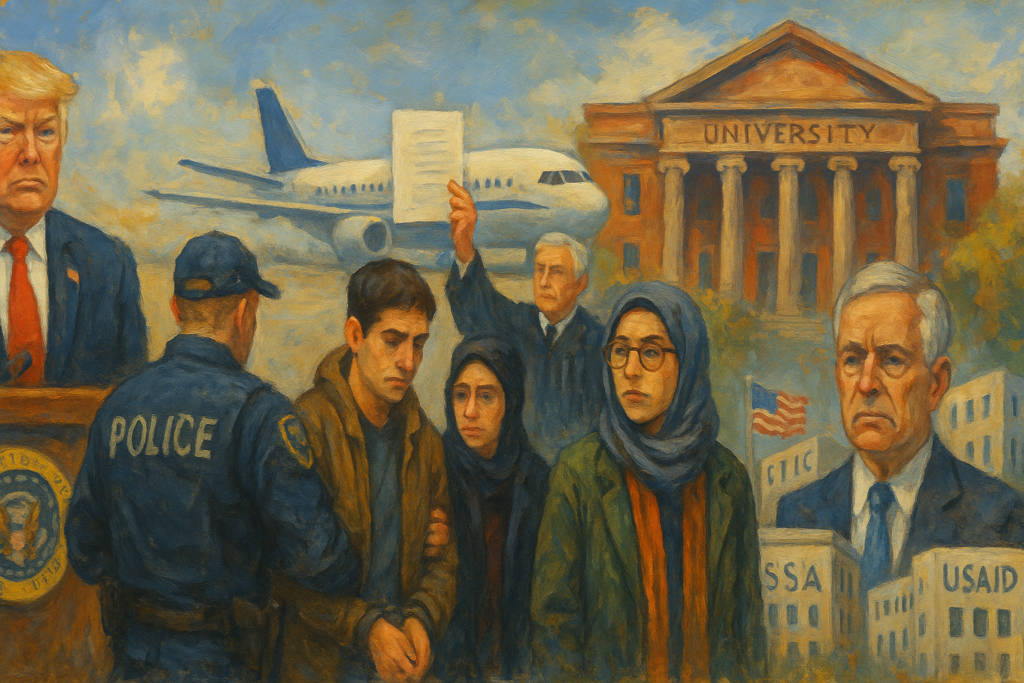
This week’s throughlines
- The deportation fight escalated from emergency order to constitutional confrontation — Trump’s Alien Enemies Act proclamation, the deportation flights to El Salvador, the administration’s apparent refusal to comply with Judge Boasberg’s order, and the later court demands for explanations formed the week’s clearest escalation cycle.
- Pressure on universities moved from rhetoric to money, policing, and immigration enforcement — The administration paired funding threats against Columbia and Penn with detentions, visa revocations, and deportation efforts aimed at students and researchers tied to pro-Palestinian activism.
- The administration widened its campaign against independent and semi-independent institutions — Media outlets, regulators, aid agencies, law firms, and cultural institutions all faced some mix of shutdowns, funding cuts, firings, coercive demands, or takeover attempts.
- Courts became the main site of resistance, and then a target — Judges blocked or slowed several administration actions, but the response was not limited to appeals: it included calls to impeach Judge Boasberg, public attacks from the White House, and harassment directed at his family.
This Week in Democracy: Deportations, Campus Pressure, and Executive Reach
The week turned on a basic question of constitutional government: what happens when a president claims extraordinary power, a judge orders him to stop, and the government acts as if the order may not matter? That question first surfaced in an immigration case, but by week’s end it had spread to universities, federal agencies, public media, benefits systems, and the treatment of students, scholars, and immigrants whose speech or status put them in the administration’s path.
Over the weekend, President Trump invoked the Alien Enemies Act of 1798 to deport alleged Venezuelan gang members without the ordinary process that usually accompanies removal cases. Judge James Boasberg moved quickly to block the action and ordered deportation flights turned back. But flights to El Salvador continued anyway, creating the week’s defining confrontation. The immediate dispute concerned the reach of an old wartime statute and the status of people already on planes. The larger issue was whether the executive branch would treat a federal court order as binding in a high-stakes immigration operation.
That same weekend, the administration also moved against U.S.-funded media and continued tightening its grip on press access. Trump ordered the dismantling of the U.S. Agency for Global Media, placing Voice of America staff on leave and cutting support for affiliated broadcasters. Separately, the White House kept restricting Associated Press access during an ongoing dispute over official naming language. These were different fights, but they pointed in the same direction: reducing the independence of institutions that gather and distribute information while making access to the presidency more contingent on compliance.
Universities were already under pressure as the week began. The administration cut $400 million in federal funding to Columbia, formally tying the move to antisemitism concerns but using it in a way that signaled a broader effort to force changes in campus governance and protest policy. At the same time, immigration actions against Mahmoud Khalil and threats involving visas for protesters suggested that federal funding and immigration enforcement were being used in tandem. The target was not only campus disorder as the administration defined it, but the rules under which universities govern speech, protest, and internal discipline.
Trump also used the weekend to project a broader theory of presidential freedom from institutional restraint. In a speech at the Justice Department, he aired grievances about past prosecutions in a setting that traditionally symbolizes some distance between presidential politics and federal law enforcement. He also ordered airstrikes in Yemen without congressional authorization, adding a foreign-policy example of unilateral action. On Sunday he went further, claiming that President Biden’s pardons were invalid because they had been signed by autopen, a claim that challenged settled assumptions about presidential acts. The same day, an appeals court lifted a block on anti-DEI executive orders, giving the administration more room to push federal policy in that area.
By Monday, the deportation case had become a direct test of judicial authority. At a hearing, Judge Boasberg pressed the Justice Department to explain whether the administration had violated his order to stop the flights. The White House and DOJ argued that the deportations were lawful, or that the judge’s authority did not extend to planes already in the air or outside U.S. territory. New reporting and court filings, meanwhile, raised doubts about the government’s claims of gang affiliation and about whether those sent to El Salvador had received meaningful process. The case was no longer only about who could be deported under the Alien Enemies Act. It was about whether the government could act first, move people beyond easy judicial reach, and then argue that review had become impossible.
The administration’s use of immigration power also widened on Monday in cases tied to protest and academic life. Mahmoud Khalil’s case continued, and other actions reinforced the message that noncitizens associated with protest could be singled out. Brown professor Rasha Alawieh was deported despite a judge’s order requiring notice, and other accounts showed immigration powers being used against activists and students with little practical chance to contest what was happening. These cases differed in posture and facts, but together they suggested a pattern: immigration enforcement was becoming a tool not just of border control, but of political and institutional discipline.
Monday also brought quieter but revealing changes in what the government chose to make visible. A federal advisory that treated gun violence as a public-health issue was removed. At the same time, the military’s removal of material on the Tuskegee Airmen, women pilots, and other minority service members showed a broader effort to strip public institutions of information tied to diversity and historical recognition. Civil society began organizing its response as well, through protest guidance, town halls, empty-chair events for absent lawmakers, and a growing wave of lawsuits across immigration, labor, education, and public information. The courts were becoming a central arena, but so were civic groups trying to document and resist what was changing.
On Tuesday, judges pushed back in one of the administration’s other major institutional fights. A federal judge ruled that the shutdown of USAID likely violated the Constitution and ordered parts of the agency restored. Courts elsewhere continued scrutinizing DOGE-linked actions as the administration defended its authority to restructure agencies from within. The USAID ruling did not settle the broader struggle over executive control of agencies created and funded by Congress, but it showed that judges were willing to ask whether rapid dismantling by presidential allies could lawfully substitute for legislation.
Tuesday also sharpened concerns about Elon Musk’s role inside government. Reports that Starlink had been installed across the White House campus raised security and procurement questions because Musk remained both a major private businessman and a central figure in executive operations. The problem was not merely optical. It was the growing difficulty of separating public authority from private commercial interests when a politically connected outsider had unusual access to government systems and decision-making.
In the immigration cases, the administration did not retreat. It continued arguing that Boasberg’s oral instructions did not bind it once planes were airborne or outside the country, even as more cases surfaced involving harsh treatment of migrants and lawful residents. Reports included the detention of a German permanent resident at the border and family challenges to abusive detention conditions. The legal theory behind the deportation flights was thus being tested against a widening set of human consequences. On the same day, Trump fired the two Democratic commissioners at the FTC, threatening the independence of a regulator designed to operate with some insulation from direct presidential control. He also kept pressing the claim that Biden’s pardons were void. Chief Justice John Roberts publicly rebuked calls to impeach Judge Boasberg, an unusual intervention that underscored how quickly a legal dispute had become a political attack on the judiciary itself.
That attack intensified on Wednesday. As the deportation case deepened, Trump called for Boasberg’s impeachment, and a House ally filed articles against him. The administration continued resisting disclosure about the flights and defending its conduct. What had begun as a legal argument over statutory authority and emergency relief had also become a campaign to discredit the judge overseeing the case. That matters because courts depend not only on formal power but on a political culture in which adverse rulings are answered through appeal and argument, not threats against the judge.
Wednesday also made clear that Columbia was not an isolated target. After the earlier funding cut, the administration sent the university a letter demanding a mask ban, stronger campus policing, and changes to academic departments. Penn’s funding freeze over trans athlete policy showed the same method being applied elsewhere. Federal money was being used not simply to punish institutions after alleged violations, but to dictate internal rules, disciplinary approaches, and academic governance. On the same day, Trump signed an executive order giving DOGE broad access to unclassified agency records, data, and software systems, extending its reach across the federal bureaucracy even as courts were still examining its legal footing.
Education became another front in the same struggle over executive reach. Trump signed an order aimed at dismantling the Department of Education, despite the fact that the department exists by act of Congress. A teachers union lawsuit over halted student loan repayment processing arrived alongside the order, showing how quickly administrative disruption could spill into the lives of borrowers and schools. The move tested whether a president could effectively hollow out a cabinet department without formally abolishing it, using executive action to achieve much of the same result.
On Thursday, the university campaign widened further. The White House announced a task force and investigations into alleged antisemitism at major universities, warned dozens of schools of possible action, and reiterated the funding freeze on Penn. Columbia’s punishment now looked less like a singular response than the opening move in a national effort to reshape campus policy through civil-rights enforcement, grant leverage, and direct federal demands. The administration’s push against the Department of Education also became a central national issue, part of a larger flood of executive actions relying on unilateral directives rather than legislation.
The deportation case also reached a more serious stage on Thursday. Judge Boasberg ordered the administration to show cause for its failure to comply with the restraining order, while hearings exposed more inconsistencies about who had been sent to El Salvador and on what basis. A show-cause order is not a final sanction, but it marks a shift from ordinary disagreement to possible enforcement. The court was now asking not just whether the administration’s legal theory was wrong, but whether the government had openly disregarded judicial authority.
At the same time, the administration paired harsher immigration plans with more speech-linked cases. Reports described plans for a militarized buffer zone on the New Mexico border in which active-duty troops could detain border crossers. A judge blocked the deportation of Georgetown academic Badar Khan Suri, and additional cases involving border detentions and phone searches showed how immigration enforcement was colliding with academic freedom, protest, and due process. Courts were preserving review in some individual cases, but the broader pattern was one of expansion: more people exposed, more aggressive theories of authority, and more reliance on immigration law in politically charged settings.
By Friday, the week’s central conflict had hardened. Boasberg ordered the Justice Department to explain why it should not be found in violation of his deportation order, while White House press secretary Karoline Leavitt publicly attacked him and misrepresented his ruling. The legal and political tracks were now running together. In court, the administration faced the possibility of a finding that it had not complied. In public, it continued trying to delegitimize the judge. That combination sharpened the week’s central question: whether courts can still impose meaningful limits when the executive branch treats compliance as negotiable and criticism of judges as part of ordinary political strategy.
Friday also brought a major expansion of the immigration crackdown beyond the El Salvador flights and the protest-linked cases. DHS announced that it would end parole-based legal status for more than 530,000 immigrants from Cuba, Haiti, Nicaragua, and Venezuela. This was a mass change in legal status with immediate consequences for work authorization, family stability, and the scale of future enforcement. It showed that the week’s immigration story was not only about dramatic flights or headline cases involving students and scholars. It was also about the government’s ability to alter the legal position of very large groups at once.
Courts, meanwhile, continued trying to set limits on DOGE’s reach into sensitive systems. A federal judge blocked DOGE from accessing Social Security records, ordered destruction of data already obtained, and later clarified the scope of the restraining order after confusion inside the agency. The case mattered not only because of privacy, but because Social Security is one of the government’s largest and most consequential benefits systems. At the same time, DOGE-style intervention spread into cultural institutions: personnel arrived at the Institute of Museum and Library Services, sent employees home, installed new leadership, and canceled contracts and grants. Trump also acknowledged that Musk’s business ties to China created conflicts of interest, even as Musk remained deeply entangled with executive operations. And immigration enforcement kept intersecting with activism and academic life, as a judge protected Jeanette Vizguerra from removal while her case proceeded and DHS told Cornell student Momodou Taal to surrender after he sued the administration.
Taken together, the week showed more than a series of aggressive policy moves. It showed a governing method. Immigration law was used both broadly and selectively, against large populations and against named students and scholars. Federal money was used to pressure universities into changing internal rules. DOGE and allied actors pushed deeper into agencies, data systems, benefits administration, and cultural institutions. Judges repeatedly intervened, sometimes forcefully, but their orders did not by themselves restore the older boundaries between executive power and the institutions meant to check it. The week’s record is therefore not one of settled outcomes. It is one of escalating tests: whether courts can compel obedience, whether Congress’s creations can be hollowed out without Congress, and whether public institutions can remain independent when funding, access, and legal status are used as instruments of control.