This week’s throughlines
- Federal pressure spread from one university to a wider campaign — What began with Columbia's funding loss and compliance demands widened into a broader effort to use grants, contracts, and immigration status to shape campus speech, protest, and governance, including a major funding review of Harvard and visa revocations for student protesters.
- Immigration enforcement hardened while courts tried to slow it — The administration pushed deportations through aggressive legal theories, subjective gang-labeling systems, and admitted errors, while judges issued restraining orders and blocked removals or funding cuts affecting legal representation.
- Emergency powers became the vehicle for a major economic shock — Trump spent the first half of the week signaling broader tariffs, then used a national emergency declaration to impose sweeping import taxes, prompting market losses, congressional objections, and questions about executive control over trade policy.
- Institutional weakening showed up as layoffs, closures, and record-keeping failures — Mass layoffs at HHS, the planned shutdown of USAID, cuts to research and FOIA staff, and the use of Signal and personal Gmail for official business all pointed to a governing style that reduced capacity while making oversight harder.
- Election rules and voting access faced pressure on several fronts — The week brought lawsuits over a federal voting order, a House push for stricter proof-of-citizenship rules, a Wisconsin voter-ID amendment, and a North Carolina court ruling that threatened to discard ballots after the fact.
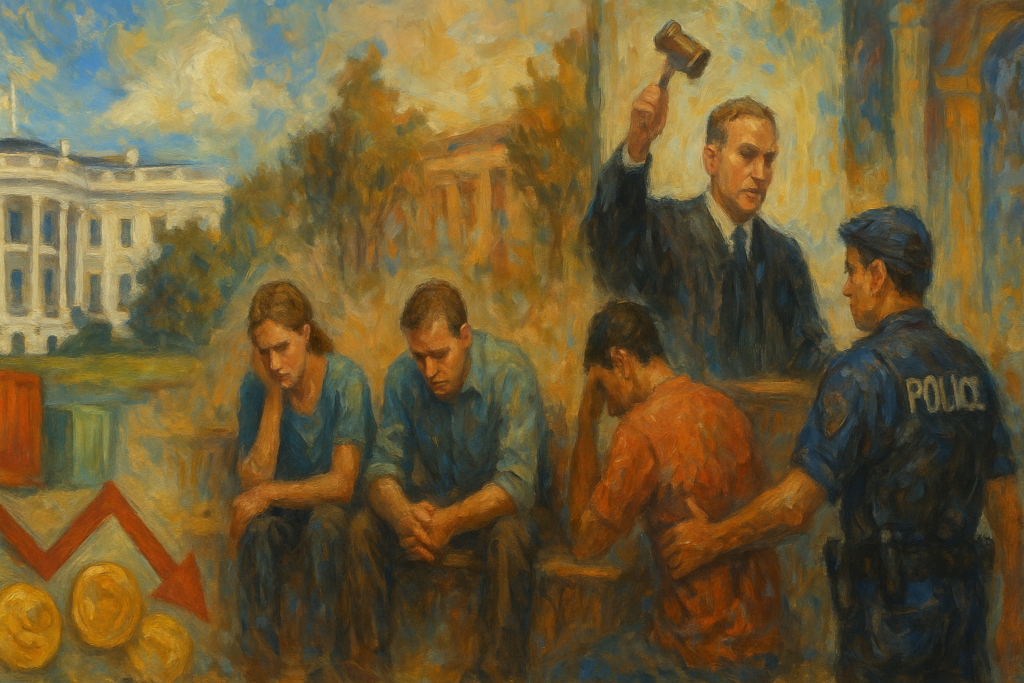
A single week in late March and early April saw the federal government pull hard on two levers at once: the economy and the state itself. Sweeping tariffs, imposed under emergency powers, rattled markets and reoriented trade policy around the president’s preferences. At the same time, deep cuts to health, science, and cultural institutions hollowed out parts of the civil service and redirected public money toward political and ideological goals. Around these moves, courts, state officials, and a handful of lawmakers tried to draw lines—over immigration, elections, and public records—but mostly found themselves reacting to a rapidly centralizing executive.
Over the weekend, the administration used federal funding as a direct instrument to reshape universities and cultural institutions. The White House canceled $400 million in research funding for Columbia University, explicitly tying the move to the school’s handling of pro-Palestinian protests and allegations of antisemitism. Columbia responded by tightening protest rules and accepting outside oversight of a key department, a rare concession that underscored how vulnerable even elite universities are when core research budgets are at stake. Native-serving Haskell Indian Nations University and other tribal institutions faced damaging budget cuts of their own, signaling that the pressure campaign extended beyond Ivy League campuses. In parallel, an executive order directed the Smithsonian to strip exhibits deemed “improper, divisive or anti-American,” with shows on race and African American history singled out. Together, these steps showed the administration using money and executive directives to narrow the range of acceptable narratives in higher education and public history.
Immigration and foreign aid policy also shifted sharply over the weekend. The administration moved to gut the Department of Homeland Security’s civil rights division even as the ACLU of Louisiana documented severe neglect in an ICE facility, weakening one of the few internal checks on abusive conditions. It announced the shutdown of USAID, folding its work into the State Department and concentrating foreign-assistance power more tightly under the president and his top diplomats. At the same time, migrants were deported to El Salvador under contested legal authority, including the use of the Alien Enemies Act, while a remote Louisiana court became the venue for aggressive efforts to deport Columbia activist Mahmoud Khalil. Yet courts still intervened at the margins: a federal judge blocked the deportation of Tufts student Rümeysa Öztürk absent a court order, illustrating that judicial review, though limited, could still slow individual removals.
Other education and representation fights surfaced as well. Following a Trump executive order, the U.S. Naval Academy ended affirmative action in admissions, eliminating a longstanding tool for maintaining a diverse officer corps. In Florida, New College fired Chinese language professor Kevin Wang under a “countries of concern” law, despite his asylum status and clean record, showing how nationality-based hiring bans were reshaping public universities. In Wisconsin, Attorney General Josh Kaul sued Elon Musk and his political action committee over a million-dollar voter giveaway program tied to a state supreme court race, arguing it violated bans on paying people to vote. An appeals court declined to grant emergency relief on procedural grounds, leaving the program in place. Musk’s more than $20 million in spending and high-profile checks underscored how a single billionaire could test the boundaries of election law in a judicial contest that would help decide future voting rules and maps.
Law enforcement priorities and clemency decisions also shifted over the weekend. The administration ended funding for multiple counter-terrorism research projects, and the FBI redirected resources away from far-right domestic terrorism toward gangs, border taskforces, and leftwing groups, even dedicating counter-terrorism resources to investigate vandalism of Tesla vehicles. Trump granted clemency to Ozy Media co-founder Carlos Watson, wiping away a fraud sentence and $96 million in penalties. The combination of defunding research on radicalization, reorienting enforcement away from the main documented domestic terror threat, and extending leniency to a well-connected media executive highlighted how public safety and equal justice were being reframed.
Economic policy began to tilt toward confrontation. Trump announced a 25 percent tariff on imported cars and parts, warned automakers not to raise prices in response, and threatened secondary tariffs on Russian oil tied to Ukraine talks. Cleveland-Cliffs responded by laying off more than 600 steelworkers in Minnesota, and the Dallas Federal Reserve reported rising uncertainty in the oil sector as tariffs raised equipment costs. These were early signs of a broader trade shock that would unfold midweek, previewing higher consumer prices, disrupted supply chains, and industrial job losses. At the same time, the administration escalated its conflict with the press: Trump sued CBS News for $10 billion over an edited interview, the FCC opened investigations into NBC, NPR, and PBS, and the White House barred AP reporters from the Oval Office while excluding Reuters and HuffPost from key events. Lawsuits, regulatory probes, and access bans together narrowed the space for independent scrutiny.
The weekend also brought a reminder of how federal power can override local self-rule. Congressional Republicans cut Washington, DC’s budget by $1 billion, threatening police, schools, and health services. Trump then signed an executive order to “increase crime-fighting,” ramp up immigration arrests, and speed concealed-carry permits in the capital, overriding local preferences in a heavily Democratic city. The moves used budget and policing powers to reshape governance in the nation’s capital, setting a precedent for targeting disfavored jurisdictions.
By Monday, the focus shifted to the machinery of government itself, especially in health and environmental policy. The administration announced plans to eliminate 1,155 scientists from the Environmental Protection Agency’s research office and terminated $14 billion in climate grants created under the previous administration, even as a judge temporarily blocked some cuts. Trump froze funding under the Inflation Reduction Act and halted approvals of wind and solar projects on federal lands and waters, effectively stalling a major climate and industrial policy without passing new legislation. These steps weakened environmental protection and climate response capacity at the very moment when extreme weather and pollution concerns were mounting.
At the same time, Trump signed an order creating the United States Investment Accelerator inside the Commerce Department to fast-track projects over $1 billion and oversee implementation of the CHIPS program. The new office centralized discretion over which mega-deals would move quickly, giving the White House more leverage over industrial policy. A separate order directed the Justice Department and the Federal Trade Commission to crack down on unfair practices in the live entertainment ticket market, including scalping and opaque fees. While framed as consumer protection, the combination of streamlined approvals for large projects and selective enforcement in concentrated markets raised questions about who would benefit from the new regulatory posture.
Domestic criminal justice policy also turned back toward punitive approaches. In Oregon, the state’s recriminalization of low-level drug possession, enacted in late 2024, translated into thousands of arrests and growing jail overcrowding. The shift reversed the earlier public-health approach under Measure 110 and strained public defenders and local jails, moving drug use back into the criminal justice system with predictable impacts on poor and addicted people. In Congress, internal Republican rifts over representation rules stalled the House. A rule vote defeat led by Representative Anna Paulina Luna halted House voting for the week, blocking parts of Trump’s agenda including the SAVE Act. The dispute centered on a bipartisan proposal to allow new parents to vote by proxy, which Republican leaders tried to block but a small group of Republicans joined Democrats to advance. The episode showed how conflicts over basic participation rules could paralyze the legislative branch.
Outside the House chamber, Senator Cory Booker used Senate procedure to mount a symbolic but pointed challenge. He delivered the longest speech in Senate history—over 25 hours—condemning Trump’s second-term agenda, from agency cuts and tariffs to efforts to bypass courts and abolish the Education Department. Framing the period as “not normal times,” he urged Congress and the public to resist what he described as grave threats to democracy. While the speech did not change votes, it marked one of the clearest uses of formal institutional tools to call out the administration’s direction.
Meanwhile, the Social Security Administration quietly tested how administrative changes could reshape access to benefits. SSA and Elon Musk’s Department of Government Efficiency (DOGE) first moved to close field offices in Kentucky and Oklahoma, then reversed course after protests, scrubbing closure notices from the web. An internal memo revealed plans to sharply limit phone service and require more in-person visits, which were scaled back after media coverage. At the same time, SSA prepared new ID and in-person verification rules expected to add up to 160,000 weekly visitors to field offices. Without any change in statute, these shifts would effectively ration benefits and services, especially for the poor, disabled, and noncitizens. In a separate sign of eroding respect for legal norms, some House Republicans posted “Wanted” posters of federal judges who ruled against Trump, drawing condemnation from colleagues, and Representative Victoria Spartz told constituents they were not entitled to due process when they raised rule concerns.
Tuesday brought the public health cuts into sharper focus. The Department of Health and Human Services began implementing plans to cut up to 10,000 jobs—nearly a quarter of its workforce—under Health Secretary Robert F. Kennedy Jr.’s restructuring, heavily influenced by Musk’s DOGE. The layoffs hit the Centers for Disease Control and Prevention, the National Institutes of Health, the Food and Drug Administration, and the Centers for Medicare and Medicaid Services. Entire divisions focused on mine safety, infertility, and smoking were eliminated, and thousands of Freedom of Information Act staff were among those let go. The result was a simultaneous weakening of the government’s ability to prevent and respond to disease and its capacity to answer public records requests, making it harder for the public to see what was happening inside the system.
Immigration enforcement collided with the courts on several fronts that day. A federal court issued a temporary restraining order halting deportations of Venezuelans labeled gang members based on tattoos and clothing, questioning the administration’s use of the Alien Enemies Act and the reliability of its criteria. Another judge temporarily blocked cuts to legal services for unaccompanied children. Court filings revealed that ICE had deported Maryland resident Kilmar Abrego Garcia, who had protected status, to El Salvador due to an “administrative error,” and the government initially claimed it could not bring him back. Later in the week, a judge in Oregon would order his return by a set deadline. Separately, a federal judge delayed the administration’s plan to end Temporary Protected Status for Venezuelans, calling it unprecedented and rooted in stereotypes. These rulings did not remake immigration policy, but they showed that courts could still slow or reverse some of the harshest moves, often only after significant harm had occurred.
Voting rules became another arena for executive power. The House prepared to vote on the Republican-backed SAVE Act, which would impose stringent ID requirements to prevent noncitizen voting and criminalize officials who mistakenly register them, despite scant evidence of such fraud. In parallel, Trump issued an executive order adding proof-of-citizenship requirements for voter registration and requiring mail ballots to arrive by Election Day. Election watchdogs and Democratic attorneys general quickly challenged the order, arguing that it usurped states’ authority over elections and would disenfranchise eligible voters, especially naturalized citizens and others with complex paperwork. The moves layered new documentation rules on top of existing safeguards, entrenching a narrative of widespread noncitizen voting and shifting the burden of proof onto voters.
Musk’s influence threaded through these developments. As his 130-day cap on formal government service approached, reports detailed how DOGE had already driven the 10,000 HHS layoffs and plans to eliminate agencies like USAID and Voice of America. An executive order ensured DOGE would continue operating until 2026 under leaders Musk installed, even after he stepped down. His role in the Wisconsin voter giveaway case and his imprint on the federal workforce illustrated how a private billionaire could shape both campaign finance and the structure of the civil service. At the border, Homeland Security Secretary Kristi Noem filmed a video inside a Salvadoran prison holding deported Venezuelans, warning would-be migrants about the consequences of illegal entry. Reports also showed U.S. border officers searching travelers’ devices and denying entry based on messages critical of Trump, prompting the ACLU to advise travelers to minimize data on their phones. Using incarcerated migrants as a backdrop and policing political speech at the border turned enforcement into propaganda and chilled dissent.
On Wednesday, the economic story that had been building since the weekend broke fully into view. Trump declared a national emergency under the International Emergency Economic Powers Act to impose a 10 percent blanket tariff on all imports and higher “reciprocal” tariffs on many countries, with special duties on low-value imports from China and Hong Kong tied to synthetic opioids. Markets plunged: the Dow fell nearly 1,700 points and the NASDAQ almost 6 percent. Analysts warned of recession risks, and allies bristled at the unilateral move. Russia and many fossil fuel products were notably exempted from the new tariffs, foreshadowing the carve-outs that would be detailed the next day. Using emergency powers to rewrite trade terms shifted decisions that function like taxes from Congress to the presidency, with immediate consequences for prices, jobs, and global alliances.
Congress registered some unease but stopped short of reclaiming full authority. The Senate passed a bipartisan resolution to block Trump’s tariffs on Canadian products, with four Republicans joining Democrats, and senior senators introduced the Trade Review Act to require congressional approval for future tariffs. Yet Congress did not revoke the underlying emergency authorities that enabled the tariff package, leaving most of the new regime intact. The result was a symbolic pushback that signaled discomfort with executive overreach on trade, but also broad tolerance for a president-led tariff system.
Transparency and the rule of law came under strain in national security and justice. Reporting revealed that National Security Adviser Mike Waltz’s team ran at least 20 Signal group chats to coordinate sensitive national security work, and that Trump National Security Council officials used personal Gmail accounts for government business. While the White House insisted Signal was approved on government devices, routing decisions through encrypted apps and private email raised questions about compliance with presidential records laws and operational security. In a separate case, a coalition of labor unions won an injunction blocking DOGE staff at the Office of Personnel Management from accessing databases with sensitive personal information on millions of federal employees, limiting how far Musk’s efficiency project could reach into worker data. And in New York, a federal judge dismissed the Justice Department’s corruption case against Mayor Eric Adams with prejudice after pressure from the Trump administration, which argued the case distracted Adams from helping with immigration enforcement. The judge criticized the administration’s push as resembling a bargain over policy, and the dismissal prompted high-level DOJ resignations, raising doubts about prosecutorial independence.
Thursday deepened the tariff shock and clarified who would bear the costs. A new 10 percent universal tariff package notably exempted many fossil fuel products, including Canadian crude and liquefied natural gas, following large industry donations to Trump’s campaign. Analysts described the tariffs as the largest peacetime tax hike in modern history, yet designed to spare oil and gas interests while raising costs on a wide range of consumer goods. Treasury Secretary Bessent defended the policy, arguing that “access to cheap goods is not the essence of the American dream,” and conservative economist Oren Cass praised the tariffs as a chance to reindustrialize, suggesting only minor tweaks. Markets continued to fall on fears of recession. After critics noted that claimed foreign tariff rates were inflated or fabricated, the administration released a formula it said underpinned its numbers, but the formula itself underscored how economic data had been massaged to justify sweeping new duties.
National security leadership was reshaped around loyalty tests. Trump fired six National Security Council officials and then removed General Timothy Haugh as head of U.S. Cyber Command and director of the National Security Agency, reportedly after meeting with far-right activist Laura Loomer. The firings were framed as responses to perceived disloyalty. In the health sphere, investigative reporting revealed that the NIH had continued to block grants despite two federal injunctions; agency leadership then issued a memo ordering staff to resume funding. The judge’s earlier injunction blocking DOGE’s access to OPM personnel databases remained in force. These course corrections showed that litigation and public scrutiny could still force compliance with court orders and protect sensitive data, even as broader institutional norms eroded.
By Friday, the week’s themes converged around elections, public services, and emergency response. A coalition of 19 Democratic attorneys general filed suit in federal court in Massachusetts challenging Trump’s executive order that imposed proof-of-citizenship requirements for voter registration and mandated that all mail ballots be received by Election Day. They argued that the order was unconstitutional, usurped states’ authority over elections, and would disenfranchise eligible voters. The lawsuit became a major test of whether the president could unilaterally rewrite core election rules that traditionally belong to states and Congress. In Florida, a small business—stationery company Simplified and its founder Emily Ley—filed a federal lawsuit challenging new 20 percent tariffs on Chinese imports, arguing that Trump had improperly used emergency powers instead of established trade procedures and that the tariffs were economically unjustified. The case highlighted the strain on small firms forced to raise prices or cut staff and could clarify how far a president can go in reshaping trade without congressional findings.
State courts showed how judicial decisions could both threaten and protect rights. In North Carolina, the Court of Appeals, in a 2–1 decision, sided with Republican Jefferson Griffin in a challenge to his loss in a state supreme court election, ordering that more than 65,000 ballots lacking certain ID details be subject to potential disqualification. The ruling could overturn Democrat Allison Riggs’s 734-vote win and was expected to go to the state supreme court, where Riggs would be recused. Retroactively discarding tens of thousands of ballots threatened the principle that voters, not courts, decide elections and could entrench partisan control over judicial selection. In Georgia, by contrast, Tift County District Attorney Patrick Warren dropped charges against Selena Maria Chandler-Scott, who had been arrested and charged after a miscarriage. Prosecutors concluded the fetus was non-viable and not legally considered born alive under Georgia law. The decision illustrated how pregnancy outcomes could be criminalized in the post-Roe landscape, and how prosecutorial discretion could either escalate or de-escalate such threats to women’s autonomy.
The administration’s campaign to shape education and culture continued. In two closely related rulings, the U.S. Supreme Court, in 5–4 decisions, allowed the Trump administration to freeze $65 million in teacher-training grants aimed at diversity, equity, and inclusion, and granted a stay in Department of Education v. California, letting terminations of TQP and SEED grants proceed pending appeal. The decisions reversed a lower court order restoring the funds and signaled judicial deference to executive cuts in education. The administration also announced cuts to federal grants for arts and humanities, affecting museums, archives, and educational projects nationwide, following earlier moves against the Institute for Museum and Library Services and the Smithsonian. Combined with university funding reviews and the weekend’s Smithsonian order, these cuts formed a coherent campaign to centralize control over which histories and cultural narratives receive public support.
Federal benefits and emergency-response capacity were further drawn into political conflict. Acting SSA Commissioner Leland Dudek canceled contracts that allowed Maine parents to apply for newborns’ Social Security numbers in hospitals, and the administration froze federal funds for Maine educational programs after Governor Janet Mills said the state would follow state and federal law rather than Trump’s demands. The moves were widely seen as retaliation, using core federal services as leverage against a state government and directly harming residents who rely on those services. FEMA announced a hiring freeze despite ongoing deadly severe weather, and the administration confirmed cuts to CDC jobs and programs amid rising measles cases and infant deaths from whooping cough. Coming on the heels of HHS layoffs and EPA cuts, these decisions weakened disaster and disease-response agencies during active crises, increasing the likelihood that foreseeable emergencies would cause avoidable harm.
Across the week, the pattern was consistent: emergency statutes, budget powers, and administrative discretion were used to concentrate authority in the executive branch and to reward or punish institutions based on their alignment with the president’s agenda. Tariffs, framed as a path to reindustrialization, were imposed through emergency powers with carve-outs for key donors. Public health, environmental science, and cultural institutions were cut back or redirected, while immigration enforcement and election rules were sharpened into tools of political control. Resistance came from state attorneys general, unions, judges, some Republican senators, and public protests, but these actors mostly operated in response to decisions already made. For democratic life, the week underscored how much of the constitutional order depends not only on formal checks and balances, but on the willingness of those in power to respect institutional boundaries, protect independent expertise, and keep the rules of voting and representation open to all.