This week’s throughlines
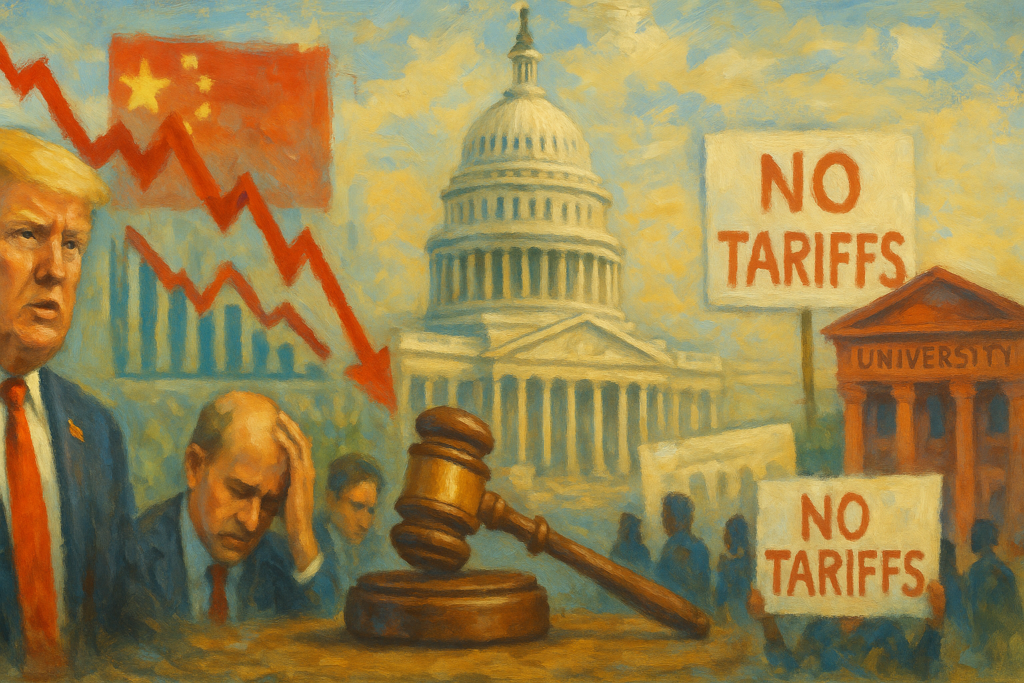
- Tariff policy drove both economic turmoil and a separation-of-powers fight — Trump’s tariff announcements, threats, reversals, and China escalation whipsawed markets and triggered bipartisan congressional resistance, lawsuits, and renewed arguments that Congress had ceded too much trade power to the presidency.
- Immigration enforcement broadened from deportation to surveillance, data use, and campus speech — The administration combined deportation cases, visa revocations, student targeting, tax-data sharing, social-media monitoring, detention expansion, and pressure to self-deport into a wider enforcement campaign that reached schools, universities, and people with temporary or protected status.
- Federal pressure campaigns spread across universities, law firms, and states — The administration used grants, access, investigations, executive orders, and threatened consent decrees to force compliance from universities, punish law firms, and target state policies, while some courts temporarily checked those moves.
- Courts remained central, but remedies were narrowed, delayed, or openly resisted — Judges repeatedly intervened on deportations, press access, agency firings, and funding disputes, yet the Supreme Court narrowed some paths for relief and the administration resisted or delayed compliance in key cases, especially Abrego Garcia’s.
The week opened with an economic jolt and closed with institutions still struggling to absorb it. A sweeping tariff campaign, launched with little warning, shook global markets and underscored how much trade power has migrated to the presidency. Around that central shock, the administration pressed its advantage on other fronts: immigration enforcement widened and became more data‑driven, universities and civil society groups faced funding threats tied to ideology, and climate and scientific capacity were pared back. Courts and parts of Congress tried to draw lines, but often found themselves reacting to faits accomplis rather than shaping events.
Over the weekend, the White House staged what it called “Liberation Day,” announcing unexpectedly high tariffs on a broad range of imports. Framed as a unilateral correction to trade imbalances, the move immediately wiped trillions from U.S. markets as major indices plunged and banks raised the odds of recession. The Federal Reserve warned that the tariffs would likely fuel inflation and cost jobs, while trading partners prepared retaliatory measures. China, the European Union, and others signaled they would respond in kind, setting the stage for a trade war driven less by negotiated policy than by emergency declarations from the Oval Office.
At the same time, the administration used federal funding as leverage over higher education. Columbia University became the most visible target when the government threatened, then briefly withdrew, roughly $400 million in federal support. Officials tied the money to demands that Columbia crack down on pro‑Palestinian protests and alter its security and governance structures. Similar reviews and threats spread to other elite campuses, making clear that access to research grants and contracts would depend on aligning protest and diversity policies with White House preferences. The message to universities was that academic independence and campus speech now carried direct fiscal risk.
Immigration tools were quickly folded into this pressure campaign. Over the weekend, ICE and DHS agents arrested graduate students involved in pro‑Palestinian protests and moved to deport Columbia activist Mahmoud Khalil under a foreign‑policy provision, treating political activity as a national‑security concern. Venezuelan holders of Temporary Protected Status were detained despite statutory safeguards, and DHS began revoking visas for hundreds of students labeled foreign‑policy threats. A British tourist was held for 19 days in ICE custody while trying to leave the country, illustrating how tenuous status could become once caught in the enforcement net. These cases showed how immigration law, traditionally focused on border control and criminality, was being repurposed to police dissent and association in academic spaces.
The courts, meanwhile, were drawn into a running confrontation over wrongful deportations. A federal judge ordered the government to return Kilmar Abrego Garcia, a lawful permanent resident who had been unlawfully removed to El Salvador, underscoring that his deportation violated existing law and that the executive branch had overstepped. Instead of simply complying, the Justice Department suspended the immigration lawyer who admitted the mistake, and the White House publicly attacked the presiding judge, Paula Xinis, as a “Marxist judge.” The Abrego Garcia case became a human measure of the broader struggle: judicial orders insisting on due process on one side, and an executive willing to punish both lawyers and judges on the other.
Beyond immigration and trade, the weekend also revealed how deeply Elon Musk’s Department of Government Efficiency had penetrated the federal bureaucracy. Reporting described how the department helped hollow out agencies like USAID, installed allies in key posts, and steered contracts toward Musk‑linked companies. Inside the Social Security Administration, staff warned that personnel cuts were pushing the agency into a “death spiral,” threatening basic service for beneficiaries. Yet public resistance was visible too. Tens of thousands joined “Hands Off” protests in Washington and millions more participated nationwide, denouncing agency cuts and what they saw as constitutional erosion. In Wisconsin, a Musk‑backed conservative candidate lost a state supreme court race despite heavy spending, suggesting that elite influence could still be checked at the ballot box.
By Monday, institutional responses to the tariff shock began to take shape. Bipartisan senators introduced legislation that would require congressional approval for new tariffs within 60 days, and a separate amendment sought to roll back 25 percent duties on Canadian imports. A libertarian group funded by conservative donors filed suit arguing that Trump’s use of the International Emergency Economic Powers Act (IEEPA) to impose tariffs on China was unconstitutional, contending that a law designed for national‑security emergencies was being stretched into a standing economic tool. At the same time, House and Senate hearings advanced efforts to curb nationwide injunctions, which have been one of the few mechanisms courts use to halt sweeping executive policies. Even as some conservatives urged Congress to reclaim its trade authority, other moves in the legislature aimed to limit judicial capacity to check the president.
The Supreme Court weighed in on immigration with a 5–4 decision that narrowed collective challenges to deportations under the 1798 Alien Enemies Act. The Court vacated a class‑wide injunction protecting Venezuelans, allowing deportations to proceed so long as detainees received notice and an opportunity to file individual habeas petitions in Texas. On paper, the ruling preserved a form of due process; in practice, it fragmented legal resistance by forcing migrants to pursue relief one by one in a distant venue. The decision revived an 18th‑century wartime statute for modern deportations and shifted leverage toward the executive, even as it insisted on minimal procedural safeguards.
Monday also saw the administration move to reshape public memory and diversity narratives across federal institutions. A new executive order directed the Smithsonian and other cultural bodies to remove content deemed “improper” or “anti‑American.” The National Park Service quietly stripped Harriet Tubman material from an Underground Railroad page, reframing the story away from slavery, while the Pentagon launched a “digital content refresh” that deleted references to racism, ethnicity, and LGBTQ topics from its public platforms. These changes did not alter laws directly, but they narrowed what the public can learn from official sources about past injustice and present inequality, with long‑term implications for civic understanding.
On the immigration front, enforcement widened again. ICE arrested Nicaraguan asylum seeker Alberto Lovo Rojas despite his regular check‑ins, and the administration broadened ICE’s mandate to prioritize arrest of all undocumented immigrants, including those previously considered low‑risk. DHS revoked the legal status of more than 900,000 migrants who had entered through the CBP One app, ordering them to leave immediately. For people who had followed government‑sanctioned pathways and complied with supervision, the reversals signaled that cooperation offered no protection. Trust in the system—already strained by cases like Abrego Garcia’s—eroded further.
Tuesday brought a new cluster of executive orders on energy and climate. Trump moved to “reinvigorate” coal by reclassifying it as a mineral, lifting leasing limits on federal lands, and directing agencies to remove regulatory barriers and promote coal‑fired power for AI data centers. Another order instructed the Justice Department to challenge state climate “superfund” laws in New York and Vermont, which seek to recover climate‑related damages from fossil‑fuel companies. These steps centralized energy policy in the executive branch, weakened state‑level climate initiatives, and locked in support for high‑carbon fuels at a time when scientific assessments—soon to be curtailed—warn of accelerating climate risk.
In a separate but related move toward data‑driven governance, the IRS signed a memorandum of understanding with DHS allowing ICE to request taxpayer information on undocumented immigrants with final removal orders. Treasury and DHS leadership backed the deal, but it sparked immediate controversy over privacy and legality. Within a day, the acting IRS commissioner resigned, and reporting revealed a broader agreement to share sensitive taxpayer data for deportation and investigations. Turning confidential tax records into an immigration tool threatened the voluntary compliance that underpins the tax system and gave enforcement agencies a powerful new surveillance resource.
The administration also signaled a retreat from systemic oversight in emerging financial markets. The Justice Department disbanded its National Cryptocurrency Enforcement Team and announced it would no longer pursue litigation that effectively imposed regulatory frameworks on digital assets. Aligned with a Trump order to protect blockchain networks, the shift refocused DOJ on individual criminal use of crypto rather than on exchanges and platforms. In a sector prone to complex frauds and rapid innovation, the change left more of the field to industry self‑policing.
Tariff escalation continued on Tuesday as well. From the Oval Office, Trump threatened an additional 50 percent tariff on China unless it rolled back its own increases, then signed an order raising effective tariffs on Chinese imports to 84 percent and adjusting duties on low‑value shipments. Each new order deepened the sense that trade deficits were being treated as a national emergency justifying unilateral action, rather than as a subject for negotiated policy. At the same time, Trump and Defense Secretary Pete Hegseth proposed a $1 trillion defense budget and launched reviews to speed Pentagon procurement and foreign arms sales, even as domestic agencies faced cuts. The imbalance underscored a broader shift of federal resources toward the security state and away from civilian services.
In North Carolina, the state’s highest court stepped into a contested state supreme court race. It temporarily stayed an appeals‑court order that would have required verification of 60,000 ballots, after Democratic candidate Allison Riggs argued the ruling violated due process and the Purcell principle against changing election rules close to voting. The underlying order would have forced targeted voters to prove their identity within 15 business days or see their ballots discarded. The stay was temporary, but it highlighted how judicial decisions about post‑election verification can determine whose votes count in close races.
By Wednesday, the tariff conflict with China had hardened into a full‑blown trade war. A new executive order modified reciprocal tariff rates, raising effective duties on Chinese imports to around 145 percent when combined with a fentanyl‑linked surcharge, while temporarily standardizing a 10 percent duty for some aligned partners. Markets fell again as investors absorbed the permanence of triple‑digit rates between the world’s two largest economies. China responded by lifting its own tariffs on U.S. goods to 125 percent and signaling that many American exports were no longer competitive. Supply chains, consumer prices, and geopolitical stability all came under strain.
Facing steep losses and bond‑market unrest, the White House tried to manage the fallout with an abrupt partial retreat. Trump announced a 90‑day pause on steep hikes for most countries while keeping very high tariffs on China. Markets briefly rallied on rumors of a broader pause, then fell again when details showed that the core conflict remained. Lawmakers raised concerns about possible insider trading around the timing of the announcement, underscoring how personalized, opaque decision‑making on tariffs can create opportunities for abuse even as it destabilizes the broader economy.
The executive branch also escalated its campaign against perceived legal and bureaucratic opponents. New memoranda directed the Justice Department to investigate former officials Miles Taylor and Chris Krebs, strip their security clearances, and pursue allegations of disloyalty. Separate orders targeted the law firm Susman Godfrey, which had helped secure Dominion Voting Systems’ settlement with Fox News, by revoking access to government buildings and clearances and labeling the firm a national‑security risk. These moves built on earlier efforts to punish firms like Perkins Coie and Jenner & Block for representing Trump’s rivals, and they signaled that legal representation itself could become grounds for executive retaliation.
The Supreme Court, for its part, granted an administrative stay blocking lower‑court orders that had required the rehiring of roughly 16,000 probationary federal employees fired under Trump. The justices focused on plaintiffs’ standing rather than the merits, but the effect was to leave large‑scale civil service purges in place while litigation continued. A related decision cleared the way for NOAA to proceed with terminating climate and weather researchers. Combined with the administration’s termination of funding for the next National Climate Assessment and cuts to grant‑making staff in “woke” fields, the rulings contributed to a cumulative weakening of federal scientific capacity.
Wednesday also brought new revelations about the expansion of immigration surveillance. Acting ICE director Todd Lyons announced collaboration with Musk’s Department of Government Efficiency to access Social Security numbers for voter‑fraud checks, while DHS said USCIS would begin monitoring visa holders’ social media for “antisemitism.” These initiatives built on the IRS–DHS data‑sharing pact and existing Palantir‑based databases, extending the reach of enforcement into financial records and online speech. For migrants and visa holders, the line between lawful presence and ideological scrutiny grew thinner.
On Thursday, the House narrowly approved a Republican budget framework projected to add trillions to the national debt while enabling Trump’s tax and immigration agenda through reconciliation. It also passed the Safeguard American Voter Eligibility (SAVE) Act, which would require documentary proof of citizenship to register for federal elections and allow lawsuits against officials who fail to enforce the requirement. Supporters framed the bill as a guard against non‑citizen voting; critics warned it would disenfranchise millions of eligible voters, especially young, poor, and minority citizens who lack ready access to documents. Together, the budget and voting‑rule changes illustrated how narrow partisan majorities can lock in long‑term shifts in who benefits from government and who can easily participate in elections.
The administration’s use of funding as a disciplinary tool widened beyond campuses. Reports detailed investigations into progressive and climate‑focused nonprofits, threats to their tax‑exempt status, and cuts to federal funding for advocacy groups seen as opposing the president’s agenda. In higher education, the government canceled or paused hundreds of millions in grants and loans to Columbia, Harvard, Princeton, and the University of Pennsylvania over allegations of antisemitism and objections to transgender inclusion, extending the earlier campaign against Columbia. The pattern was consistent: organizations that hosted or tolerated dissenting views risked financial punishment.
Courts again played a dual role in immigration. A federal judge halted the administration’s attempt to terminate a humanitarian parole program covering more than 500,000 Cubans, Haitians, Nicaraguans, and Venezuelans, preserving their temporary status for now. In the Abrego Garcia case, the Supreme Court unanimously ordered the government to facilitate his return from El Salvador, reinforcing lower‑court findings that his removal was unlawful. These rulings showed that, even as the Court narrowed collective remedies under the Alien Enemies Act, it could still act as a backstop for large groups of migrants and for individuals harmed by clear legal violations. Yet the need for repeated orders in Abrego Garcia’s case underscored how fragile judicial authority can be when the executive resists.
At the same time, the administration adopted new tactics to pressure immigrants to leave without formal proceedings. It began canceling Social Security numbers for people with temporary legal status, cutting off their ability to work or access benefits and effectively forcing many to self‑deport. A separate memorandum directed the Defense, Interior, Agriculture, and Homeland Security departments to create a military buffer zone along the southern border, authorizing active‑duty soldiers to detain migrants until ICE arrived and allowing the military to take over public lands for these operations. The moves blurred the line between civilian law enforcement and military roles and shifted immigration control further into a security framework.
Friday capped the week with further politicization of law, religion, and information systems. After days of pressure on law firms, Trump announced that five major firms, including Kirkland & Ellis and Latham & Watkins, had agreed to provide $600 million in pro bono work for Trump‑aligned causes and to drop race‑conscious hiring practices. In exchange, the Equal Employment Opportunity Commission withdrew an inquiry into their diversity programs and the firms avoided harsher executive measures. The episode showed how the threat of executive orders and access restrictions could reshape private legal advocacy and hiring, with implications for which clients receive robust representation.
The administration’s faith agenda also moved outward through the State Department. An internal cable from Secretary of State Marco Rubio instructed staff worldwide to catalogue instances of “anti‑Christian bias” that occurred during the Biden administration, as part of an initiative to end what Trump called the “anti‑Christian weaponization of government.” Coming after the creation of a White House faith office and a Task Force to Eradicate Anti‑Christian Bias, the directive risked turning diplomatic machinery into a vehicle for domestic culture‑war narratives and raised questions about how foreign policy resources would be allocated.
On immigration, the week’s earlier data‑sharing moves culminated in a clearer picture of a rapidly expanding deportation infrastructure. New reporting showed ICE using Palantir‑built databases to filter immigrants by physical traits and financial data, while DOGE staff worked with immigration officials to broaden access to government databases. The administration announced plans to spend up to $45 billion on new, privately run detention facilities with lower oversight standards, and Avelo Airlines confirmed contracts to operate deportation flights from Arizona. Combined with the IRS–DHS pact and social‑media monitoring, these developments pointed toward a system in which large‑scale removals could be driven by opaque algorithms and private contractors, with limited avenues for oversight or redress.
Errors and overreach within that system were evident by week’s end. The government mistakenly sent deportation notices to U.S. citizens and green‑card holders; DHS used a British man’s tattoo photo as supposed evidence of Venezuelan gang affiliation; an Australian worker with a valid visa was detained and banned for five years; and a Tufts student reported medical neglect and religious violations in ICE custody. These incidents echoed the Abrego Garcia saga on a smaller scale, illustrating how an enforcement apparatus built for speed and volume can put even lawful residents and citizens at risk when safeguards falter.
The week also saw further erosion of scientific and educational infrastructure. Mississippi’s Library Commission ordered the deletion of race relations and gender studies databases from the statewide Magnolia system used by schools, libraries, and universities, citing new anti‑DEI laws and budget pressures. At the federal level, the administration implemented deep cuts to workforces that administer scientific grants, especially in areas labeled “woke” such as AIDS, transgender issues, and climate change. Combined with NOAA firings and the termination of funding for the National Climate Assessment, these cuts weakened the country’s ability to generate and apply scientific knowledge across multiple fields.
Finally, the North Carolina Supreme Court returned to the contested state supreme court race it had paused earlier in the week. In a new order, it required thousands of overseas and military voters to re‑prove their eligibility within 30 days or have their ballots discarded, in an election where Allison Riggs led by just 734 votes. The decision built on earlier lower‑court rulings and underscored how retroactive documentation demands aimed at narrow groups of voters—many serving abroad—can effectively decide outcomes. In Washington, the Senate confirmed retired Air Force Lt. Gen. John Dan Caine as chairman of the Joint Chiefs of Staff under a presidential waiver of usual qualifications, further illustrating how formal standards in key institutions could be bent to executive preference.
Taken together, the week’s events traced a pattern of concentrated executive power meeting uneven resistance. Emergency authorities like IEEPA were stretched to cover standing trade policy, while immigration statutes from the 18th century were revived for modern mass deportations. Courts sometimes constrained these moves, as in the Abrego Garcia orders and the parole‑program injunction, but they also enabled them by narrowing collective remedies and allowing purges to stand during litigation. Congress oscillated between asserting its prerogatives and shielding the president from accountability, and private actors—from universities and nonprofits to law firms and corporations—often adjusted their behavior under threat. In this landscape, the health of democratic governance depended less on any single decision than on whether institutions could still enforce limits on power, protect vulnerable populations, and preserve the information and scientific capacities that make self‑government possible.