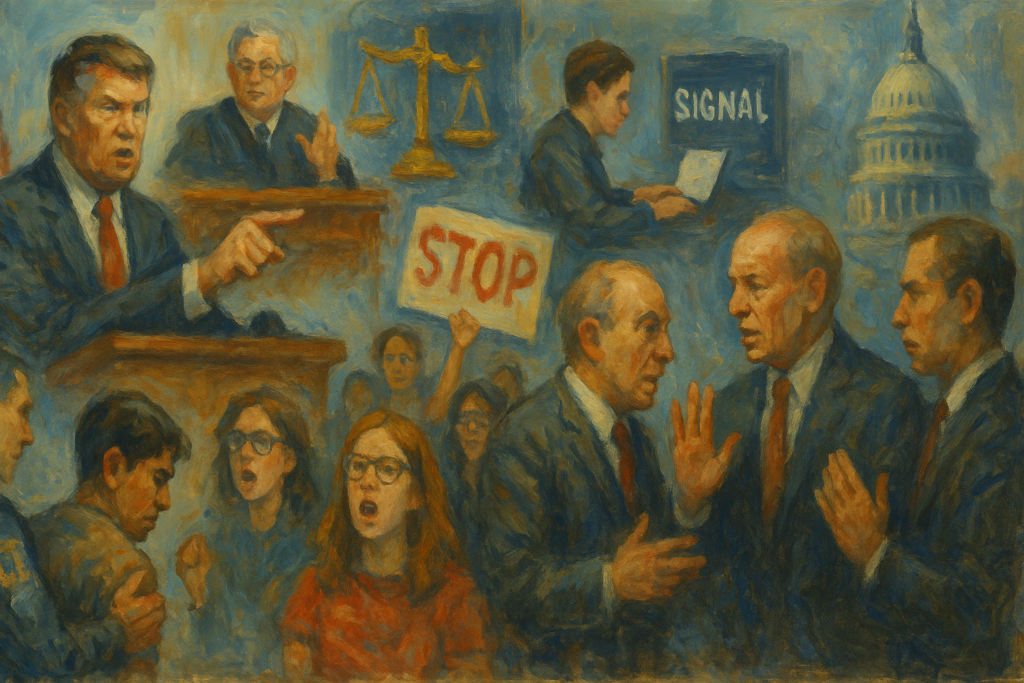
This week’s throughlines
- Retaliation against the legal system widened through the week — What began with pressure on Paul Weiss and a directive to review lawyers involved in litigation against the government expanded into a broader campaign of executive orders, threats, and lawsuits involving multiple major firms.
- The Signal leak turned from embarrassment into an accountability fight — After reports that senior officials used Signal to discuss Yemen strike plans, the story moved into congressional hearings, public denials, lawsuits over records preservation, and a court order to preserve the messages.
- Immigration enforcement kept colliding with courts and campuses — The administration pressed ahead with deportation fights under the Alien Enemies Act, expanded surveillance and screening tools, and targeted students and scholars tied to pro-Palestinian activism, prompting repeated court intervention.
- Executive power was used to reshape civic institutions beyond immediate policy fights — The week also brought moves to dismantle the Education Department, strip bargaining rights from federal workers, pressure universities through funding, and rewrite how federal institutions present American history.
The week opened with three conflicts already in motion and soon colliding: the White House’s use of executive power against legal opponents, a widening immigration crackdown repeatedly checked by judges, and a national security scandal that would grow into a fight over records and truthfulness. As the days passed, those pressures spread into universities, federal labor, election administration, public history, and the civil service. Again and again, courts were not peripheral observers but central actors, issuing restraining orders, preserving records, and forcing the administration to answer for actions it had tried to move quickly past.
Over the weekend, President Trump sharpened his campaign against the legal world itself. He issued and then withdrew an order aimed at Paul, Weiss after the firm made concessions, while also directing the attorney general to identify lawsuits he considered partisan and recommend punishment for the firms behind them. The message reached beyond any one firm: lawyers and firms associated with investigations, political rivals, or legal challenges to the administration could face direct presidential retaliation. In a system that depends on lawyers being able to represent unpopular clients and sue the government without fear of reprisal, that was a significant escalation.
At the same time, the courts moved to slow one of the administration’s most coercive immigration initiatives. Judge James Boasberg temporarily blocked further deportation flights to El Salvador under the Alien Enemies Act, while the administration faced scrutiny over whether it had carried out removals despite court orders. The dispute was not only about the migrants already sent out of the country, many of them Venezuelans, but about whether the executive branch could act first and leave courts to sort out legality afterward. Confusion deepened when Trump denied signing the proclamation behind the policy, muddying responsibility for a major use of state power even as litigation intensified.
Other weekend immigration developments showed enforcement pushing deeper into the ordinary systems people use to comply with the law. The White House halted funding for legal aid for unaccompanied migrant children. Reports indicated that the IRS was moving toward sharing migrant tax data with ICE, threatening to turn tax compliance into an enforcement tool. ICE also detained Cuban immigrants during scheduled appointments, making routine check-ins newly risky. Together, those moves suggested an administration trying not just to deport more people, but to make legal and administrative channels themselves less trustworthy.
By Sunday, pressure on the judiciary was becoming visible as well. House Republicans introduced resolutions to impeach judges who had ruled against the administration, and Chief Justice John Roberts issued a rare public rebuke, saying impeachment is not the proper response to disagreement with judicial decisions. That warning came as the ACLU filed an affidavit alleging that officials had ignored or misrepresented a court order in the El Salvador deportation case. The combination mattered: judges were being threatened politically at the same moment they were being asked to determine whether the executive had obeyed them.
The weekend also brought quieter but telling signs of pressure on public information. Government websites and school materials were scrubbed or restricted; reports described lists of disfavored words, the removal of references to LGBTQ+ figures and Black veterans from official pages, and military history pages taken down and later restored after backlash. A federal judge also blocked the Social Security Administration from sharing personally identifiable information with DOGE, prompting an aggressive reaction from the acting commissioner, who threatened a shutdown. Even before the week’s larger scandals fully broke, the administration was already testing how much control it could exert over records, archives, and sensitive databases.
On Monday, the campaign against major law firms widened. Trump expanded his use of executive orders against firms including Covington & Burling and Perkins Coie, restricting access to federal buildings and government work based on past clients and investigations. A judge blocked parts of the Perkins Coie order, showing that courts were willing to intervene, but the earlier Paul, Weiss episode remained a warning about the costs of resistance. The issue was larger than elite firms: if the government can punish lawyers for whom they represent, the adversarial legal system itself begins to bend.
Monday also brought a direct attempt to reshape the federal government by executive order. Trump directed Education Secretary Linda McMahon to begin dismantling the Department of Education, even though Congress created and funds the department. The order followed staffing cuts and immediately raised questions about student aid, civil-rights enforcement, and whether the White House was trying to hollow out a cabinet agency without legislation. It was one of several moments this week when the administration acted as though statutory structure could be overcome by presidential instruction alone.
Universities became another front. Columbia student Yunseo Chung sued over an attempted deportation tied to her participation in pro-Palestinian protests, and a judge granted a temporary restraining order. The case quickly became a national test of whether immigration enforcement was being used to punish campus speech. Trump, speaking at the Justice Department, also intensified his attacks on the press, calling CNN and MSNBC illegal and corrupt. Meanwhile, pressure on information institutions widened as defunding of the U.S. Agency for Global Media threatened Voice of America and related outlets, and court filings sought to preserve DOGE records amid rapid changes across agencies. In a separate but related register, Trump’s personal financial interests and regulatory power collided in public view after Coinbase listed the $TRUMP meme coin, the SEC dropped its lawsuit against the platform, and Trump promoted the coin himself.
Tuesday was one of the week’s heaviest days. Trump signed a sweeping executive order on elections requiring documentary proof of citizenship for federal voter registration, pushing states toward stricter ballot deadlines and threatening funding consequences for noncompliance. Critics immediately argued that the order intruded on powers reserved to states and Congress and risked disenfranchising eligible voters who lacked the required documents. Election administration is often technical, but this order went to the heart of who gets to set the rules of participation in federal elections.
That same day, the Signal leak burst into full public view. Reports showed that senior officials had used a Signal group chat to discuss Yemen strike plans and had accidentally included a journalist. Democrats demanded investigations, and the Senate Intelligence Committee questioned intelligence leaders as the administration insisted that no classified information had been shared. The scandal was serious on two levels at once: first as a matter of operational security, and second as a test of whether senior officials would answer candidly to Congress and preserve the records needed to reconstruct what happened.
Tuesday also showed how the week’s pressure on education and immigration was spreading beyond Washington. In Texas, the state Senate advanced bills that would criminalize educators for assigning certain books, inject religious practices into schools, restrict DEI and gender-identity teaching, and reshape library and curriculum rules. On the immigration side, a judge blocked Yunseo Chung’s detention, and academic groups sued to stop deportations of foreign students and scholars targeted for pro-Palestinian views. In the El Salvador deportation litigation, the administration invoked the state-secrets privilege in the J.G.G. case, signaling an effort to keep key facts about removals and compliance with court orders out of judicial view.
By Wednesday, the Signal affair had shifted from revelation to confrontation. At a House hearing, intelligence chiefs denied that classified information had been discussed on Signal, even as new reporting and released messages suggested the chat contained sensitive operational detail. Michael Waltz took responsibility for creating the chat, and more of the exchange was published. The central question was no longer only why such a conversation had happened on a commercial app, but whether officials were now misleading Congress and trying to evade federal recordkeeping obligations after the fact.
Courts pushed back elsewhere too. Judge Beryl Howell granted Perkins Coie a temporary restraining order against Trump’s order targeting the firm, a concrete judicial check on the administration’s retaliation campaign. On the same day, Speaker Mike Johnson suggested Congress could defund, restructure, or even eliminate federal courts. That remark extended the week’s pattern of political threats against the judiciary: adverse rulings were being met not simply with appeals, but with talk of institutional punishment. The courts were still functioning as a brake, but the cost of doing so was being raised in public.
Wednesday also brought the campus immigration crackdown into sharper focus. Reporting showed ICE had targeted multiple students and academics of color over pro-Palestinian protest activity, while courts continued to protect Yunseo Chung from detention. The Social Security data fight resurfaced when the agency appointed DOGE operative Scott Coulter as chief information officer after a court had blocked DOGE affiliates from accessing SSA databases, suggesting an attempt to preserve access by changing titles rather than conduct. And a major account of removals to El Salvador described deportations carried out without hearings and on thin indicators such as tattoos, reinforcing the due-process concerns already before the courts.
On Thursday, the administration opened two more fronts. Trump issued an order excluding many agencies from federal labor-management rules, part of a broader move to strip collective bargaining rights from large parts of the federal workforce. Framed in terms of national security and executive control, the practical effect was to weaken one of the few institutional protections federal workers have against politicized management. He also signed an order titled “Restoring Truth and Sanity to American History,” directing federal institutions including the Smithsonian to present a more celebratory national narrative and remove what the administration called divisive ideology. What had begun over the weekend as piecemeal website removals was now a formal federal project to shape civic memory.
The Signal scandal also entered a more formal accountability phase on Thursday. Senate Armed Services Committee leaders requested a Pentagon inspector general investigation, and Judge Boasberg ordered officials to preserve Signal messages tied to the Yemen operation. A watchdog lawsuit added another legal front focused on whether auto-delete settings had been used in violation of federal law. Preservation orders can seem procedural, but they are often decisive: before Congress, inspectors general, or courts can determine responsibility, the record has to survive.
Immigration enforcement kept colliding with judges. A federal judge demanded an explanation for the detention and transfer of Tufts student Rumeysa Ozturk, while reporting indicated she had been moved despite a notice requirement. ICE also detained a University of Alabama doctoral student, widening fear among international students and faculty. Elsewhere, an appeals court upheld the block on deportations to El Salvador under the Alien Enemies Act. Other rulings kept the transgender military ban from taking effect and refused to pause orders requiring the reinstatement of thousands of probationary federal workers. By late Thursday, the judiciary was serving as the main institutional counterweight across several policy areas at once.
Friday brought the week’s themes together. New lawsuits from Jenner & Block and WilmerHale challenged retaliatory orders targeting their business and security clearances, showing that the law-firm campaign was now producing a sustained court fight. At the same time, Trump created a “safe and beautiful” task force for Washington, D.C., and the administration continued using federal leverage against Columbia University. By then, the pattern was familiar: executive power was being used not only against direct legal adversaries, but across local governance and higher education.
The anti-union and anti-civil-service drive also became unmistakable on Friday. Reporting and implementation details showed the White House moving to end collective bargaining for hundreds of thousands of federal workers while planning deep staffing cuts across agencies. Weakening labor rights and shrinking the workforce at the same time would make federal employees more vulnerable to political pressure and leave agencies less able to carry out ordinary public functions. Universities and foreign students faced a similarly multi-channel squeeze: the University of Michigan shut down its flagship DEI program under federal pressure, the State Department ordered expanded social-media screening for student visas, and courts continued to intervene in student detention and removal cases.
The administration’s effort to shape public memory sharpened further as a new order directed the Smithsonian to remove what it called improper or divisive ideology and restore a more nationalist presentation of American history, including on gender and Confederate memory. And the deportation fight reached the Supreme Court, with the administration asking the justices to let removals under the Alien Enemies Act resume even as lower courts blocked deportations to third countries without notice and kept Ozturk from being removed while her case proceeded. By the end of Friday, the immigration battle was moving upward and outward at once, through emergency applications, district court orders, and appeals.
Taken together, the week showed a government pressing on many institutions at once: law firms that challenge it, judges who restrain it, universities that host dissent, workers inside the state, agencies that hold sensitive data, and museums and media outlets that shape public understanding. The administration’s actions were not confined to one policy dispute. They formed a broader pattern of using executive power to punish opponents, narrow independent spaces, and move first while forcing courts and other institutions to catch up. The most important democratic fact of the week was not simply that these pressures expanded, but that the main resistance came from institutions built to slow power down: courts demanding process, records, and legal authority before the government could make its choices irreversible.