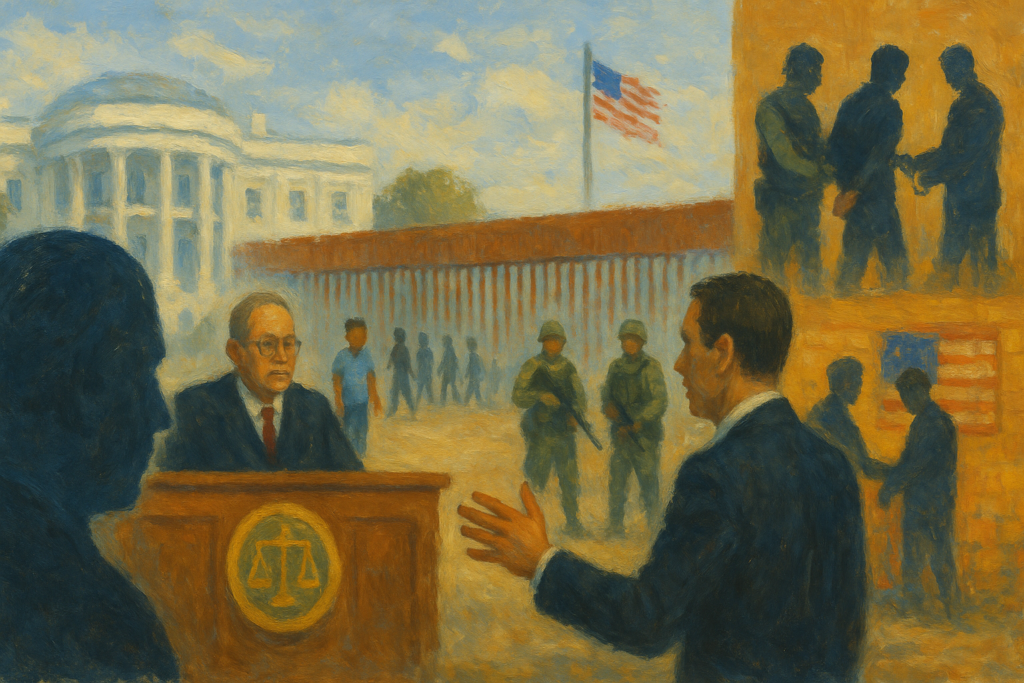
This week’s throughlines
- The Abrego Garcia case escalated from wrongful deportation to a direct test of court authority — What began with the administration confirming a mistaken deportation became a weeklong struggle over whether the executive would comply with Supreme Court and lower-court orders, culminating in fact-finding, appellate rebukes, and contempt-related proceedings.
- Federal leverage was used to pressure universities, students, and dissenting speech — The administration and allied agencies moved across several fronts: deportation cases tied to political expression, demands on Harvard backed by funding freezes, and continued censorship fights in military and school settings.
- Transparency and information control became a parallel battleground — The week included fights over access to White House events, threats against media outlets, lawsuits over removed spending and climate data, and the replacement of a public-health website with political messaging.
- Voting and civil-rights rules shifted toward restriction — State and federal actions tightened ballot access rules, reopened a contested North Carolina election, and redirected civil-rights enforcement away from traditional protections for marginalized groups.
The week’s clearest story was a wrongful deportation case that became a test of whether a president must obey the courts. Around that fight, other fronts opened or widened: the military’s role at the border expanded, immigration enforcement reached further into campus speech and legal advocacy, the White House pressed universities and media outlets with federal leverage, and judges spent much of the week trying to slow or contain actions already set in motion.
Over the weekend, the administration broadened the meaning of border enforcement itself. President Trump authorized the military to take control of federal land at the southern border, creating a framework in which troops could detain people accused of trespassing and hand them to immigration authorities. That pushed the armed forces further into direct domestic immigration work. At the same time, the administration ended the de minimis rule for low-value Chinese imports, a separate trade-policy move that reflected the same governing style: rapid unilateral action, justified as border control, with effects extending well beyond traditional customs enforcement.
The more consequential weekend development involved Kilmar Ábrego García, whose case had already become a legal and moral embarrassment for the government. The administration acknowledged that he had been wrongly deported and was being held in El Salvador, but its court filings offered no meaningful plan to bring him back. Instead, officials and allies publicly blurred what the Supreme Court had required. Lawmakers began seeking access and answers from Salvadoran authorities, but the central fact was already plain: a man the government said should not have been removed was outside the country, in foreign custody, while the executive branch resisted responsibility for correcting its own error.
That same weekend, immigration power was used in ways that reached beyond ordinary border policing. An immigration judge ruled that Mahmoud Khalil could be deported based on a State Department rationale tied to his views and associations rather than criminal conduct. A lawyer representing a pro-Palestinian protester was stopped and searched at an airport. Reporting also showed the administration treating Salvadoran prisons as a destination for deportees who would then be harder for American courts to reach. In each case, the issue was not simply removal policy. It was the growing use of immigration authority against speech, association, and legal representation, with due process protections looking thinner once a person was placed into the system.
The weekend also brought smaller but telling fights over information and dissent. The Naval Academy’s removal of hundreds of books under anti-DEI directives drew criticism as an attempt to reshape institutional memory from above. The White House continued blocking Associated Press journalists despite a court order restoring access. Trump also stripped security clearances from former officials Christopher Krebs and Miles Taylor, extending a pattern of retaliation against internal critics. These were different kinds of actions, but they pointed in the same direction: control over who may speak, what may be read, and which dissenters may be punished.
By Monday, the Ábrego García case had moved from troubling noncompliance to an explicit constitutional argument. In court, administration lawyers said they were not legally required to return him. Their position was that because he was now in Salvadoran custody, any real effort to secure his release would intrude on presidential control of foreign affairs. The Supreme Court, they argued, required only that the government remove domestic obstacles, not that it actually bring him home. That distinction mattered because it offered a template for evading judicial review: once the executive transfers a person abroad, it can claim the courts have little left to enforce.
Monday also showed how broadly immigration enforcement was being applied. A Georgetown scholar and a Columbia student were drawn into cases in which detention or immigration consequences appeared tied to pro-Palestinian speech or associations, with little public evidence offered by the government. Separate reporting showed a U.S.-born immigration lawyer receiving an erroneous deportation notice and a Venezuelan teenager being deported even though agents allegedly knew he was not the intended target. These were not identical cases, but together they suggested a system operating with weak safeguards, where political expression, bureaucratic error, and severe state power were increasingly entangled.
Another major front opened on Monday at Harvard. The administration demanded sweeping changes touching hiring, governance, and campus policy. Harvard refused, arguing that the demands violated constitutional limits and the university’s independence. By day’s end, the administration had frozen billions of dollars in grants and contracts. What might once have been framed as a dispute over campus policy became something larger: an effort to use federal money to reshape the internal life of a private university. The significance was not confined to Harvard. If successful, the same model could be used against other institutions that depend on federal funds but resist political direction.
Monday also brought a quieter but important shift in financial regulation. The administration’s crypto agenda advanced through a national cryptocurrency stockpile, the disbanding of a Justice Department crypto enforcement team, and reports that the Securities and Exchange Commission had dropped or paused multiple enforcement actions. In a sector where the Trump family had visible financial interests, the retreat from oversight raised obvious conflict concerns. The issue was not merely policy preference. It was whether politically connected actors were benefiting from a softer regulatory environment created by the same administration.
Tuesday was the week’s sharpest escalation point. During Salvadoran President Nayib Bukele’s White House visit, Trump and Bukele made clear in public that Ábrego García would not be returned, despite the Supreme Court’s instruction that the United States facilitate his release. Trump also openly discussed sending U.S. citizens to Salvadoran prisons. What had been a legal standoff became a public challenge to judicial authority. The message was that the executive could move people abroad, rely on a foreign partner to hold them, and then deny that American courts had practical power to remedy the situation.
The same day, pressure on Harvard intensified. After the university refused the administration’s demands, the Education Department froze roughly $2.3 billion in federal funds, and further threats emerged, including demands for records on foreign students and the possibility of revoking Harvard’s tax-exempt status. This mattered because it expanded the tools of pressure from grants to taxation and regulatory scrutiny. A dispute over campus governance was becoming a demonstration of how many levers the federal government could pull against a disfavored institution.
Tuesday also showed that the administration’s contest with independent institutions was not limited to universities. The White House again barred Associated Press journalists from an Oval Office event despite a court order, while Trump and allies pressed for punitive action against media outlets they disliked. At the same time, the administration classified its arrangement with El Salvador, limiting scrutiny of a policy central to the Ábrego García case, and watchdog groups sued over the removal of a public spending tracker from the Office of Management and Budget. Secrecy and access restrictions were working together: less information for the public, less visibility for Congress, and fewer practical consequences for ignoring legal limits.
By Wednesday, the courts began responding more forcefully. Judge Paula Xinis opened a fact-finding process into the administration’s failure to facilitate Ábrego García’s return, saying the government had done nothing to comply. In a separate deportation case, Judge James Boasberg found probable cause for criminal contempt over removals carried out despite a court order. Those steps did not resolve the underlying disputes, but they changed the posture. Judges were no longer merely issuing instructions; they were beginning to ask whether executive officials were defying them and whether sanctions might follow.
Wednesday also brought pushback from outside the federal judiciary. California sued over Trump’s tariffs, arguing that the president had bypassed Congress. Maine, after earlier funding threats tied to transgender athletes, faced a federal lawsuit. Harvard publicly defended its independence and cast the administration’s demands as an attack on academic freedom rather than a routine funding disagreement. These were distinct conflicts involving different legal questions, but together they showed states and institutions trying to draw lines around federal coercion. The administration was not just making policy. It was testing how far funding threats, lawsuits, and executive discretion could be used to compel compliance.
The information environment remained another active front. The administration shut down the State Department’s foreign-disinformation hub, removing a federal capacity built to track influence operations. FCC Chair Brendan Carr threatened Comcast over coverage of the Ábrego García case, extending the week’s pattern of using regulatory power against disfavored media. And Trump Media launched investment products marketed around Trump’s political agenda and tariff themes, another example of public power and private Trump-linked business interests moving in parallel. None of these developments stood alone, but together they suggested a government increasingly willing to weaken independent information systems while blurring the line between governance and brand.
On Thursday, appellate judges reinforced the lower courts’ resistance. The Fourth Circuit rejected the administration’s effort to block orders requiring action in the Ábrego García case, emphasizing that the government could not simply detain residents without due process and then disclaim responsibility once they were outside the country. Other courts continued hearing emergency challenges to student visa revocations, detentions, and rapid removals under the Alien Enemies Act. That appellate backing mattered. It showed that concern about executive overreach was not confined to one trial judge or one courthouse.
Thursday also made clear that the immigration agenda was generating mounting collateral damage. A federal judge dismissed the case against a wrongfully detained U.S. citizen in Arizona. International students sued over mass visa revocations and status terminations. The detention of Tufts student Rümeysa Öztürk over an op-ed continued to draw constitutional objections. These cases differed in posture and facts, but they shared a common pattern: severe immigration consequences imposed quickly, often with thin explanation, leaving courts to sort out basic errors and constitutional questions after the fact.
The conflict with Harvard widened further on Thursday when reporting indicated that the IRS was considering revoking the university’s tax-exempt status. That possibility carried a message beyond one campus: refusal to comply with political demands might bring not only funding losses but tax penalties as well. Markets, meanwhile, fell amid continuing tariff uncertainty and warnings from Federal Reserve Chair Jerome Powell, while Trump Media asked the SEC to investigate a hedge fund that had shorted its stock. The week’s economic backdrop remained volatile, but the more durable point was institutional: public authority and private political interest repeatedly appeared in the same frame.
Friday closed with a shift inside the Justice Department itself. Under new leadership, the Civil Rights Division issued mission statements that moved emphasis away from its traditional role protecting marginalized groups and toward voter-fraud claims, anti-DEI enforcement, and protection of white plaintiffs. Bureaucratic mission statements can sound abstract, but they shape what cases are brought, what harms are recognized, and which communities receive federal protection. A civil-rights office does not need a new statute to change national enforcement priorities; it can do so by redefining its own purpose.
Friday also brought a major voting development. The House approved the SAVE Act, which would require proof of citizenship for voter registration, while states continued advancing similar measures and other restrictions involving ballot assistance and disenfranchisement. Supporters described these steps as election-integrity measures. Their practical effect, however, would be to make registration more document-heavy and more difficult for eligible citizens who lack ready paperwork or whose records do not match. The week’s broader pattern was visible here too: rules justified as administrative safeguards that, in practice, shift burdens onto individuals and narrow access.
Courts continued acting as emergency brakes on Friday. A federal judge blocked mass layoffs at the Consumer Financial Protection Bureau, another court suspended a large reduction in force tied to Russell Vought, and judges kept preserving due-process protections in immigration cases involving rapid third-country deportations and student visa terminations. At the same time, public information systems were repurposed toward political messaging. Covid.gov was transformed from a public-health resource into a site centered on the lab-leak theory and criticism of prior officials, and the White House circulated an edited New York Times front page about Ábrego García that removed the word “wrongly” and added a taunting line about his return. Official channels were being used less to inform the public than to shape a preferred narrative.
By week’s end, the pattern was unmistakable. The administration moved first and broadly: across deportation, border militarization, campus governance, media access, civil-rights enforcement, and voting rules. Courts, universities, states, journalists, and some lawmakers responded, but mostly after the executive had already acted. The week did not settle these fights. It showed where they now stand. A wrongful deportation became a measure of whether judicial orders still bind the presidency. Harvard became a test of whether federal money and tax power can be used to discipline institutional independence. And repeated immigration cases showed how quickly due process can erode when the government treats removal, detention, and foreign custody as tools of political control as well as law enforcement.