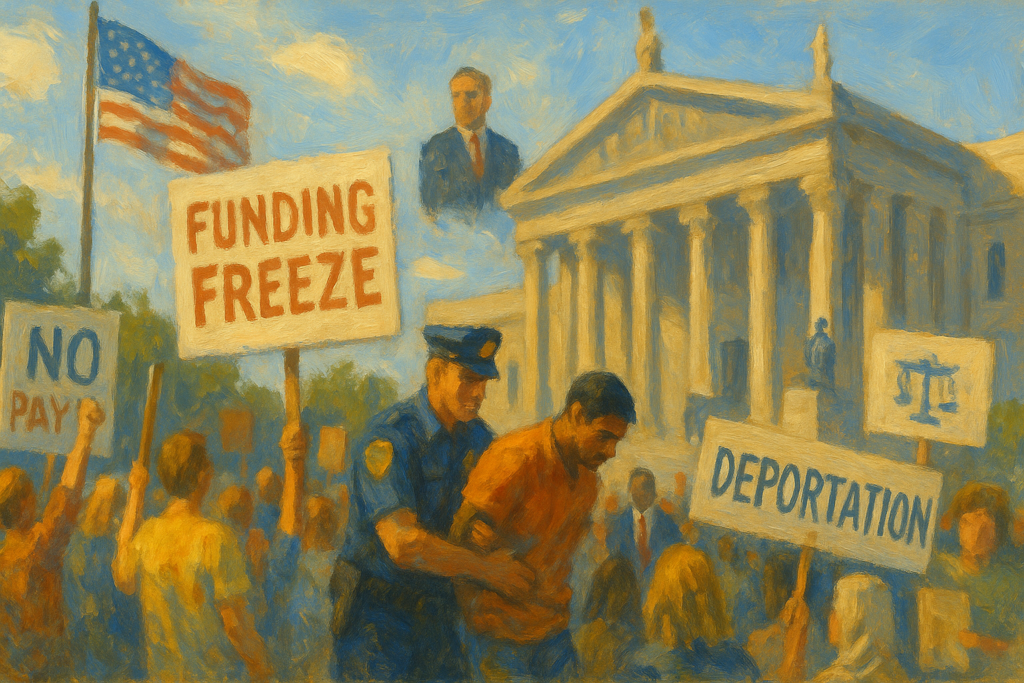
This week’s throughlines
- The deportation fight became a broader test of whether the executive would obey courts — The week began with the administration insisting it had no duty to return Kilmar Abrego Garcia and continued with Supreme Court and lower-court interventions blocking removals, contempt findings, and new orders requiring returns or notice before transfers.
- Federal pressure on higher education moved from threats to a coordinated campaign — What started as a funding freeze and tax threat against Harvard expanded into broader demands on universities, new executive orders on accreditation and campus policy, and a growing institutional backlash led by Harvard’s lawsuit and a joint statement from university presidents.
- Private channels, opaque data practices, and weakened transparency safeguards kept widening — The Hegseth Signal story deepened through the week, DOGE faced new scrutiny over records and data access, and the Justice Department rolled back protections for reporters, reinforcing a pattern of official secrecy paired with aggressive information control.
- Executive power was increasingly used against perceived opponents and disfavored institutions — The administration and its allies used funding threats, criminal referrals, lawsuits, pardons, and investigative directives against universities, state officials, Democratic infrastructure, and local governments, often prompting immediate legal challenges.
The week unfolded as a contest between widening executive pressure and repeated judicial resistance. The White House and allied agencies moved against universities, immigrants, broadcasters, civil servants, and political opponents, often through abrupt funding threats, executive orders, or aggressive enforcement. Again and again, courts intervened—not always finally, and not always fast enough to prevent harm, but often enough to become the week’s central counterweight.
Over the weekend, the clearest new front opened in higher education. After Harvard refused administration demands, the White House froze more than $2 billion in grants and contracts and threatened the university’s tax-exempt status. The move was larger than a dispute with one campus. It tested whether federal money and regulatory leverage could be used to force changes in a private university’s governance, speech environment, and internal policies. By choosing Harvard, the administration picked an institution with the resources to fight back publicly and in court, making the confrontation an early measure of how far executive power could be pushed against civil-society institutions that do not answer to the president.
At the same time, immigration enforcement continued to move faster than the legal system could comfortably absorb. The administration said it had no obligation to return Kilmar Abrego Garcia, even as courts examined the circumstances of his removal and the government’s obligations after the fact. More migrants were sent to El Salvador, and the administration kept pressing deportations under the Alien Enemies Act. But the weekend also brought a sharp judicial response: the Supreme Court temporarily halted deportations of Venezuelan detainees, lower courts blocked additional removals, and Judge James Boasberg found probable cause for contempt over earlier defiance of deportation orders. That combination—continued removals, claims of executive discretion, and judges openly examining compliance—set the tone for the rest of the week.
A third weekend story came from inside the national-security state. Reports said Defense Secretary Pete Hegseth had shared sensitive Yemen strike details in private Signal chats that included family members and personal associates. Former insiders described the Pentagon as being in disarray, and reports suggested the White House had begun considering whether he could remain in the job. The significance was not only the apparent carelessness of the communications. It was also what the episode suggested about recordkeeping, chain of command, and whether the civilian leadership of the Defense Department was operating through normal channels at all.
The weekend also showed pressure on other institutions meant to stand apart from direct presidential control. Trump publicly attacked Federal Reserve Chair Jerome Powell and floated firing him, while continuing attacks on the press, including denying Associated Press journalists Oval Office access despite a court order. A criminal referral targeting New York Attorney General Letitia James and renewed false attacks on ranked-choice voting added to the sense that the administration was willing to test boundaries across unrelated parts of public life. Outside government, large protests across the country offered a different kind of response, with demonstrators rallying against deportations, executive overreach, and attacks on constitutional norms.
By Monday, the immigration conflict had become more explicit. During a meeting with El Salvador’s president, Trump indicated he would ignore the Supreme Court’s direction in the Abrego Garcia case. What had been a hard-fought legal dispute now looked more like a separation-of-powers confrontation: not simply whether the government had acted lawfully, but whether a president would honor a court’s authority in practice. Democratic lawmakers and Senator Chris Van Hollen traveled to El Salvador to press for Garcia’s return, underscoring that the case had moved beyond the courtroom into a broader struggle over whether judicial orders still carried operational force.
Monday also brought the first organized institutional response from higher education. Harvard sued over the funding freeze and publicly defended the authenticity of the administration’s pressure campaign. More than 150 college presidents signed a statement condemning political interference, and reports showed that Harvard was not the only target. The administration’s pressure on universities was beginning to look systematic rather than episodic: a campaign to use federal funding and oversight tools to reshape campus policy and governance without new legislation.
Elsewhere on Monday, Secretary of State Marco Rubio announced a major State Department reorganization with deep cuts, including in offices tied to democracy and human rights. On the same day, a federal judge ordered the restoration of Voice of America and related services, ruling that the administration could not simply dismantle broadcasters created by Congress. The juxtaposition mattered. One part of the executive was trying to remake foreign-policy institutions from above, while the judiciary was insisting that congressionally established entities could not be erased by administrative will alone.
The Pentagon story widened in parallel. New reporting on Hegseth’s Signal chats and internal chaos was followed by threats to prosecute leakers and a lawsuit seeking preservation of official Signal messages. What had begun as a security scandal was becoming a records and accountability fight. If sensitive decisions were being discussed off official systems, the question was no longer just what had been shared, but whether the public record of government action was being lost or concealed. Monday also showed immigration enforcement reaching further into ordinary life: Florida directed law enforcement and public universities into ICE’s 287(g) program, and more cases surfaced of U.S. citizens and detainees caught up in aggressive enforcement practices.
On Tuesday, the campaign against higher education widened beyond Harvard. Reports indicated that multiple universities were being threatened with funding losses or other penalties, while Harvard’s lawsuit moved forward and university leaders continued to denounce federal overreach. The conflict was no longer about one school’s refusal to comply. It had become a broader attempt to pressure universities into changing speech, hiring, and governance practices through financial coercion rather than through Congress or ordinary rulemaking.
Tuesday also brought new scrutiny to executive secrecy and data control. A whistleblower alleged that DOGE staff had accessed and obscured sensitive National Labor Relations Board data, while congressional Democrats sought investigations into DOGE’s handling of personal information across agencies. Litigation continued over whether DOGE is subject to transparency laws and whether Signal records from senior officials were being preserved. These were not glamorous disputes, but they went to the mechanics of accountability. If politically empowered actors can move through agencies, access sensitive systems, and leave uncertain records behind, oversight by Congress, courts, inspectors general, and the public becomes much harder.
Courts kept restoring disrupted institutions on Tuesday. Federal judges ordered Voice of America operations resumed and reinstated the legal status of international students whose records had been revoked. These were not sweeping final victories, but they showed judges acting as a practical brake when executive action had abruptly stripped people of legal status or shut down institutions authorized by law. At the same time, the economic effects of tariff policy became harder to dismiss as theory. Manufacturers reported layoffs, canceled sales, reduced investment, and worsening survey results, while more states moved to challenge the tariffs in court. Trade policy was becoming both an economic and a legal problem.
The human consequences of immigration policy remained visible as well. Reports showed immigrant children appearing in court without lawyers after cuts to legal services, and Mahmoud Khalil was denied permission to attend the birth of his child. These were distinct cases, but together they showed how enforcement choices were narrowing access to counsel, family contact, and basic procedural fairness. The week’s immigration story was not a single controversy. It was a series of overlapping tests—wrongful deportation, student detention, family separation, and the treatment of citizens and noncitizens alike.
Wednesday centered on executive redesign. Trump signed a broad set of orders affecting accreditation, school discipline, historically Black colleges and universities, AI education, workforce training, foreign funding disclosures, and the use of disparate-impact standards in civil-rights enforcement. Taken together, the orders sought to redirect education and equality policy nationwide through presidential action. Some were framed as administrative reforms, others as ideological correction, but the common feature was an attempt to change major policy terrain without going through Congress.
Immigration cases kept moving at the same time. The Supreme Court again blocked Alien Enemies Act deportations in Texas. Judge Paula Xinis ordered daily updates in the Abrego Garcia case, while Judge Boasberg’s contempt finding remained central to the broader deportation fight. Yet judicial checks did not stop enforcement from advancing elsewhere: an immigration judge ruled Mahmoud Khalil eligible for deportation. By midweek, immigration had become the clearest arena in which courts were trying to enforce legal limits while the executive kept pressing for speed, discretion, and operational freedom.
Wednesday also added to the picture of internal disorder. New filings sought to preserve DOGE records, more reporting described Pentagon chaos and insecure communications, and the Interior Department was shown to have concentrated broad authority in a single political appointee. A dozen states sued over Trump’s tariff policy, arguing that it rested on presidential whim rather than lawful authority. Across these stories, the pattern was similar: authority was being centralized, records were contested, and ordinary administrative safeguards were being weakened or bypassed.
Thursday brought one of the week’s strongest bursts of judicial pushback. Federal judges blocked the administration from withholding funds from sanctuary jurisdictions, stopped Trump’s proof-of-citizenship voter-registration order, and issued injunctions against contested Education Department directives. These rulings did not settle every dispute, but they drew clear lines around presidential power in elections, education, and federal-state relations. They also reinforced a theme that had been building since Monday: courts were not merely reviewing policy choices, but protecting areas where Congress or the Constitution assigns authority elsewhere.
The White House answered with new offensives of its own. Trump issued a memorandum directing the Justice Department to investigate ActBlue, the main Democratic fundraising platform, and pardoned Michele Fiore after her fraud conviction. The pairing was striking. One move burdened a major piece of opposition political infrastructure; the other relieved an ally of criminal consequences. The same day also brought new privacy and rights controversies. Robert F. Kennedy Jr.’s autism-monitoring plans raised alarm over the use of private medical records, the administration canceled an environmental justice settlement in Alabama, government lawyers admitted ICE lacked a warrant for Mahmoud Khalil’s arrest, and reports emerged of EEOC texts to Barnard employees asking about Jewish or Israeli identity. By Thursday, many of the week’s conflicts no longer looked isolated. They were overlapping fights over surveillance, selective enforcement, and procedural protection.
By Friday, some of the week’s starkest consequences were visible. Under court pressure, the administration reversed some student visa terminations, a reminder that litigation could still force partial retreat. But the broader immigration picture darkened. Lawmakers called for the release of Rümeysa Öztürk, court filings underscored the warrantless arrest of Mahmoud Khalil, a two-year-old U.S. citizen was deported to Honduras, and the administration’s closure of detention oversight offices came into sharper focus. Even where judges compelled reversals, the machinery of enforcement kept reaching into citizenship, family life, and detention conditions.
Then came the week’s most dramatic institutional clash: FBI agents arrested Milwaukee County Judge Hannah Dugan on obstruction charges tied to an ICE operation at the courthouse. The arrest was immediately understood as more than a local criminal case. In the context of the week—after open resistance to court pressure in deportation cases, after repeated judicial interventions, after escalating immigration enforcement—it looked like a warning to judges and local officials who complicate federal operations. Arresting a sitting judge in the middle of an immigration conflict raised profound questions about intimidation, judicial independence, and the use of federal coercive power against another part of the legal system.
Friday also brought a ruling blocking Trump’s order ending collective bargaining rights for large numbers of federal workers, preserving union rights while broader fights over DOGE access to personal records and Elon Musk’s role inside the executive branch continued. And Attorney General Pam Bondi revoked a policy that had protected reporters’ records in leak investigations, opening the door to more aggressive seizure of journalists’ communications. That decision landed in a week already marked by pressure on the press and by internal secrecy battles across the government. It suggested an administration trying both to control information inside the state and to make outside scrutiny more difficult.
Taken together, the week showed how democratic strain often appears: not in one decisive break, but in repeated efforts to convert executive preference into immediate institutional reality, met by courts, lawsuits, protests, and scattered acts of resistance. Universities went to court to defend their independence. Judges restored broadcasters, blocked election-related orders, protected union rights, and demanded answers in deportation cases. Yet the week also showed the limits of those checks. Temporary injunctions do not erase deportations, restore family separation, or undo the chilling effect of arrests and investigations. By Friday, what had emerged was a government pressing on many fronts at once, and a constitutional system increasingly reliant on judges to slow it down.