This week’s throughlines
- Transparency fight over the Epstein files turned into a contest over control of disclosure — Congress forced release of the Epstein files and Trump signed the bill, but his earlier order for a new investigation and later DOJ claims about exemptions created a parallel effort to preserve executive control over what would actually become public.
- Immigration enforcement widened from a local raid into a broader climate of fear and legal conflict — Operation Charlotte’s Web began as a federal response to local noncooperation, then expanded into mass arrests, protests, school disruption, and fresh scrutiny of detention, deportation, and surveillance practices.
- Courts repeatedly checked executive or prosecutorial overreach — Judges intervened in the Comey prosecution, blocked racially gerrymandered maps in Texas, halted some immigration rollbacks, and flagged violations of court orders, showing the judiciary acting as a recurring counterweight through the week.
- Pressure on dissent and independent institutions intensified — The week included threats against internal party dissenters, pressure on universities, attacks on journalists, surveillance of activists, and increasingly explicit presidential language casting opponents as traitors.
The week opened with federal power on display in North Carolina neighborhoods. In Charlotte, Homeland Security launched “Operation Charlotte’s Web” after local officials limited cooperation with immigration detainers. Over the weekend, masked Border Patrol teams in unmarked vehicles swept through streets, churches, and businesses, detaining between 80 and 130 people. Many of those taken into custody had no criminal records; some were U.S. citizens. Witnesses reported property damage and racial profiling, and immigrant communities responded with protests, legal hotlines, and emergency organizing. The raids showed how quickly everyday spaces—sanctuaries, workplaces, homes—can be turned into sites of enforcement when the federal government chooses to test the limits of its authority.
In Washington, the same days saw the administration turn a long‑running scandal into a political weapon. President Trump directed Attorney General Pam Bondi to investigate specific Democrats and donors named in Jeffrey Epstein–related materials, including Bill Clinton, Larry Summers, and Reid Hoffman. He also ordered a new Epstein investigation despite having previously dismissed the case. These moves coincided with House investigators releasing thousands of documents from the Epstein estate, including evidence that Epstein had texted with a member of Congress during a 2019 hearing. The timing suggested a dual strategy: embrace the scandal as a tool against opponents while trying to shape which facts would emerge and when.
The weekend also highlighted how differently the justice system treated allies and others. The Justice Department entered settlement talks over Michael Flynn’s $50 million claim, even though his lawsuit had already been dismissed. At the same time, Trump issued a rapid pardon to Charles Scott, a convicted stock‑manipulation offender who had served only two weeks in jail and had donor ties to the president. Prosecutors warned that such interventions undermined deterrence in financial crime cases. Together, the Flynn negotiations and Scott’s pardon signaled that proximity to the president could outweigh court outcomes, while those on the wrong side of power faced a very different legal landscape.
Inside the president’s own party, loyalty tests intensified. Trump publicly withdrew support from Representative Marjorie Taylor Greene and criticized Representative Thomas Massie after they backed releasing Epstein‑related files, casting their votes as personal betrayal. He also attacked Indiana Republicans, including Governor Mike Braun and key state senators, for resisting a gerrymander designed to add Republican congressional seats, urging primary challenges against them. Endorsements and threats became tools to enforce personal allegiance over institutional judgment, warning lawmakers that crossing the president on transparency or redistricting could carry electoral and personal risks.
The weekend brought fresh signs of politicization inside federal law enforcement. Reporting showed FBI Director Kash Patel waiving standard polygraph exams for his deputy Dan Bongino and other senior staff, granting them access to sensitive information without the usual vetting. Patel also arranged an FBI security detail—normally a SWAT‑team function—for his girlfriend, diverting elite tactical resources to a private purpose. These decisions cut against long‑standing professional norms at the bureau, raising questions about whether loyalty and personal relationships were displacing security standards and public safety priorities.
At the Department of Homeland Security, a different kind of power was being exercised through messaging and money. Secretary Kristi Noem oversaw a $220 million anti‑immigration advertising campaign that steered $143 million to a Delaware firm linked to Republican operatives, without competitive bidding. Critics argued that the campaign functioned less as neutral public information and more as taxpayer‑funded political advertising. The episode underscored how federal communications budgets can be used to shape public opinion on contentious issues while rewarding politically connected contractors.
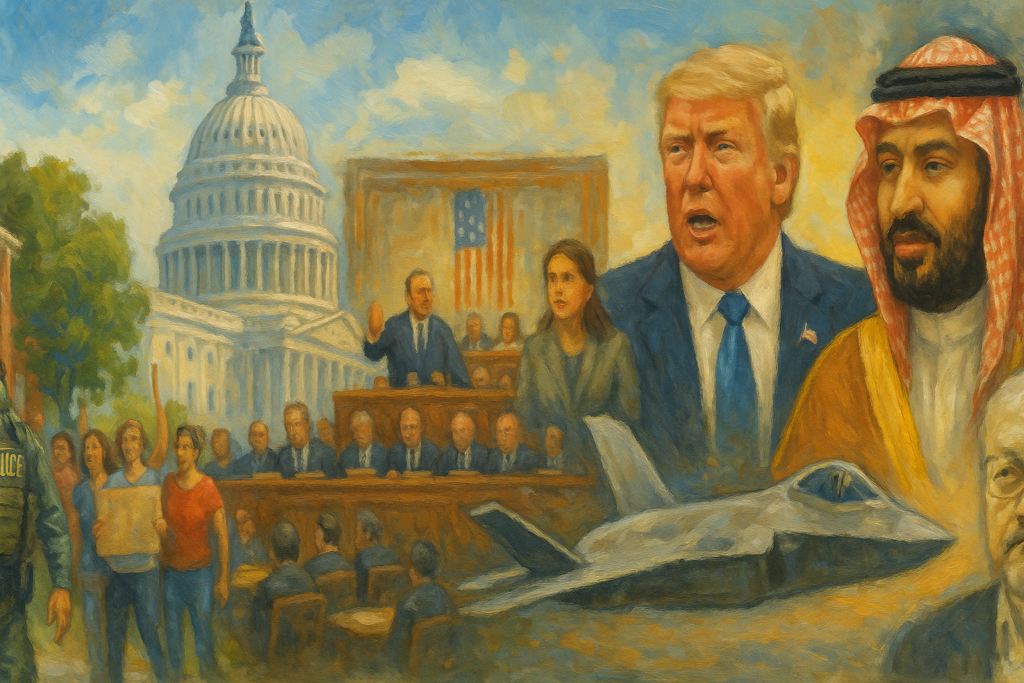
Abroad, Trump deepened ties with Saudi Arabia in ways that intertwined U.S. foreign policy with his own business interests. Over the weekend and into Sunday, he advanced negotiations for Trump‑branded real estate in a Saudi state‑backed project, announced plans to sell F‑35 jets to the kingdom despite Pentagon and Israeli concerns, and hosted Crown Prince Mohammed bin Salman at the White House. He designated Saudi Arabia a major non‑NATO ally and publicly dismissed U.S. intelligence findings that the crown prince ordered journalist Jamal Khashoggi’s murder, calling Khashoggi “extremely controversial.” When a president’s private ventures overlap with arms deals and diplomatic upgrades, it becomes difficult to separate national security decisions from personal and regime enrichment.
Courts, meanwhile, offered some of the week’s earliest institutional pushback. A federal judge in Virginia, reviewing the indictment of former FBI Director James Comey, found “profound investigative missteps,” including false legal instructions and misuse of grand jury procedures, and ordered grand jury materials turned over to the defense. In Chicago, another judge sharply reprimanded Border Patrol official Gregory Bovino for attacks on peaceful protesters, insisting the agency could not continue such tactics. These rulings did not reverse broader trends, but they showed judges using their authority to check politicized prosecutions and abusive enforcement.
Even as the administration moved against transgender people, some turned to the courts. Seventeen transgender Air Force members filed suit after the government revoked their early retirement benefits, arguing the move was unlawful and discriminatory. In a separate case, officials admitted they had deported Britania Uriostegui Rios, a transgender woman, to Mexico in violation of a court order that barred her removal there due to risk of torture. The government was working to bring her back as she sued for release from custody. These cases illustrated how policy shifts and enforcement errors can abruptly strip vulnerable people of both legal protections and physical safety, leaving litigation as their only recourse.
By Monday, the immigration crackdown that began in Charlotte had spread. ICE and Border Patrol teams deployed into the Raleigh–Durham area, prompting local groups to organize witness teams and hotlines. In Chicago, filings in Castañon Nava v. DHS revealed that more than 97 percent of immigrants arrested in “Operation Midway Blitz” had no criminal convictions, contradicting official claims that the operation targeted “violent criminals.” The data undercut public‑safety justifications for large‑scale raids and strengthened legal challenges to warrantless arrests and violations of existing consent decrees.
On the Epstein front, Congress moved toward formal transparency even as the White House looked for leverage. House leaders scheduled votes on releasing Epstein‑related files and advanced the Epstein Files Transparency Act. Trump, who had earlier resisted broad disclosure, publicly urged Republicans to support the measure. At the same time, he and Bondi’s new investigation into Democrats’ Epstein ties positioned the Justice Department to argue that some records must be withheld due to ongoing cases. The same scandal was thus invoked both to justify openness and to justify secrecy, highlighting how control over timing and framing can shape accountability.
Trump’s pressure on Indiana Republicans over redistricting escalated, and the costs of dissent became more concrete. He threatened to “strongly endorse against” lawmakers who refused to redraw congressional districts to his liking, insisting Republicans must keep the House majority “at all costs.” Shortly afterward, State Senator Greg Goode, a key opponent of the plan, was targeted in a dangerous swatting incident at his home. While no direct link was established, the sequence underscored how heated rhetoric around partisan maps can be followed by real‑world harassment, raising the stakes for officials trying to defend fair representation.
Economic data released Monday showed a widening gap between the administration’s “Golden Age” narrative and conditions on the ground. Unemployment rose to 4.4 percent and inflation climbed above 3 percent, with manufacturing, construction, and transportation shedding jobs. Economists tied the slump to Trump’s tariffs on intermediate goods—inputs used by U.S. factories—arguing that these policies raised costs and suppressed demand. Senior advisers, however, continued to describe the job market as in a “quiet time” and blamed former President Biden for looming beef price spikes, claims disputed by industry leaders. The divergence between rhetoric and reality risked misleading voters and delaying policy corrections.
At the same time, Congress inched toward a defense posture that would lock in high levels of military spending. Lawmakers worked to reconcile House and Senate versions of the 2026 National Defense Authorization Act and the “One Big Beautiful Bill” package, with total military spending projected up to $1.045 trillion. Analyses indicated that four major contractors—Lockheed Martin, Raytheon, General Dynamics, and Northrop Grumman—could receive more than a quarter of Pentagon contract dollars, after a decade in which they used public revenue to fund $103 billion in stock buybacks and dividends. The numbers illustrated how a war‑oriented economic structure channels public funds into a small set of firms with significant political influence.
Elsewhere in the executive branch, capacity for basic public protection showed signs of strain. Acting FEMA Administrator David Richardson resigned after criticism of his handling of catastrophic Texas flooding that killed more than 130 people. The White House signaled plans to use his departure to accelerate a broader downsizing and cost‑cutting overhaul of FEMA under incoming chief of staff Karen Evans. Weakening the agency responsible for disaster response after a deadly event raised questions about the federal government’s willingness and ability to protect communities from climate‑driven emergencies.
Monday also brought small but notable efforts in Congress to claw back executive overreach. Representative Jared Golden announced that a bipartisan discharge petition had reached 218 signatures to force a House vote on repealing Trump’s order stripping union rights from federal workers. Separately, Representative Robert Garcia warned the Justice Department not to destroy or withhold Epstein‑related records, underscoring concern that the new transparency law could be undermined in practice. These moves showed legislators using procedural tools and public pressure to reassert oversight over workplace rights and politically sensitive investigations.
On Tuesday, the Epstein story reached a new stage. The House voted 427–1 to pass the Epstein Files Transparency Act and related resolutions mandating that the Justice Department release unclassified Epstein and Ghislaine Maxwell records within 30 days. The law allowed redactions to protect victims’ names but barred redactions solely to avoid embarrassment. The Senate agreed to pass the measure by unanimous consent, and Trump said he would sign it. At the same time, he ordered Bondi to open a new investigation into Democrats’ Epstein links, and survivors held a press conference outside the Capitol warning against politicization and delay. The near‑unanimous votes were a rare formal win for transparency, but they set up a test of whether statutory mandates could overcome executive incentives to shield elites.
Civil rights and security lines blurred sharply in Texas that day. Governor Greg Abbott issued a state‑level designation naming the Council on American‑Islamic Relations (CAIR) and the Muslim Brotherhood as “foreign terrorist organizations,” barring them from owning property in Texas and authorizing legal action against affiliates. The move conflicted with federal law, which reserves such designations to the Secretary of State, and targeted a long‑standing U.S. Muslim civil rights group. By unilaterally labeling a domestic advocacy organization as terrorist, the state blurred the line between counterterrorism and ideological punishment, with likely chilling effects on Muslim advocacy and association.
Elsewhere, those harmed by high‑profile enforcement actions turned to the courts. In California, ICE detainees filed a federal class action alleging they were denied critical medical care—including insulin, dialysis, and cancer treatment—after the Veterans Affairs Department abruptly terminated its agreement to process ICE medical claims and replacement no‑bid contracts failed to function. In Utah, workers at Rubicon sued former Attorney General Sean Reyes, claiming he staged a televised human‑trafficking raid based on false information that destroyed their jobs and contracts. These suits showed how administrative decisions and media‑driven enforcement can inflict lasting harm on people with little political power.
There were also signs of resistance to partisan overreach at the state and local level. A federal judge in Texas blocked new congressional maps that added five Republican districts, finding they were likely racially gerrymandered and ordering use of 2021 maps instead. In Indiana, Senate leaders announced they would not hold a December redistricting session despite pressure from Trump and Governor Braun. In San Diego, the city council advanced an ordinance requiring federal agents to obtain warrants before entering non‑public areas of city facilities. Courts and local governments thus emerged as venues where partisan map‑drawing and warrantless federal access were being checked.
The justice system’s politicization drew scrutiny from another angle on Tuesday. A federal grand jury in Maryland opened an investigation into whether Federal Housing Finance Agency Director Bill Pulte and Justice Department prosecutor Ed Martin had improperly used mortgage fraud probes to target Trump critics such as Senator Adam Schiff and New York Attorney General Letitia James. Separately, Senator Ron Wyden released a report urging investigation of JPMorgan Chase for allegedly underreporting more than $1 billion in suspicious Epstein‑linked transactions, which may have impeded law enforcement. If regulators and prosecutors are found to have targeted critics or shielded powerful clients, it would confirm that key enforcement tools are being steered by political and financial interests rather than law.
Trump’s alignment with Saudi Arabia returned to the foreground as Crown Prince Mohammed bin Salman visited Washington. Trump hosted a black‑tie dinner with major U.S. CEOs, announced $1 trillion in prospective deals, and formally designated Saudi Arabia a major non‑NATO ally. At a joint press event, he attacked female reporters who asked about his family’s Saudi business ties and Epstein connections, even suggesting that ABC News should lose its license. The combination of economic deals, security upgrades, and attacks on the press during a high‑profile visit underscored how foreign policy, private enrichment, and information control can reinforce one another.
By Wednesday, the Epstein transparency bill had cleared both chambers and reached Trump’s desk. The Senate approved it by unanimous consent after the House’s 427–1 vote, and Trump signed it, giving the Justice Department 30 days to release investigative files with only narrow redactions. House Democrats formally transmitted the resolution and publicly warned DOJ not to destroy or withhold records, while survivors and lawmakers continued pressing for full disclosure. The law’s impact would depend less on its text than on whether the department honored its spirit or used exemptions and timing to keep politically sensitive material out of view.
That same day, Trump’s rhetoric against domestic opponents crossed a new line. After a group of Democratic senators and representatives—many with military or intelligence backgrounds—released a video reminding service members to refuse unlawful orders, he responded on social media by labeling them “traitors” and calling for their execution. He amplified posts advocating hanging them, drawing widespread condemnation and raising fears of incitement. When a sitting president calls for killing elected opponents over constitutional speech, it directly threatens the safety and independence of the legislative branch and normalizes political violence as a response to dissent.
Inside the FBI and Justice Department, internal conflicts over loyalty and law continued to surface. FBI veteran David Maltinsky sued the bureau, Director Kash Patel, DOJ, and Attorney General Bondi, alleging he was fired for displaying a Pride flag at his desk in violation of his First Amendment rights. In parallel, new filings in the Comey case revealed that Trump‑appointed prosecutor Lindsey Halligan had failed to properly present a revised indictment to the full grand jury, deepening concerns about procedural misconduct in a politically charged prosecution. Targeting employees over LGBTQ symbols and cutting corners in high‑profile cases both pointed to a justice system where ideological alignment could matter more than professional standards.
Former military leaders added their own warnings about politicization. A report by six former service secretaries and retired four‑star officers cautioned that recent National Guard deployments to U.S. cities without local consent and the firing of senior officers, including the chair of the Joint Chiefs, were eroding the military’s apolitical character. They urged Congress to require clear justification and post‑action review for major domestic deployments and high‑level personnel changes. Their intervention highlighted how the norms that keep the armed forces under constitutional rather than partisan control were being tested.
In the House, ethics and accountability fights stalled in familiar patterns. A Republican‑led resolution to censure Democratic delegate Stacey Plaskett over her text exchanges with Epstein during a 2019 hearing failed 209–214, after which Democrats dropped a planned censure of Republican Cory Mills. Separately, the House unanimously voted to repeal a Senate‑inserted provision that could have granted GOP senators taxpayer‑funded damages, signaling bipartisan discomfort with overt self‑dealing. These maneuvers showed both parties using ethics tools tactically while occasionally uniting to block the most blatant enrichment, leaving deeper questions about accountability unresolved. A new Marist poll showing Democrats leading Republicans by double digits on the 2026 generic ballot, and the arrest of a pardoned January 6 rioter on child sexual abuse charges, added to a sense that public opinion and the behavior of pardoned allies were feeding back into assessments of the administration’s use of power.
Thursday brought into focus a coordinated federal campaign against transgender Americans that had been building in fragments. A cluster of executive orders and guidance—centered on EO 14168 and related directives—rolled back federal recognition and protections across multiple domains. The State Department eliminated the “X” gender marker and revoked some passports. Agencies deleted LGBTQ health pages, suicide‑risk data, and trans terminology from federal records. EO 14183 banned most transgender military service and cut off gender‑affirming care in the military health system. EO 14187 threatened funding for hospitals treating trans youth, prompting clinic closures. Federal guidance pushed schools on military bases to remove LGBTQ and race‑related books and discouraged social transition. Housing rules led shelters to turn trans women away, while prison policies transferred trans women to men’s facilities and authorized invasive searches. The administration also shut down the dedicated 988 crisis line option for LGBTQ youth. State legislatures, emboldened by a recent Supreme Court ruling, followed with bans on youth gender‑affirming care in more than 25 states. Taken together, these measures did not just change discrete policies; they redefined who counted in federal law and data, making it harder for transgender people to access services, assert rights, or even appear in the public record.
The same day, the administration began to pull back from the transparency it had just signed into law. Barely a day after Trump approved the Epstein Files Transparency Act, reports indicated that he and Bondi were seeking to withhold releases by invoking broad “national security” and “active investigation” exemptions tied to their new probe into Democrats’ Epstein links. House Oversight Democrats warned DOJ not to destroy or conceal records, while activists prepared a large‑scale “Removal Coalition” mobilization in Washington to demand accountability. The episode showed how even strong transparency statutes can be undermined if the executive branch is determined to stretch exemptions and run out the clock on politically sensitive disclosures.
Economic developments on Thursday reinforced the week’s earlier warnings. New analyses confirmed that Trump’s “Liberation Day” tariffs on intermediate goods had pushed U.S. manufacturing into recession‑like conditions, with subdued orders, longer delivery times, and job losses in autos, construction, and transportation. Economists noted that the administration had ignored long‑standing advice against taxing inputs that domestic industries rely on. Under pressure, Trump partially rolled back some China tariffs through a maze of exemptions and deferrals, lowering the effective rate but leaving much of the structure intact. Tariffs wielded unilaterally by the executive had quietly reshaped the economy, imposing diffuse costs on workers and consumers that were easy to obscure behind optimistic messaging and partial reversals.
Analyses of China’s strategy offered a contrasting model of state power. Commentators described how Beijing uses social media controls as a warfighting tool to maintain internal cohesion and manage narratives, while mastering every stage of the drone supply chain. They urged the United States to improve its own industrial policy, including easing tariffs on allies, to compete in drone production and adapt to drone‑centric warfare. The discussion underscored that authoritarian and democratic states are competing not just on weapons, but on who controls the platforms and narratives of modern conflict.
By Friday, few new formal actions were recorded, but the consequences of the week’s decisions were already setting the stage for confrontations ahead. With the Epstein transparency law in force and the Justice Department signaling resistance, the Removal Coalition organized a three‑day mobilization in Washington beginning November 20 to demand accountability and transparency. The protest, featuring prominent activist voices and live entertainment, aimed to keep public attention on both the Epstein files and broader concerns about democratic backsliding. Large, peaceful mobilizations remained one of the few tools available when formal institutions appeared unwilling or unable to enforce transparency and accountability on their own.
Taken together, the week traced a pattern of power being used to redraw the boundaries of law, rights, and belonging. Federal agents swept through North Carolina neighborhoods and Chicago streets; Congress forced open a window into a long‑hidden abuse scandal even as the executive tried to close it; a coordinated set of orders sought to erase transgender people from policy and data; and the justice system was bent differently for allies and opponents. At the same time, foreign policy intertwined with private business, tariffs strained the economy while defense spending soared, and the president’s rhetoric against lawmakers crossed into calls for execution. Against these moves, courts, local governments, former officials, and civil society offered partial resistance. How these competing forces resolve—or fail to resolve—will shape not only specific policies, but the basic expectations Americans can have about equal treatment, truthful information, and the safety of dissent in the years ahead.