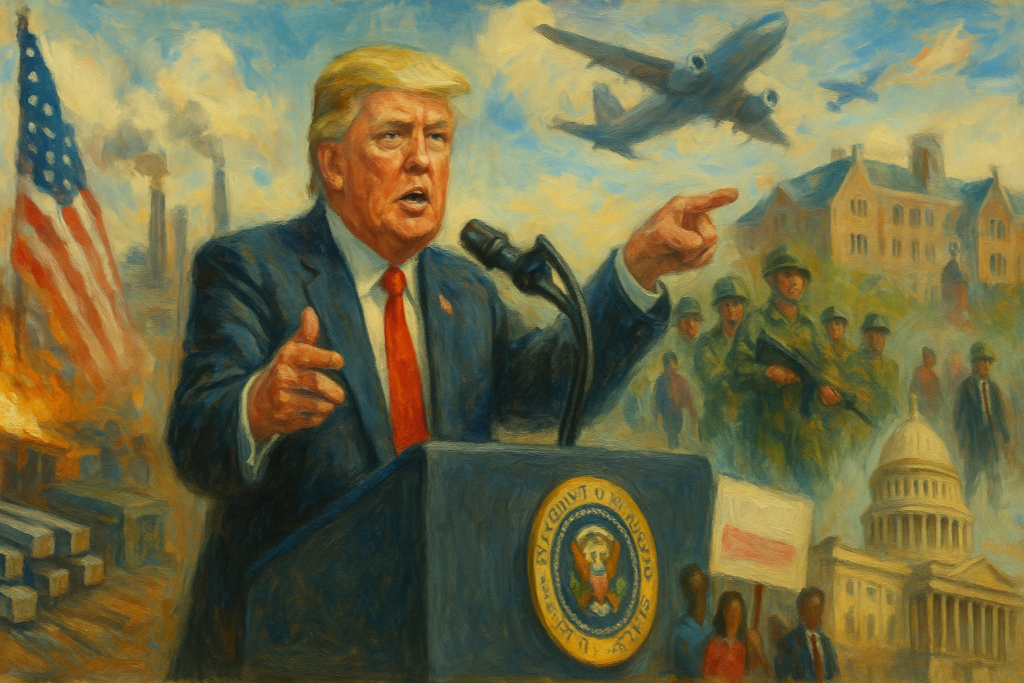
This week’s throughlines
- Immigration enforcement widened from legal status changes to broader exclusion and intimidation — The week moved from court-enabled loss of parole and TPS protections, to pressure for higher deportation numbers, to raids, family detention fights, a new travel ban, and visa restrictions aimed at Harvard students.
- Executive power claims kept colliding with courts, but often remained in force during appeal — Tariffs, spending control, agency firings, DOGE access, and secrecy claims all produced a pattern in which lower courts sometimes pushed back, while appellate courts and the Supreme Court often preserved executive action pending further review.
- Retaliation against institutions became more explicit — The administration and its allies targeted public media, Harvard, Biden-era officials and aides, and even a congressional office, while using funding threats, investigations, and immigration tools as leverage.
- Public capacity eroded as storm season began — Cuts, hiring freezes, and weak leadership at FEMA, NOAA, the National Weather Service, and the VA raised questions about whether the federal government was reducing its own ability to protect the public.
- Personalized government and private power became harder to separate — Tariff policy, crypto legislation, DOGE litigation, and the Trump-Musk feud all showed how public decisions, private wealth, and personal retaliation were increasingly entangled.
The week opened with a jolt to the global trading system and a reminder of how much power the modern presidency can wield over the economy. Late Friday and into the weekend, Donald Trump announced and then formalized a doubling of tariffs on foreign steel and aluminum, raising them to 50 percent and again invoking national security as the justification. The move came just as the Court of International Trade ruled that an earlier round of “Liberation Day” tariffs exceeded his legal authority, even while an appeals court kept other contested tariffs in place for now. The result was a split-screen: judges warning that the president had overstepped, while the White House pressed ahead with even more aggressive trade barriers. Businesses that rely on imported metals, from automakers to construction firms, were left to guess how to price contracts and whether allies would retaliate, knowing that the legal ground under these tariffs was already shaking.
Immigration law and executive power were also in motion over the weekend. The Supreme Court allowed the administration to end humanitarian parole for roughly half a million migrants from several countries, instantly exposing them to possible deportation and underscoring how quickly legal status can change when it rests on executive discretion rather than statute. At the same time, lower courts ordered the return of a wrongly deported Maryland resident and ruled that Trump’s use of an emergency economic law to impose some tariffs was unlawful. Inside the administration, the State Department signaled a more permanent shift by planning an “Office of Remigration” focused on sending migrants back rather than integrating them. Together, these moves showed both the fragility of protections created by executive action and the willingness of courts to push back at the edges, even as the overall direction tilted toward removal.
Budget politics surfaced early as well. Over the weekend, budget director Russell Vought floated plans to rely on “executive tools” and revived impoundment tactics to push through large cuts to the federal workforce and spending without full congressional approval, sending only a fraction of reductions to Capitol Hill. That approach, if carried out, would sidestep Congress’s constitutional power of the purse and give the White House more unilateral control over which programs live or die. It foreshadowed the detailed budget proposals and House legislation that would dominate the week.
The weekend also brought a clash over information and institutions. Trump used his social media platform to promote a baseless conspiracy theory that Joe Biden had been executed and replaced by clones, while Homeland Security Secretary Kristi Noem accused Harvard of advancing Chinese Communist Party priorities. In parallel, NPR and public radio stations sued over an executive order cutting funding to outlets the president labeled “biased,” arguing that the order violated the First Amendment. These attacks on media and universities were not just rhetorical; they were paired with concrete efforts to defund and stigmatize institutions seen as critical or independent. Against this backdrop, there were small but notable signs of resistance. Judge Tanya Chutkan allowed a lawsuit by 14 states to proceed against the “Department of Government Efficiency,” a new unit led by Elon Musk that has been tasked with streamlining government operations. Her ruling questioned the legality of outsourcing state power to a private figure. On Capitol Hill, Senator Angus King and Representative Jamie Raskin invoked Margaret Chase Smith’s 1950 “Declaration of Conscience” to warn about executive overreach and character assassination, while a Utah lawyer was sanctioned for submitting an AI-generated brief with fake citations, a reminder that courts still insist on basic standards of accuracy.
By Monday, the administration’s budget vision came into sharper focus. The White House released 2026 proposals that would deeply cut social spending: a 42 percent reduction in rental assistance, steep reductions to the WIC nutrition program for women and children, elimination of Preschool Development Grants, and mass layoffs plus contract cancellations across the Veterans Affairs system. Separate plans would slash FEMA grants, reduce NOAA’s climate and weather research, and sharply cut NIH funding. Officials downplayed the impact, but independent estimates projected that millions could lose housing support, food assistance, or access to early education and medical research. These proposals, combined with the weekend’s talk of bypassing Congress, outlined a coherent retrenchment of public services, shifting risk and cost onto low-income families, veterans, and states.
Immigration enforcement intensified on the ground the same day. ICE agents raided a San Diego restaurant, detaining staff and using flash-bang grenades on protesters outside. DHS published a list shaming sheriffs it deemed insufficiently cooperative with immigration enforcement, even as it quietly removed a separate, flawed “sanctuary jurisdictions” list after backlash from law enforcement groups. In the courts, judges blocked a deportation under the Alien Enemies Act and issued orders protecting a Boston student, Marcelo Gomes Da Silva, from transfer and clarifying his detention status. These episodes illustrated a widening gap between federal enforcement priorities and local or judicial constraints: aggressive tactics and public shaming from Washington, met by legal interventions in individual cases.
The Justice Department’s focus also shifted toward political and cultural battles. The administration opened an investigation into Biden-era pardons, including those for family members and Anthony Fauci, and launched a separate inquiry into Biden’s clemencies for death row inmates. At the same time, DOJ’s Civil Rights Division warned California school districts that allowing trans girls to compete in sports could violate equal protection, signaling a repurposing of civil rights tools against marginalized groups. In the background, a new executive order to centralize personal data across federal agencies using Palantir technology drew bipartisan warnings about a potential surveillance state. This data initiative intersected with the still-pending lawsuit against the Musk-led Department of Government Efficiency, raising questions about how much sensitive information could end up in the hands of a politically connected contractor. Even within the harsh immigration landscape, there were moments of selective mercy: after revoking humanitarian parole for a four-year-old girl receiving life-saving treatment, the administration reversed course under public and congressional pressure, restoring her status for a year, while a judge blocked the deportation of a Venezuelan man under a wartime statute. These contrasting outcomes underscored how publicity and litigation, rather than consistent standards, often determine who is spared.
Other institutions experienced quieter but consequential shifts. The Federal Election Commission canceled an open meeting without explanation, trimming a rare moment of public oversight. The VA ordered its doctors and scientists to seek political clearance before publishing or speaking, after internal research criticized staffing cuts. And Dominion’s defamation trial against Mike Lindell opened, testing whether election lies would face meaningful legal accountability. These developments, though less dramatic than raids or proclamations, showed how procedural changes and litigation can cumulatively reduce transparency and shape the information environment.
On Tuesday, the legislative side of the administration’s agenda advanced. The House passed Trump’s “One Big Beautiful Bill” and a companion budget measure by a single vote. The package extended the 2017 tax cuts while embedding deep reductions in Medicaid, food assistance, and other social programs. It also barred states from regulating many AI systems for a decade and included industry-friendly provisions such as mining leases with limited judicial review. Later analysis by the Congressional Budget Office projected that the bill would add trillions to the deficit and leave up to 16 million more people without health insurance. In effect, the legislation locked in long-term tax advantages while shrinking the federal role in cushioning inequality and overseeing emerging technologies.
Immigration enforcement reached a new peak the same day. ICE arrested more than 2,200 people in a single day, the highest on record, including many who had been enrolled in alternatives-to-detention programs and were picked up at routine check-ins. Internal directives urged agents to “turn the creative knob up” on collateral arrests, sweeping in people who were not the original targets. In Los Angeles, Trump deployed National Guard and Marine units to suppress largely peaceful protests against deportations, a rare use of military forces in domestic crowd control. The combination of mass arrests and military deployment moved immigration enforcement and protest management into more coercive territory, raising serious civil liberties concerns.
The administration also tightened its grip on science. A new executive order, branded as “Restoring Gold Standard Science,” accused the prior administration of misusing science during COVID-19 and empowered political appointees to silence or punish federal scientists whose work was deemed objectionable. Coming on top of VA publication controls and looming NIH cuts, the order signaled a broader effort to bring federal research under political discipline. In the cultural realm, Defense Secretary Pete Hegseth ordered the USNS Harvey Milk and other ships renamed to emphasize a “warrior culture,” stripping a prominent gay rights activist’s name from a Navy vessel during Pride month. That decision, along with earlier steps to alter historical content on official sites, showed how the administration was reshaping public memory and symbols. Meanwhile, reports indicated that more U.S. battery manufacturing projects were canceled in the first quarter than in the previous two years combined, as tariffs, expected rollbacks of industrial policies, and a House bill cutting clean-energy subsidies took hold. New fees on electric vehicle owners and reduced support for charging infrastructure further undercut the sector, linking the tariff shock at the week’s start to a broader reversal of industrial and climate policy. In Colorado, federal prosecutors charged Mohamed Sabry Soliman with a hate crime and attempted murder after he allegedly used a makeshift flamethrower at a rally for Israeli hostages in Boulder. His lack of legal status quickly became a talking point in administration rhetoric supporting broader travel bans and deportation policies, illustrating how a serious antisemitic attack was folded into arguments for sweeping immigration restrictions.
By Wednesday, the administration’s rhetoric about universities and foreign students hardened into formal policy. Trump signed proclamations banning or restricting entry from 12 countries and partially from seven more, reviving and expanding earlier travel bans. In a separate proclamation, he suspended Harvard from the student visa program and ordered a review of current students’ visas, citing security concerns. Harvard called the move illegal and retaliatory. These steps came as Homeland Security officials and political allies increasingly framed universities and foreign students as security risks, tying immigration controls to cultural and political conflicts over higher education. At the same time, federal judges intervened in some of the harshest deportation practices. A court in Washington ordered that more than 100 migrants sent to a prison in El Salvador under an 18th-century wartime law must be allowed to challenge their deportations. In Boston, a judge ordered the return of a gay Guatemalan asylum seeker wrongly deported to Mexico after officials misrepresented his fear claims. In Colorado, a judge temporarily halted deportation of the family of the Boulder attack suspect, citing irreparable harm and due process. These rulings did not alter the overall enforcement push, but they showed courts acting as a backstop against its most extreme edges.
The administration’s campaign against independent information sources continued midweek. Building on a May executive order, officials formally asked Congress to rescind $9.4 billion in already approved spending, including $1.1 billion for NPR and PBS and $8.3 billion in State Department and USAID funds. This came as NPR and Colorado public radio stations pursued their lawsuit arguing that the earlier order cutting funding to “biased” outlets violated free speech protections. At the same time, new reporting detailed that FEMA had lost about 30 percent of its full-time staff and reduced training for state and local officials, with an internal report warning the agency was “not ready” for hurricane season. NOAA and the National Weather Service had shed roughly 1,000 employees, including 600 at NWS, and faced proposed budget cuts of nearly 30 percent. The administration also canceled nearly $4 billion in FEMA’s BRIC infrastructure grants for projects not yet under construction. These cuts to forecasting, mitigation, and response capacity fit squarely within the week’s broader pattern of dismantling public services, even as climate-related disasters grow more frequent.
Federal funding became a tool of political leverage in other ways. The Transportation Department threatened to pull billions in federal funding from California’s high-speed rail project, citing noncompliance and lack of a viable plan, and the administration prepared broader moves to cancel significant federal funding for the state by directing agencies to identify grants that could be withheld. On the ground, citizens responded to national policy with local action. Rev. William Barber and seven others were arrested in the Capitol Rotunda during a “Moral Monday” protest against the House budget bill’s healthcare and social service cuts, reviving a tradition of civil disobedience aimed at economic justice. In Charlottesville, a traffic safety activist was charged with vandalism for chalking a crosswalk at a dangerous intersection after the city ignored his requests for a real one. These small-scale confrontations showed how policy choices filter down to individual acts of protest and the legal risks that can follow.
On Thursday, the administration turned investigative powers more fully onto its predecessor. Trump directed Attorney General Pam Bondi and the White House counsel to investigate Joe Biden’s cognitive fitness and who was “really” running his administration, while a Justice Department attorney opened a separate inquiry into Biden’s late-term clemencies, including for family members and death row inmates. House Republicans on the Oversight Committee sought transcribed interviews with five former Biden aides, threatening subpoenas. These moves extended earlier probes into Biden’s pardons and suggested an effort to relitigate the legitimacy of the prior presidency, using executive and congressional tools that are traditionally aimed at current misconduct.
The week’s immigration and rights divides sharpened further. Trump signed another executive order fully restricting entry for nationals from 12 countries and partially from seven more, broadening the travel bans announced the day before. Separately, the administration announced it would no longer enforce Biden-era guidance requiring emergency rooms to perform necessary abortions under federal law, even in states with bans. A prosecutor in West Virginia suggested that women should report miscarriages to police. These steps deepened stratification of rights by nationality and geography, affecting who can enter the United States and who can access life-saving reproductive care. In the judicial sphere, the Supreme Court issued a trio of unanimous rulings that reshaped liability and religious exemptions. The Court dismissed Mexico’s lawsuit against U.S. gunmakers under a federal immunity law, exempted Catholic Charities from unemployment taxes on First Amendment grounds, and lowered the burden for majority-group plaintiffs in reverse discrimination cases. Together, the decisions strengthened protections for powerful industries and religious entities while redirecting discrimination law in ways that may make it harder for historically marginalized groups to prevail.
The Court also played a central role in the story of data and privatized governance. In a series of emergency orders, it granted stays that allowed the Department of Government Efficiency to access Social Security Administration records and proceed with contested “efficiency” measures despite privacy and union challenges. DOGE is a Musk-led unit created to streamline government operations, and access to SSA data gives it a window into the earnings, disability status, and personal information of tens of millions of Americans. By overturning lower-court injunctions, the Court shifted the balance toward management and contractor-led “efficiency” claims over union and privacy concerns. In Congress, financial legislation intersected with presidential business interests. Sixteen Senate Democrats joined Republicans to advance the GENIUS Act, a stablecoin framework that could benefit USD1, a token backed by the Trump family. Reporting showed those senators had received large contributions from crypto industry PACs. Separately, a UAE sovereign fund used USD1 to invest $2 billion in Binance, illustrating how the token can channel foreign capital in ways that may curry favor with the president. On the House floor, religious intolerance surfaced when Representative Mary Miller criticized a Sikh Granthi who led the chamber’s opening prayer, mistakenly identifying him as Muslim and calling his presence “deeply troubling.” The comment drew bipartisan condemnation but highlighted persistent bias and confusion about minority faiths. Meanwhile, the CBO and the OECD undercut the administration’s economic narrative, reporting that Trump’s tariffs and omnibus bill would raise inflation, slow growth, add trillions to the deficit, and cause millions to lose health coverage, even as the White House claimed historic deficit reduction.
Friday capped the week with a cluster of executive orders and legal clashes that extended the themes of centralization and confrontation. Trump signed four major orders: one updating and expanding federal cybersecurity policy with AI-enabled defenses; one directing the FAA to repeal the longstanding ban on overland supersonic flight and set new noise standards; one tightening drone restrictions over critical infrastructure and mass gatherings; and one promoting U.S. “drone dominance” by accelerating beyond-visual-line-of-sight rules and bolstering the domestic drone industry. These directives consolidated federal control over key technologies and airspace, with implications for privacy, civil liberties, industrial policy, and the conduct of future conflicts. New details on the proposed VA budget showed plans to eliminate 80,000 jobs, cut “medical services” by nearly 20 percent, and cancel hundreds of community contracts, while increasing funding for private-sector care. Veterans’ groups warned that this would degrade integrated VA care and push more veterans into fragmented private systems, illustrating how the week’s social spending cuts would be felt by those who served.
The struggle over the legacy of January 6 continued in the courts. Enrique Tarrio and other defendants filed a lawsuit against the federal government, contesting the legitimacy of their prosecutions for the Capitol attack. This came after Trump’s earlier mass pardons and commutations for January 6 offenders and his directive to drop remaining cases. The suit formed part of a broader effort to recast accountability for the attack as persecution, potentially weakening deterrence against future political violence. The Supreme Court’s emergency stay in Social Security Administration v. AFSCME, allowing contested employment practices to proceed, combined with its DOGE-related orders, underscored a judicial tilt toward management and data access over union and privacy concerns inside federal agencies. On the streets of Los Angeles, the collision between labor and enforcement turned personal when SEIU of California president David Huerta was arrested and hospitalized during an immigration raid at a garment factory. DHS claimed he assaulted officers, despite video showing officers using force against him. His arrest followed a pattern of detentions of prominent figures challenging immigration enforcement, raising fears that labor activism and protest were being met with criminal charges and physical force.
Economic and diplomatic crosscurrents rounded out the week. The OECD reported that Trump’s trade war was slowing U.S. and global growth, contradicting claims of a booming economy and tying back to the tariff shock that opened the period. At the same time, the UAE sovereign fund’s $2 billion investment in Binance using the Trump-linked stablecoin USD1 highlighted new channels through which foreign capital could intersect with presidential business interests. Trump escalated his public feud with Elon Musk, threatening to cancel tens of billions in government contracts and subsidies, prompting Musk to threaten decommissioning spacecraft serving the International Space Station. The dispute showed how personal conflicts between the president and a key contractor could endanger critical public services, even as the same contractor’s unit gained expanded access to Social Security data through Supreme Court orders.
Taken together, the week traced a pattern of concentrated executive power, shrinking public services, and contested institutions. Tariffs were doubled even as independent economists warned of higher inflation and slower growth. Travel bans were broadened and Harvard’s foreign students were placed under suspicion, while immigration enforcement relied on mass arrests and military deployments. Social spending cuts, from housing vouchers to FEMA and the VA, pointed toward a leaner, more privatized state, even as data and enforcement powers were centralized in politically connected hands. Courts acted as a partial check in some immigration and trade cases, yet enabled corporate, religious, and contractor interests in others. Across the country, from Moral Monday protests in the Capitol to a union leader’s arrest at a factory raid, citizens and institutions tested the remaining channels for resistance. How those channels hold or erode will shape the resilience of democratic governance in the months ahead.