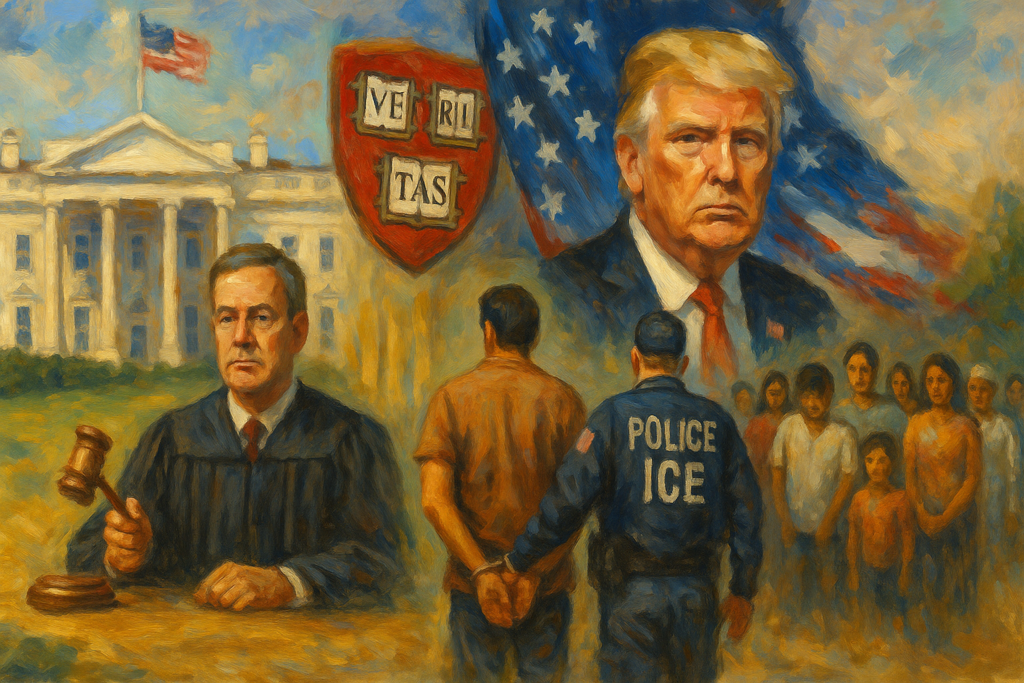
This week’s throughlines
- The campaign against Harvard widened from rhetoric to administrative punishment — What began with attacks on Harvard's foreign student enrollment became a broader pressure campaign: revoking its ability to enroll foreign students, pausing student visa interviews, canceling federal contracts, and finally imposing social media screening for Harvard-linked visa applicants. Courts repeatedly intervened to preserve the status quo.
- Immigration enforcement escalated while due process fights intensified — The week moved from individual cases of wrongful detention and revoked humanitarian relief to system-level escalation: a daily arrest quota, Supreme Court backing for ending parole protections, and continued fights over deportations to third countries. Judges kept pushing back in some cases, but the overall direction was toward more aggressive enforcement.
- Courts remained the main institutional brake on executive overreach — Across trade, immigration, university policy, local funding disputes, and retaliation against law firms and broadcasters, judges repeatedly limited or delayed executive action. Some rulings were quickly appealed or narrowed, but the judiciary remained the central arena where the week's power struggles were contested.
- Clemency, self-dealing, and loyalty politics blurred public and private power — A cluster of pardons for politically connected or donor-adjacent figures, reporting on Trump-linked business advantages abroad, and new investment products tied to presidential policy all reinforced concerns that access, loyalty, and personal gain were increasingly entangled with state power.
The week opened with a stark contrast between an administration accelerating its use of unilateral power and a set of institutions—courts, universities, media outlets, parents, and protesters—trying to hold the line. From military academies to immigration courts, from tariff tribunals to school boards, the central question was how far executive authority can reach before other parts of the system push back.
Over the weekend, the White House moved quickly on culture and control inside the federal government. A new executive order dismantled diversity, equity, and inclusion programs across federal entities, with immediate and visible effects at service academies. At West Point, women’s, Latinx, and LGBTQ+ student groups were disbanded and their materials ordered removed. The next day, Trump appeared at the academy’s graduation in a campaign hat and delivered overtly partisan remarks. Retired officers criticized the spectacle as a breach of the military’s nonpartisan tradition, underscoring how ceremonial roles and internal policies were being used together to reshape the culture of a key national institution.
At the same time, the administration began narrowing the public record of its own words. The White House stopped publishing official transcripts of Trump’s speeches and removed many that had already been posted, leaving only a limited set of videos. For journalists, historians, and citizens, this shift made it harder to search and verify what the president has said. It also fit into a broader pattern that would become clearer as the week went on: efforts to control information, punish critical outlets, and elevate loyal ones.
On the economic front, Trump announced a 50 percent tariff on European Union goods, to take effect June 1, and threatened a 25 percent tariff on Apple products unless the company moved production to the United States. Within a day, the administration extended the EU deadline to July 9, citing ongoing talks, but the abrupt announcement and quick adjustment left businesses and allies facing deep uncertainty. These moves previewed the legal battles that would unfold later in the week over how far a president can go in using emergency powers to reshape trade without Congress.
Immigration enforcement also produced early flashpoints. A federal judge ordered the administration to return a gay Guatemalan asylum seeker who had been deported without proper hearings, highlighting how rushed procedures can violate basic due process. In Alabama, a U.S. citizen filming a worksite raid was tackled and detained after officers dismissed his Real ID as fake. And in California, officials revoked humanitarian parole for a four-year-old Mexican girl receiving life-saving medical care, despite warnings that she could die without treatment. These individual cases showed how aggressive enforcement can sweep in citizens and vulnerable people alike, eroding trust in the system.
Harvard emerged over the weekend as a central target of federal pressure. The administration informed the university that it would lose the ability to enroll foreign students, citing Harvard’s refusal to share information about protests and coursework. Trump publicly complained that Harvard admits too many international students and demanded a list of them, even though immigration authorities already hold that data. Harvard responded by suing, and a federal judge quickly issued a temporary restraining order blocking the policy. That early court intervention set up a week-long struggle over whether immigration and funding tools could be used to discipline a single university.
Other developments rounded out the weekend’s picture of a country under strain. The white nationalist group Patriot Front marched in Kansas City, a reminder that organized extremism remains visible and active. FEMA denied North Carolina’s request for full federal funding to remove debris from 2024’s Hurricane Helene, despite earlier commitments, raising questions about the consistency of disaster aid. States and cities, meanwhile, moved to loosen housing constraints through environmental review changes, upzoning, and new design rules. New data showed mass shootings and violent crime declining toward levels not seen in decades, even as national rhetoric continued to emphasize crisis and disorder. And federal judges, worried about rising threats and political attacks, began discussing whether to create their own armed security force independent of the Justice Department and U.S. Marshals Service—a sign of fraying trust between branches of government.
By Monday, the blending of personal, political, and state power was on full display. Trump issued an unconditional pardon to former Culpeper County sheriff Scott Jenkins, who had been convicted of conspiracy, fraud, and bribery for selling deputy badges that conferred legal privileges. The White House framed the move as correcting an overzealous prosecution and hostile judge. Freeing a law-enforcement official convicted of monetizing public power signaled that loyalty and narrative alignment with the president could outweigh court judgments, and it foreshadowed a broader wave of clemency for well-connected figures.
The administration also escalated its confrontation with public media. NPR and several Colorado public radio stations filed suit challenging an executive order that barred federal agencies from spending congressionally appropriated funds on NPR and PBS. They argued that the order violated both Congress’s constitutional control over spending and the First Amendment, framing it as retaliation for critical coverage. The case linked directly to the White House’s earlier decision to remove speech transcripts: together, they pointed to an effort to both limit official records and punish independent outlets that shape public understanding of those records.
Courts continued to assert their role in immigration oversight. A federal judge rejected the administration’s attempt to delay or undo an order requiring that men deported to South Sudan remain in U.S. custody for “reasonable fear” interviews. The judge accused officials of mischaracterizing his ruling and creating chaos, insisting that even in an aggressive enforcement environment, basic screening procedures must be followed before people are sent to dangerous conditions abroad.
The Harvard conflict deepened as the administration signaled plans to require social media screening for all foreign student visa applicants and ordered embassies to pause new interview scheduling while procedures were developed. Universities warned of financial and academic fallout, noting that broad social media vetting could chill speech among students and scholars who depend on U.S. visas. At the same time, acting through the General Services Administration and multiple departments, the administration ordered agencies to cancel roughly $100 million in contracts and grants with Harvard, including research and clinical trials tied to veterans’ health. The use of contracting power and visa controls against a single institution underscored how immigration and procurement tools were being repurposed as levers of ideological pressure.
Elsewhere, Deputy FBI Director Dan Bongino announced that the bureau would reopen investigations into the 2023 discovery of cocaine at the White House and the leak of the Supreme Court’s Dobbs draft opinion, while devoting more resources to the unresolved January 6 pipe bomb case. And abroad, Islamic State media incorporated Trump’s tariff policies into propaganda about Western decline, showing how domestic economic decisions can be repurposed by adversaries to fuel recruitment narratives.
Tuesday brought into focus the scale of Trump’s reliance on unilateral authority. Reports tallied 152 executive orders signed since his return to office, far outpacing recent predecessors and shifting policymaking away from Congress. In parallel, senior aide Stephen Miller floated the idea of suspending the writ of habeas corpus—allowing detention without charge—even though the Constitution reserves that power to Congress and only in cases of rebellion or invasion. The suggestion did not become policy, but its public airing signaled a willingness to contemplate extraordinary measures that would weaken core protections against arbitrary detention.
Clemency decisions continued to blur the line between justice and favoritism. Trump pardoned reality television personalities Todd and Julie Chrisley, convicted of defrauding banks and evading taxes, after their daughter campaigned for him. These pardons joined relief for corrupt officials and donors, reinforcing a pattern in which personal and political ties appeared to drive leniency for serious financial crimes. Against the backdrop of harsh immigration enforcement, the contrast between mercy for well-connected offenders and the treatment of migrants with no criminal history became more pronounced.
The judiciary, however, was not passive. By late May, at least 177 judicial rulings had paused Trump administration actions, from unlawful firings to civil-rights rollbacks. Democratic state attorneys general had prepared and filed numerous suits anticipating overreach. Judges, already discussing their own security force, now faced direct rhetorical attacks. In a Memorial Day post, Trump called judges “USA hating” and blamed them for letting “dangerous criminals” into the country, urging the Supreme Court to intervene against “monsters” in the judiciary. The comments came as courts blocked his order targeting the WilmerHale law firm and allowed a lawsuit over Elon Musk’s role in a federal efficiency office to proceed. The president’s language framed legal oversight as unpatriotic obstruction, even as those same courts were adjudicating the limits of his power.
The Harvard saga advanced on multiple fronts. The university expanded its legal challenge, updated its public messaging, and rallied support from more than 200 college leaders, turning its case into a broader defense of academic autonomy. Meanwhile, a State Department cable ordered embassies worldwide to halt new student visa interviews, and the administration moved to cancel all federal contracts with Harvard. The fight over one university’s foreign students and research funding became a proxy for wider battles over who controls campus speech, diversity initiatives, and international collaboration.
Trade policy reached a critical juncture as well. The U.S. Court of International Trade and other federal judges ruled that most of Trump’s “Liberation Day” and reciprocal tariffs exceeded his authority under emergency statutes and violated the Constitution’s assignment of tariff power to Congress. The courts held that laws like the International Emergency Economic Powers Act do not grant unbounded authority to impose tariffs. The administration immediately filed emergency appeals, and an appellate court issued a temporary stay, keeping the contested tariffs in place while arguments proceed. In practical terms, businesses and consumers continued to face higher costs, even as judges signaled that the underlying legal theory was likely invalid.
Corporate accountability also came under scrutiny. The Justice Department allowed Boeing to enter a non-prosecution agreement over two deadly 737 MAX crashes, despite a prior deferred prosecution agreement that had been violated. Reporting highlighted Boeing’s $1 million inauguration donation, lobbying ties to Attorney General Pam Bondi, and major contracts negotiated with Trump’s involvement. For critics, the outcome reinforced perceptions that large, politically connected firms can secure favorable legal treatment after catastrophic failures. In the media sphere, coverage of the NPR lawsuit described a broader pattern in which the administration steered benefits toward friendly outlets, law firms, and universities while targeting those seen as hostile. And in the private sector, Elon Musk’s AI company xAI acquired social media platform X, concentrating control over a vast trove of user data and a major channel for political discourse in a single private actor.
Wednesday’s developments highlighted both selective mercy and intensified enforcement. Trump commuted the sentence of Larry Hoover, the former leader of the Gangster Disciples, who had been serving multiple life terms, and granted clemency to several political figures convicted of tax fraud. These decisions, like the earlier pardons, stood in sharp contrast to the administration’s portrayal of undocumented immigrants as uniquely dangerous and its refusal to extend similar leniency to them. The pattern suggested that access and notoriety, rather than neutral criteria, were shaping who benefited from the president’s clemency power.
Inside the State Department, a quieter but significant restructuring took place. The office of analytic outreach, which had linked government analysts with outside experts and research institutions, was permanently closed as part of a broader reorganization that also involved staff cuts and office closures. Reducing structured contact with external expertise narrowed the information base for foreign policy decisions and increased the risk that analysis would become more insular and politicized.
Immigration enforcement escalated sharply. Homeland Security Secretary Kristi Noem and Stephen Miller ordered immigration agents to triple daily arrests to 3,000 per day, and ICE adopted a formal 3,000-per-day arrest quota. To meet these targets, agents were drawn from other federal agencies, and operations expanded into courthouses and other previously sensitive locations. Detention facilities grew more crowded, and due-process concerns deepened as volume took precedence over individualized judgment. These policies built on the weekend’s individual cases, showing how systemic quotas can magnify the risks of wrongful detention and family separation.
The administration’s cultural agenda continued to touch on gender and identity. The Justice Department opened an investigation into whether California’s law allowing trans girls to compete in girls’ sports violated Title IX, following Trump’s earlier executive order banning trans athletes from girls’ and women’s sports nationwide. Using federal civil-rights law to restrict transgender participation reframed equality protections as tools for exclusion, with implications for LGBTQ+ rights beyond athletics.
Outside government, citizens organized their own responses to what they saw as authoritarian drift and concentrated tech power. Grassroots networks under banners like 50501, Fox Takedown, Purge Palantir, and Tesla Takedown continued decentralized protests across all 50 states. Demonstrations targeted Fox affiliates, surveillance contractor Palantir, and Elon Musk’s companies, combining street protests with boycotts and showroom actions. In Oklahoma, parents and educators mobilized against new social studies standards that embedded 2020 election conspiracies and Christian nationalism. Under the banner “We’re Oklahoma Education,” parents used a parental opt-out law to shield their children from the curriculum, while parents, grandparents, and teachers filed a lawsuit arguing that the standards were rushed through without proper transparency or review. These efforts framed curriculum as a battleground over public memory and civic education.
By Thursday, the legal struggle over tariffs reached a new stage. A three-judge panel at the Court of International Trade again ruled Trump’s “Liberation Day” tariffs illegal, reaffirming that Congress—not the president—has the exclusive power to impose tariffs. Other federal panels blocked wide-ranging tariffs, including those on China, finding that emergency statutes did not authorize such sweeping measures. Yet appeals courts quickly granted temporary stays, allowing the tariffs to remain in force while the administration pursued further appeals. The rulings underscored Congress’s constitutional role over trade and taxation, while the stays illustrated how emergency appeals can keep contested policies in place for extended periods.
Environmental law and climate policy also came before the courts. In an 8–0 decision, the Supreme Court overturned a lower-court ruling that had halted the Uinta Basin Railway, a project to move Utah crude oil to Gulf Coast refineries. The Court endorsed a narrower reading of the National Environmental Policy Act, limiting how far agencies must look at downstream environmental impacts when reviewing projects. The decision made it easier to approve large fossil fuel infrastructure, even as twenty-two young Americans filed suit arguing that Trump’s executive orders declaring a “national energy emergency,” promoting coal, and suppressing climate science violated their constitutional rights and statutory protections. Their case sought to establish that climate harms have a constitutional dimension that can constrain executive action.
The week’s broader struggle over visibility and identity came into sharper focus as Utah became the first state to explicitly ban LGBTQ+ flags at government buildings and schools, imposing daily fines for violations. Idaho and Montana followed with similar bans. At the federal level, the administration’s attacks on DEI and trans rights contributed to a climate in which major corporate sponsors pulled back from Pride events nationwide, forcing organizers to scale down or seek new funding. These measures restricted symbolic expression and public visibility for LGBTQ+ communities, signaling official disfavor and encouraging further rollbacks of rights.
Harvard, still at the center of the university fight, received a measure of protection from the courts. Judge Allison Burroughs expanded her injunction blocking the administration’s attempt to strip Harvard of its ability to enroll international students, maintaining the status quo while litigation proceeds. The order came after the Department of Homeland Security formally notified Harvard that its certification to host foreign students was being withdrawn. The ruling underscored the judiciary’s role in checking politically motivated use of immigration tools against specific institutions and their students.
In Oklahoma, parents and teachers escalated their legal fight over the state’s social studies overhaul, filing suit to block the new curriculum on the grounds that the board had approved conspiracy-laden standards with almost no time for review. The case challenged both the content and the process used to reshape civic education, testing whether procedural safeguards can slow or reverse efforts to embed disinformation and sectarian narratives in public schools. Meanwhile, following adverse court rulings on his tariffs, Trump posted a meme depicting himself as being on a “mission from God,” echoing QAnon-style imagery and inviting supporters to see legal setbacks as attacks on a divinely sanctioned leader.
Public health preparedness took a hit as the administration terminated a nearly $600 million contract with Moderna to develop a bird flu vaccine, forfeiting priority access to doses in a future outbreak and weakening federal leverage over production. And inside the federal workforce, new hiring guidelines barred agencies from considering race or gender and discouraged hiring anyone unwilling to “faithfully serve the Executive Branch,” effectively screening for ideological loyalty. The same day, Trump fired National Portrait Gallery director Kim Sajet over her support for DEI. Together, these moves signaled a push to reshape the civil service and cultural institutions along political lines, turning museums and archives into instruments of the ruling narrative.
Friday capped the week with major immigration decisions and further clashes over information control. In a series of emergency orders, the Supreme Court granted the administration’s requests to revoke Temporary Protected Status and terminate special parole programs covering more than 500,000 people from Venezuela, Cuba, Haiti, and Nicaragua. The decisions reversed lower-court stays and allowed the Department of Homeland Security to proceed with removals while litigation continues. Dissenting justices highlighted the severe consequences for long-settled migrants, but the immediate effect was to strip legal protections from large communities and increase their vulnerability to deportation.
Even as the high court cleared the way for broad rollbacks, lower courts continued to enforce individual rights. A federal judge in Boston halted a deportation flight carrying eight men to South Sudan and other countries, finding that the administration had violated an earlier order guaranteeing them a chance to challenge their removal. The men were left stranded in Djibouti with ICE officers as the court reasserted its authority. The episode illustrated how, even amid sweeping policy changes, individual deportees retain legal protections that the executive must respect.
The Harvard conflict reached a new phase as Secretary of State Marco Rubio signed a directive requiring consulates to conduct mandatory social media screenings for all visa applicants intending to visit Harvard—students, faculty, staff, and other visitors—as part of a pilot program tied to concerns about antisemitism. Private accounts were flagged as suspicious, and the order followed earlier moves to strip Harvard of research funding and foreign-student privileges. Targeting one university’s visitors for heightened surveillance fused immigration control with ideological scrutiny of academic communities, raising the stakes for international collaboration and academic freedom.
Public media and the courts continued their confrontation with the executive branch over funding and information control. PBS joined NPR in suing to block the executive order cutting federal funding to public broadcasters, arguing that it was unconstitutional retaliation for critical coverage. In a separate case, a federal judge ordered the administration to release more than $12 million in previously allocated funds to Radio Free Europe/Radio Liberty, reinforcing Congress’s authority over appropriations. These cases tested whether the executive can use funding as a weapon against independent media and highlighted the judiciary’s role in protecting both press freedom and legislative control of the purse.
Other developments on Friday pointed to emerging vulnerabilities and quieter trends. The FBI opened an investigation after an impersonator hacked Chief of Staff Susie Wiles’s phone and used AI to mimic her voice in calls to prominent Republicans, seeking pardons and cash transfers. The incident underscored how deepfake-style impersonation of top officials can create new avenues for corruption and disinformation. Economic analyses reported that U.S. health care spending as a share of GDP has been flat since 2009, with the Affordable Care Act credited for significant savings; inflation-adjusted college tuition has fallen since the pandemic, especially at private nonprofits; and service-sector productivity has accelerated even as manufacturing productivity stagnates. These structural improvements suggested that, beneath political turmoil, some aspects of health, education, and services were becoming more sustainable. The Virginia legislature advanced a proposed constitutional amendment to protect abortion rights, requiring another legislative approval before going to voters, while the Federal Election Commission scheduled a closed meeting on litigation strategy under the Sunshine Act, a routine but important part of enforcing campaign-finance rules. Regulatory agencies, from the FDA to the EPA and the National Archives, continued dense but routine work on drugs, devices, food safety, environmental impact statements, and open-government mechanisms, maintaining the machinery that underpins public health and transparency.
Taken together, the week’s events traced a contest over who sets the terms of American public life. The administration leaned heavily on executive orders, clemency, tariffs, and immigration tools to reward allies, punish critics, and reshape institutions from universities to museums. Courts, state officials, parents, educators, journalists, and protesters responded with lawsuits, injunctions, opt-outs, and demonstrations. The outcomes were mixed: tariffs remained in place despite adverse rulings, immigration protections were rolled back even as individual deportations were halted, and Harvard faced new surveillance even as judges shielded its students. Yet the very existence of these countermeasures showed that legal and civic channels remain active, and that the balance between concentrated power and democratic constraint is still being contested in courtrooms, classrooms, and streets across the country.