This week’s throughlines
- Immigration enforcement widened from raids to status insecurity — The week moved from street-level enforcement and court fights over deportation to broader administrative actions affecting TPS holders, refugees, asylum seekers, green-card applicants, and naturalized citizens.
- Federal power was used more openly against political opposition and dissent — Trump’s call to arrest Democratic lawmakers was followed by FBI contacts and an inquiry into those same lawmakers, while speech and press threats widened through the week.
- Courts both checked and failed to sustain accountability — Judges blocked deportation expansion, dismissed unlawful prosecutions, ordered faster disclosure, and rejected some partisan mapmaking, but the Georgia election-interference case against Trump was dropped, ending the last criminal case tied to 2020.
- Election and representation fights intensified across states — The DOJ’s voting-rights posture, Texas and California map fights, pressure on Indiana lawmakers, and reports from Georgia all pointed to a week of escalating conflict over who controls electoral rules.
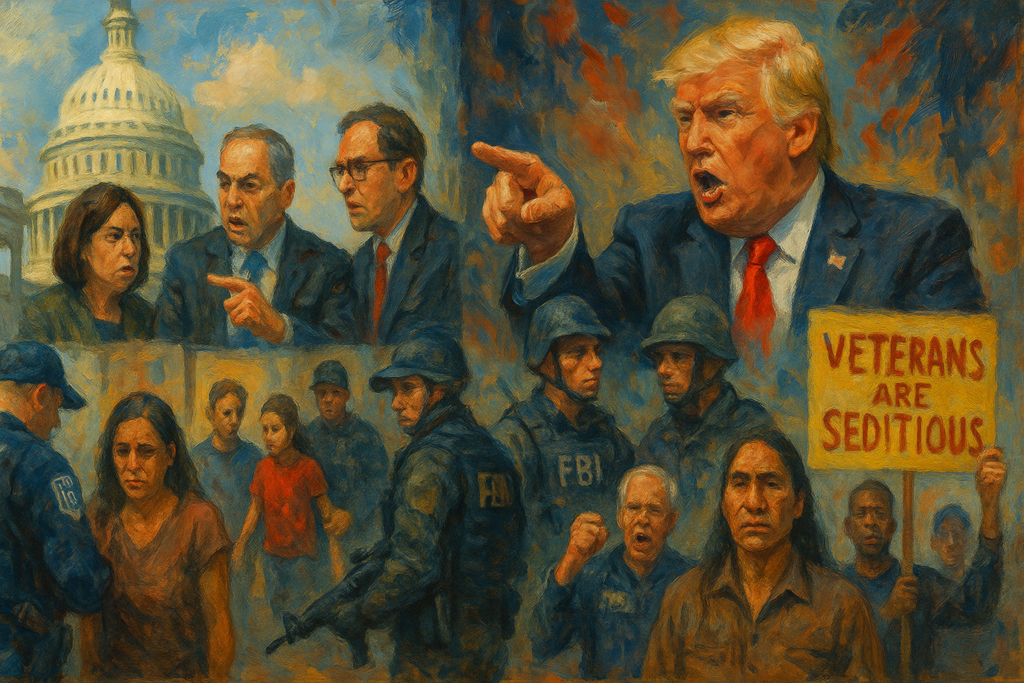
The week unfolded under the shadow of a clash between elected officials and the commander in chief over the basic rules that govern the military. Over the weekend, six Democratic lawmakers who are veterans of the armed forces or intelligence community released a video reminding service members that they are obligated to refuse unlawful orders. The message echoed long‑standing military law, but President Trump denounced the lawmakers as “seditious,” demanded their arrest and trial, and suggested that such conduct could be punishable by death. What began as a civics lesson about lawful service became a test of whether legal constraints on presidential power would be treated as treasonous.
That confrontation set the tone for the days that followed. On Tuesday, the FBI’s counterterrorism division opened an investigation into the six lawmakers, treating their video as a potential security matter rather than protected political speech. Defense Secretary Pete Hegseth ordered the Navy to investigate Senator Mark Kelly’s comments in the video and signaled that Kelly, a retired Navy captain and astronaut, could be recalled to active duty for court‑martial under laws that allow prosecution of some military retirees. Deploying counterterrorism tools and military law against sitting members of Congress for restating legal obligations blurred the line between civilian oversight and the security apparatus, and sent a message to other lawmakers about the risks of publicly questioning presidential orders.
While that domestic struggle over dissent and military obedience was taking shape, another long‑running conflict was being reshaped abroad. Over the weekend, details emerged of a 28‑point Ukraine “peace” plan backed by the Trump administration that closely mirrored Russian demands. The proposal would recognize Russian control over Crimea and parts of eastern Ukraine, cap Ukraine’s military, and grant amnesty for Russian war crimes. Ukrainian President Volodymyr Zelensky warned his citizens that he was under intense pressure to sign the agreement before Thanksgiving. A senior adviser to Vladimir Putin publicly rejected an alternative European Union plan and instead praised Trump’s framework, underscoring Moscow’s preference for a deal that would lock in its territorial gains and limit accountability.
By Tuesday, the administration was not only promoting this framework but also shaping public perception through disinformation. Officials leaked to reporters that a Ukraine peace deal had already been reached, even as both Zelensky and Russian officials denied any such agreement. The leaked terms again tracked closely with a Russian‑drafted plan previously pushed by Trump’s envoys. The false story suggested an effort to create a sense of inevitability around concessions to Russia, potentially boxing in Ukraine and U.S. allies by presenting surrender terms as a fait accompli.
The week’s other early developments showed federal power being asserted in more routine but still consequential ways. House Democrats released emails suggesting that Trump had knowledge of Jeffrey Epstein’s abuse, intensifying bipartisan calls to unseal Epstein‑related records. The Justice Department renewed its own request to unseal grand jury materials in the case, and a federal judge ordered expedited processing of related Freedom of Information Act requests. These moves, combined with congressional pressure, increased the likelihood that the public will eventually see more of how authorities handled a major case involving elite sexual abuse, even as debates continued over how to protect victims’ privacy.
On immigration, the weekend brought a sharp contrast between judicial limits and administrative expansion. A federal appeals court blocked the administration’s attempt to broaden fast‑track deportations for people who had been in the United States less than two years, citing due process concerns and the need for basic hearing rights. At the same time, the Justice Department moved to recruit specialized “deportation judges,” signaling a structural expansion of the removal apparatus even as courts imposed procedural constraints. On the ground, Border Patrol and ICE operations spread fear far from the southern border: masked agents in North Carolina conducted street operations that residents described as kidnappings, keeping children from school and adults from work; in Oregon, ICE detained a U.S. citizen high‑school student during lunch and then sought to charge him; and a raid on a South Korean‑owned battery factory in Georgia prompted a diplomatic apology and questions about whether arrest quotas were driving enforcement.
Monday showed how these threads—immigration, institutional capacity, and executive power—were being woven into broader policy. The administration ended Temporary Protected Status for nearly 4,000 people from Myanmar, ordered a review of all refugees admitted under the Biden administration with a freeze on their green‑card processing, and increased ICE detention of children separated from families after traffic stops. These steps built on the weekend’s announcement that TPS for about 700 Somalis was under review and signaled a coordinated tightening of humanitarian protections. ProPublica reporting the same day that ICE had detained more than 600 immigrant children in federal shelters this year, many separated from their families and held for extended periods, revived concerns that family separation was again functioning as an enforcement tool.
At the institutional core of federal law enforcement, Monday also brought news of a sweeping purge inside the Justice Department. Reports described about 5,500 DOJ employees being removed, including 70 percent of the civil rights division and most of the public integrity section, which was reduced to two lawyers. The voting section’s work was redirected toward advancing Trump’s electoral agenda. Against this backdrop, Georgia prosecutors moved to dismiss the last remaining 2020 election racketeering case against Trump and his allies after District Attorney Fani Willis was disqualified. The move effectively ended that line of criminal accountability for efforts to overturn the 2020 results in Georgia. At the same time, federal courts were pushing back on other politicized prosecutions: building on a weekend ruling, additional orders clarified that Lindsey Halligan’s appointment as interim U.S. attorney had been unconstitutional, voiding her indictments of former FBI Director James Comey and New York Attorney General Letitia James. The decisions underscored that even high‑profile cases must rest on lawful appointments, and that irregular personnel moves cannot be used to target political opponents without judicial scrutiny.
Monday’s docket also showed the executive branch extending its reach into new domains. Trump signed an order creating the “Genesis Mission,” a national artificial intelligence initiative centered in the Department of Energy to harness federal datasets for scientific and security uses. Centralizing AI efforts under the executive branch promised long‑term influence over a strategic technology that touches defense, surveillance, and the economy. The same day, the administration designated certain Muslim Brotherhood chapters in Lebanon, Jordan, and Egypt as terrorist organizations, expanding sanctions and surveillance tools with limited congressional input. In public health, HHS Secretary Robert F. Kennedy Jr. acknowledged directing the Centers for Disease Control and Prevention to alter its website language on vaccines and autism, despite scientific consensus that there is no causal link. After public pushback from Senator Bill Cassidy and others, the CDC added a note referencing Kennedy’s prior promise not to change the statement, highlighting how political interference in scientific messaging can undermine trust in health institutions.
Tuesday deepened the theme of legal tools being used to reshape elections and shield allies. Details emerged of a November 7 Trump pardon intended for Rudy Giuliani and others involved in the fake elector scheme but written broadly enough that it may cover any U.S. citizen involved in 2020 voter fraud. Defendants in unrelated cases began invoking the pardon to seek dismissal. If courts interpret it expansively, the measure could immunize a wide range of election‑related crimes, weakening deterrence against future attempts to subvert results. At the same time, a federal court blocked Texas’s mid‑decade congressional map, which would have added several Republican‑leaning districts, pending Supreme Court review. In Indiana, lawmakers who resisted a Trump‑backed redistricting plan reported being swatted at their homes, and one Republican senator publicly opposed the plan, citing Trump’s derogatory remarks about people with intellectual disabilities. The combination of judicial intervention and intimidation tactics showed how the struggle over representation now involves both courtroom battles and coercive pressure on legislators.
Civil liberties and social policy were also contested on Tuesday. Tennessee’s secretary of state ordered 181 public libraries to review and remove books with LGBTQ themes or characters, citing state anti‑DEI law and a Trump executive order against “gender ideology.” Libraries closed temporarily to conduct the purge, raising serious First Amendment and equal‑protection concerns about state‑mandated viewpoint censorship. Elsewhere, twenty states and Washington, D.C. filed suit against the administration’s changes to HUD homelessness policy that would cut funding and impose new conditions likely to harm trans and nonbinary people, using federalism and civil‑rights arguments to resist the shifts. Activists targeted the infrastructure of immigration enforcement through protests at airports in Houston and New Haven against Avelo Airlines’ role in deportation flights, legal challenges by contractors over lost ICE business, and a Thanksgiving‑week boycott campaign aimed at major retailers tied to ICE operations. These efforts showed how economic pressure and public disruption were being used to challenge the privatized systems that underpin mass deportation.
By midweek, the erosion of legal constraints on Trump was becoming more visible, even as some courts asserted themselves. On Wednesday, Georgia prosecutor Pete Skandalakis formally moved to dismiss the 2020 racketeering case against Trump and his co‑defendants, and a judge granted the request, closing one of the last major criminal avenues for holding a former president accountable for efforts to overturn certified election results. Yet the same day, the conservative 11th Circuit Court of Appeals upheld nearly $1 million in sanctions against Trump and lawyer Alina Habba for a conspiracy‑laden RICO suit targeting Hillary Clinton, the Democratic National Committee, and James Comey, describing it as part of a pattern of meritless litigation. The ruling signaled that at least some courts remained willing to penalize attempts to weaponize the judiciary for political vendettas.
State courts were also wrestling with transparency and accountability in policing. The Florida Supreme Court ruled that Marsy’s Law, a victim‑rights measure, does not automatically grant anonymity to officers involved in fatal incidents, curbing its use to hide their identities. The Ohio Supreme Court, by contrast, allowed anonymity in one bank‑robbery shooting case while rejecting it in another involving the killing of Ta’Kiya Young, reflecting ongoing tension between public oversight and officer safety. In the social safety net, a coalition of 21 states and D.C. sued over new guidance restricting SNAP eligibility for some legal immigrants, including refugees and asylum seekers, arguing that the changes would worsen food insecurity and effectively narrow access to basic nutrition along lines of origin and legal category.
Economic policy and national security concerns intersected on Wednesday as well. The administration quietly implemented a $12 billion bailout for farmers hurt by its own trade war, aiming to offset losses from tariffs that had benefited foreign competitors. At the same time, Small Business Administration head Kelly Loeffler publicly blamed the previous administration for economic woes without offering remedies. The bailout, coming amid reports of rising power bills and utility shutoffs in multiple states, illustrated how public funds were being used to patch over self‑inflicted trade damage while political narratives deflected responsibility. Separately, reporting revealed that xAI’s Colossus data center in Tennessee, used by the U.S. military, relied on more than 2,000 metric tons of Chinese‑made transformers, and a lawsuit alleged that a subcontractor with Russian ties had taken unauthorized photos inside the facility. The revelations raised alarms about dependence on foreign hardware and potential insider breaches at a critical AI installation that had been elevated by the Genesis Mission initiative.
Thanksgiving Day brought a series of moves that went directly to the foundations of legal continuity and belonging. Trump announced that he would cancel most executive orders signed by President Biden that used an autopen, alleging without evidence that aides had acted without Biden’s consent and hinting at perjury charges. Autopen use has long been accepted for routine presidential signatures; framing it as inherently illegitimate opened the door to retroactively voiding prior executive actions on dubious grounds. In immigration, DHS and USCIS ordered expanded reviews of asylum cases and green cards and halted processing of Afghan nationals’ residency applications, including for people who had worked with U.S. forces. These steps, layered on top of earlier TPS cancellations and refugee reviews, signaled that even those who had assisted the United States in war zones could not rely on settled expectations of protection.
Individual cases illustrated the human impact of these policies. In Dallas, ICE detained Maher Tarabishi, a 62‑year‑old father and primary caregiver for his son with a rare disease, during a routine check‑in, labeling him a “criminal alien” and terrorist despite decades in the country and no criminal record. His family struggled to locate him after he was transferred to a remote detention facility. In Seattle, ICE officers detained Elaine Miles, a Native American actor, after claiming her tribal ID looked fake; they refused her offer to verify her identity with her tribe and tried to confiscate her phone before releasing her. The incident highlighted racial profiling and ignorance of tribal sovereignty, showing how Native Americans can be swept into immigration enforcement despite their citizenship. Chicago faith leaders responded to broader detention practices by filing a First Amendment lawsuit alleging that DHS had blocked clergy from providing spiritual care and sacraments to detained immigrants, framing enforcement as a test of religious freedom as well as civil rights.
The president’s Thanksgiving message itself underscored how citizenship was being rhetorically weaponized. In remarks that veered from holiday themes into a broadside against immigrants and communities of color, Trump threatened to strip citizenship from naturalized Americans he deemed “non‑compatible with Western civilization.” While no immediate legal mechanism accompanied the threat, it signaled a willingness to treat naturalization as conditional on cultural and political conformity. On the cultural front, the earlier Tennessee order to purge LGBTQ‑themed books from libraries foreshadowed a hearing in North Carolina, where the Chapel Hill School District was summoned before the state House Oversight Committee on charges of violating new anti‑trans and anti‑DEI laws by using preferred pronouns and endorsing diversity initiatives. The hearing showed how state legislatures were using oversight powers to enforce ideological conformity in schools and chill support for LGBTQ students.
Political violence and speech were also linked on Thursday. In the wake of conservative activist Charlie Kirk’s assassination by a leftist radical, Trump and his allies issued threats against Democrats and floated new limits on freedom of speech, using rhetoric reminiscent of civil war. The killing was framed not only as a crime but as a justification for curbing what could be said by political opponents. In a separate but related pattern, Trump continued his habit of verbally attacking journalists, calling one female reporter a “stupid person” and referencing past insults about another’s appearance at a press conference, contributing to a hostile environment for the press and particularly for women reporters.
Friday capped the week with further expansions of executive power and a clearer picture of foreign‑policy realignment. Domestically, Trump used emergency authority to order Consumers Energy to keep the JH Campbell coal plant in Michigan running despite plans to retire it, invoking a national energy emergency. The order shifted an estimated $113 million in costs onto ratepayers across the Midwest, prompting Michigan’s attorney general to move to challenge it. The decision illustrated how emergency powers can be used to override state decisions and favor particular industries, with consumers bearing the financial burden. In the realm of clemency, Trump announced his intention to grant a full pardon to former Honduran president Juan Orlando Hernández, who is serving a 45‑year U.S. sentence for drug trafficking and weapons charges tied to cocaine shipments. Extending clemency to a foreign leader convicted in U.S. courts signaled that pardons could be used to rehabilitate powerful allies abroad, complicating anti‑corruption and anti‑drug efforts.
Symbolically, Trump signed an order designating the date of Charlie Kirk’s assassination as a National Day of Remembrance, framing the killing as the work of the “radical left” and embedding that narrative in official commemoration. The move followed earlier calls for speech restrictions and threats against Democrats, using the tools of presidential symbolism to enshrine a partisan reading of political violence. A broader review of the year’s actions noted that throughout 2025 Trump had issued numerous executive orders expanding presidential power beyond peacetime norms, challenging institutions from the media to the Federal Reserve and courts, with only the Supreme Court remaining as a partial check. Regulatory agencies continued their routine work—such as the FCC’s inquiry into local TV public‑interest obligations and paperwork for the E‑Rate program that funds internet access in schools and libraries—but these quieter processes unfolded against a backdrop of escalating rhetorical attacks on the press and threats to revoke broadcast licenses.
Abroad, the Ukraine story that had opened the week reached a new stage. A transcript published by Bloomberg showed Trump adviser Steve Witkoff coordinating directly with senior Russian officials to pressure Ukraine into accepting the 28‑point surrender plan drafted in Moscow. Separate reports confirmed that Trump had sent envoys, including Witkoff and Jared Kushner, to Moscow with a proposal to recognize Russian control over eastern Ukraine. The disclosures made explicit that U.S. policy was being shaped in close consultation with Russian officials on terms favorable to Moscow. As these revelations emerged, Russia launched a major attack on Kyiv, firing 22 missiles and 460 drones that killed at least nine civilians and destroyed civilian infrastructure. Trump offered no substantive public response, focusing instead on domestic political moves. The silence during a significant escalation, combined with the documented coordination on a surrender plan, raised profound questions about whose interests U.S. foreign policy was serving and how reliable Washington remained as a security partner.
On the immigration front, there were signs that organized resistance could still alter federal tactics. In North Carolina, Border Patrol withdrew agents earlier than planned, ending “Operation Charlotte’s Web” after significant local resistance. Activists and students had organized protests, mutual aid, and food deliveries for those afraid to leave home during the street operations. The early withdrawal showed that coordinated local organizing could force changes in enforcement strategies, even when operations were framed as matters of national security.
Taken together, the week’s events traced a pattern of executive power being used to shield allies, reshape legal baselines, and pressure institutions at home and abroad, while courts, states, faith leaders, and local communities mounted scattered resistance. Immigration and citizenship were increasingly treated as tools of control and fear, with status and even naturalization portrayed as contingent on political and cultural alignment. Foreign policy drifted toward Russian preferences in Ukraine, even as Russia escalated its assault on Kyiv. At the same time, some courts enforced appointment rules, sanctioned frivolous litigation, and limited secrecy around police violence; states and cities sued over social‑service cuts and detention practices; and consumers and activists targeted the corporate infrastructure of enforcement. The balance between concentrated executive authority and the diffuse checks of a constitutional system remained unsettled, with each new order, lawsuit, and protest helping to define the practical boundaries of democratic governance.