This week’s throughlines
- Mail-voting restrictions moved through multiple channels — The week opened with House Republicans attaching voting restrictions to the NDAA, then shifted into litigation as the administration asked the Supreme Court to let its mail-voting order take effect, while some lower-court rulings still limited federal reach.
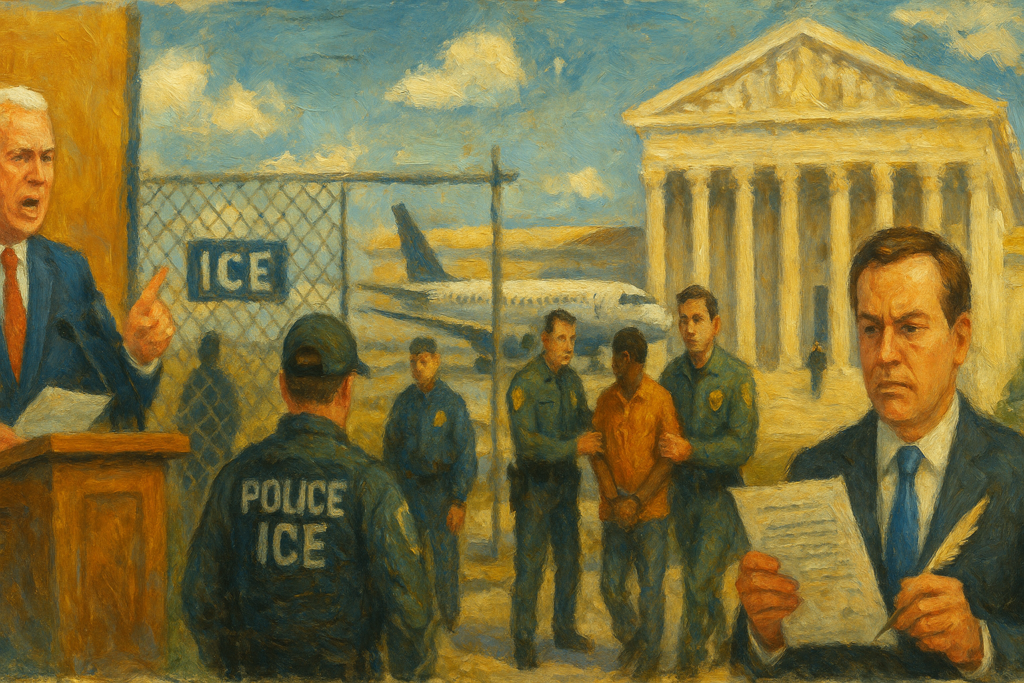
- Immigration enforcement escalated from legal exposure to operational expansion — After the Supreme Court cleared the way to end TPS for Haitians and Syrians, ICE prepared broader arrests, faced new scrutiny over detention conditions and forced treatment, and was tied to airport arrests and information-sharing that swept in children and sponsors.
- The Smithsonian fight escalated from criticism to direct intervention — A White House report and congressional hearings criticizing the National Museum of American History turned into executive orders mandating accusatory signage and reports of efforts to influence the Smithsonian’s board.
- Iran war oversight remained contested and opaque — The administration defended its legal theory for ongoing military action while casualty figures were repeatedly revised, and the Senate ultimately declined to reassert its authority over continued hostilities.
- The Todd Blanche nomination became a proxy fight over corruption and control of the Justice Department — Public opposition, testimony, and Senate resistance turned Blanche’s confirmation into a broader dispute over Trump-linked legal protections, Epstein-related transparency, and the independence of federal law enforcement.
The week unfolded as a contest over who gets to set the rules of public life: how Americans vote, how aggressively the government can police immigration status, and how far the White House can go in pressuring national institutions to tell the country’s story on its own terms. Across those fights, the same pattern kept reappearing. The administration pushed through several channels at once—Congress, the courts, executive orders, and agency action—while judges, watchdogs, and, at times, lawmakers tried unevenly to slow or narrow that reach.
Over the weekend, the fight over voting rules moved on two tracks at once. In the House, Republicans passed a defense package merged with the Save America Act, tying military legislation to a ban on mail ballots and new voter ID requirements. In the courts, the First Circuit refused to stay an injunction against parts of the administration’s election order, preserving a lower-court limit on federal involvement in state-run elections. Together, those moves showed how the same goal—tightening ballot access before the midterms—was being pursued both legislatively and through executive action, even as judges continued to question the federal government’s role.
At the same time, the White House opened an unusually direct campaign against the Smithsonian. Trump ordered signs outside the National Museum of American History accusing it of inaccuracy and directing visitors elsewhere for information. The move followed broader White House criticism of the museum’s treatment of slavery, racism, and national history, and coincided with congressional scrutiny of museum leadership. What began as an argument over interpretation was already becoming something more concrete: an attempt to use presidential power to pressure a major public cultural institution over how it presents the American past.
Another weekend disclosure sharpened a different concern about the use of federal power. In court filings, the administration acknowledged that billions of dollars in clean-energy cuts had been determined by whether states backed Kamala Harris in 2024. That admission undercut earlier claims that the cuts were about waste and gave new force to accusations that federal spending decisions were being used to reward allies and punish opponents. The issue was not only energy policy. It was whether the machinery of government was being administered on neutral terms at all.
The administration also revived broad tariffs after earlier legal setbacks, announcing new duties on goods from dozens of countries under a different legal theory after prior tariffs had been struck down. New challenges followed quickly. The immediate subject was trade, but the larger institutional question was familiar: whether the White House could keep reaching for unilateral powers after courts had already rejected one version of the same effort.
Immigration was already hardening into one of the week’s central stories. The Supreme Court cleared the way for the administration to end Temporary Protected Status for Haitians and Syrians, putting hundreds of thousands of people at risk of losing work authorization and legal presence. That legal change quickly became an enforcement story, with ICE expected to expand arrests and deportations as protections expired. At the same time, Venezuelan men sued aviation contractors over deportation flights to a Salvadoran prison, alleging unlawful collaboration in rendition. A court-appointed monitor reported severe failures in medical care at a California ICE detention center, and a separate report said at least one hunger striker had been subjected to forced medical treatment. By the end of the weekend, immigration policy was no longer just a matter of status categories and court orders. It had become a story about detention conditions, outsourced enforcement, and the coercive edge of removal.
The weekend also brought a transparency fight over the Iran conflict. Critics accused the administration of withholding the names of service members killed there, while the Pentagon revised casualty figures and created new reporting categories that changed how deaths and injuries were counted. Those revisions made it harder for the public and Congress to understand the human cost of the war and the legal footing on which it continued. Elsewhere, the White House pushed ahead with plans affecting historic preservation, including preparations to paint the Eisenhower Executive Office Building despite legal objections, revisions that would weaken Section 106 review and public input, and a proposed triumphal arch near Arlington that lawmakers said lacked legal authorization. The subjects were different, but the thread was similar: reduced oversight over projects that shape public memory and the federal landscape.
By Monday, the administration had taken the voting fight to the Supreme Court. After lower-court setbacks, it and allied states asked the justices to allow full enforcement of Trump’s executive order restricting mail voting. The appeal sought to narrow ballot access through the courts even as Senate Republicans resisted Trump’s separate push to scrap the filibuster for voting legislation. The day made clear that the administration was not relying on any single route. If Congress could not deliver all the restrictions it wanted, the judiciary might.
Monday also sharpened the constitutional dispute over Iran. Trump formally notified Congress about military action while arguing that the War Powers timeline did not constrain him because hostilities had effectively ended earlier. Critics saw that as a legal theory designed to minimize Congress’s role in authorizing ongoing conflict. Coming after the casualty-reporting confusion of the weekend, the notice underscored how the administration was pairing broad claims of presidential war authority with shifting public accounts of the war’s costs.
Another Monday fight centered on the Justice Department. Todd Blanche’s expected confirmation as attorney general drew public opposition, testimony from former DOJ lawyer Liz Oyer, and reports that survivors of Jeffrey Epstein’s abuse feared his leadership would suppress accountability. Oyer said she received death threats after testifying, a sign of the pressure surrounding the nomination. This was not a routine personnel battle. Because the attorney general controls federal prosecutions and civil-rights enforcement, Blanche’s nomination became a proxy fight over whether the department would be run on professional independence or personal loyalty. In a smaller but telling development, the Justice Department moved to dismiss charges against California labor leader David Huerta, who had been arrested during a protest against an ICE operation. Dropping the case undercut a prosecution that had been widely criticized as an attempt to chill protest.
Tuesday was one of the week’s densest days, especially on immigration. A court monitor found severe medical neglect at a California ICE facility. Reports said ICE was arresting immigrants at airports over expired visas, including some with pending applications. It also emerged that the Office of Refugee Resettlement had shared hundreds of thousands of leads with ICE, contributing to arrests of children and sponsors. A judge blocked some warrantless ICE actions near churches, a narrower form of legal pushback that showed courts could still intervene at the margins even as the broader enforcement system expanded. By this point, the administration’s immigration agenda was reaching well beyond the border, into detention, family life, religious spaces, and the child-welfare system.
Tuesday also brought a notable judicial check in public health. A federal judge halted changes to the vaccine schedule made under Health and Human Services Secretary Robert F. Kennedy Jr. and paused the work of the advisory committee behind them, finding legal problems in how the changes had been made. The ruling came in the shadow of an earlier executive order seeking to steer vaccine recommendations. It was one of the clearest examples this week of a court insisting that political control over expert institutions still had to pass through lawful process.
The Smithsonian fight widened further on Tuesday. Congressional hearings continued over the museum’s portrayal of American history, and the White House report attacking the Smithsonian’s narrative gained new force. Trump also excluded the press from major Oval Office meetings that day, reinforcing a broader pattern of tighter control over public information. In a related media development, a bipartisan group of former FCC officials warned that the agency’s review of ABC broadcast licenses, prompted by conservative complaints about bias, risked turning regulation into viewpoint pressure. The Senate, meanwhile, confirmed Jay Clayton as director of national intelligence on a party-line vote, placing another Trump ally in a sensitive national-security post after he avoided direct answers about the 2020 election and voter fraud. The day’s events were not identical, but they pointed in the same direction: pressure on institutions that shape what the public knows, from museums to broadcasters to intelligence leadership.
On Wednesday, the campaign against the Smithsonian moved from criticism and pressure into more formal attempts at control. Trump issued a new executive order formalizing the campaign against the National Museum of American History, while reports said the administration and Vice President JD Vance were delaying Smithsonian Board of Regents nominations in an effort to reshape the board. House Republicans intensified their questioning of museum director Anthea Hartig over alleged ideological bias. The escalation mattered because it shifted the fight from argument over exhibits to influence over governance. The question was no longer just what the museum said, but who would be positioned to decide what it could say in the future.
Immigration enforcement remained under scrutiny on Wednesday as well. A court filing alleged that ICE agents used racial slurs during Los Angeles operations, adding to claims that the problem was not only policy but enforcement culture. Organizers also rallied against a planned ICE detention facility near Gilroy, linking current detention expansion to older civil-liberties abuses. The week’s immigration story was thus widening in two directions at once: more operational reach by the government, and more public evidence and protest focused on how that reach was being exercised.
Wednesday also brought one of the week’s starkest justice-system alarms. James Comey’s lawyers moved to dismiss the criminal case against him as vindictive and selective, while reporting said Secret Service agents had been directed to surveil Comey’s phone and send interview details to Trump after the social-media post that triggered the case. If accurate, that would mean law-enforcement and protective-service tools were being used against a political enemy, with presidential involvement in the flow of information. On the same day, Anthony Fauci repeatedly invoked the Fifth Amendment at a combative Senate hearing on Covid origins led by Rand Paul, an episode that showed how congressional oversight had become entangled with spectacle, intimidation, and long-running distrust of expertise.
Thursday produced the week’s clearest collision between personal interest and public office. The Senate Judiciary Committee first postponed and then halted a vote on Todd Blanche’s nomination after Republican senators demanded changes to a settlement that reportedly granted Trump broad tax immunity and created a $1.8 billion fund. Trump refused to end the arrangement, turning Blanche’s confirmation into leverage in a fight over presidential self-protection. What had begun as a dispute over the future leadership of the Justice Department had now become inseparable from a question of whether presidential power was being used to shield personal financial interests.
The Senate also had a direct chance on Thursday to reclaim some authority over the Iran conflict and declined to do so. It narrowly rejected a resolution that would have required explicit congressional authorization for continued military operations. The vote came as the Pentagon again revised casualty figures upward and as the economic effects of the conflict appeared in weaker GDP growth and market unease. The significance of the vote lay not only in the outcome but in the sequence: after days of disputed casualty reporting and expansive legal claims from the White House, Congress still chose not to reassert its constitutional role over war.
Elsewhere on Thursday, Trump dismissed allegations of Iranian cyberattacks on Minnesota water systems and blamed state officials instead, muddying an already confused public-security picture. Meta announced a deal to use Newsmax content to train its AI systems, raising separate concerns about how low-credibility information could be amplified across major platforms. And the administration ordered 250 Cadillac Escalades for government use, a purchase worth more than $22 million at a time of war costs and economic strain. That last item was minor beside the week’s larger institutional fights, but it served as a small emblem of executive priorities.
Friday was lighter on new top-tier developments, but it extended the week’s main arcs. In Kansas, the Court of Appeals blocked an effort to discard ballots arriving after Election Day if they were postmarked on time, preserving an existing mail-ballot safeguard. At the same time, the administration continued pressing the Supreme Court to enforce its own mail-voting order tied to citizenship lists and Postal Service rules. The FBI’s retrieval of a South Carolina voter’s IP address added a surveillance dimension to election-fraud enforcement. The day captured the split-screen reality of election law at week’s end: some courts were still protecting access even as federal pressure for tighter controls continued.
Immigration scrutiny also continued on Friday, when ICE’s Health Service Corps confirmed that a detained hunger striker had been subjected to forced medical procedures, though officials did not specify which ones. What had begun as an alarming report earlier in the week was now an acknowledged detention practice. Civil-liberties advocates argued that the court orders authorizing such treatment often functioned as rubber stamps for detainees with little legal representation. The administration also announced plans to end a Biden-era Medicare program capping annual out-of-pocket drug spending for recipients at $2,000, a policy rollback that would remove a major affordability protection for older Americans. That was not the week’s central democracy story, but it was a reminder that administrative decisions about security and welfare can quickly become questions of civic trust and equal citizenship when they affect millions of people’s ability to live securely.
By the close of the week, the most important developments were not isolated controversies but linked tests of institutional restraint. Voting rules were being tightened through Congress, executive order, and Supreme Court appeals at the same time. Immigration enforcement was expanding from legal-status changes into detention practices, airport arrests, information-sharing, and allegations of abuse. The campaign against the Smithsonian had moved from criticism to executive action to reported efforts to shape the institution’s governing board. And in both war powers and the Justice Department, the central question was whether other institutions would check presidential claims or adapt themselves around them. Courts still acted as a counterweight in some places, and some state judges did too. But the week’s broader record was one of power pressing outward—into elections, law enforcement, public memory, and the terms on which the public is allowed to know what its government is doing.