This week’s throughlines
- Immigration enforcement widened from rhetoric to punishment — The week began with Trump dismissing due process concerns and the FBI arresting a judge in an immigration-related case, then moved into family deportations, sanctuary-city threats, militarized border prosecutions, and continued court fights over the Alien Enemies Act and wrongful removals.
- Pressure on universities intensified and met institutional resistance — Federal threats to universities over protest and diversity programs expanded into executive actions, investigations, and financial pressure, while Harvard sued and campuses like Yale and Swarthmore imposed their own penalties on student protest.
- The administration pressed harder on media access, funding, and narrative control — The week moved from restricting AP access and loosening DOJ rules for subpoenaing journalists to threatening public broadcasters, staging influencer-friendly briefings, launching a White House-curated news site, and ordering an end to NPR and PBS funding.
- Courts kept acting as a brake, even as attacks on judicial independence grew louder — Judges and appellate courts repeatedly checked executive actions on detention, deportation, funding, records access, and retaliation, while Trump and allies escalated public attacks on judges and congressional Republicans blocked some oversight efforts.
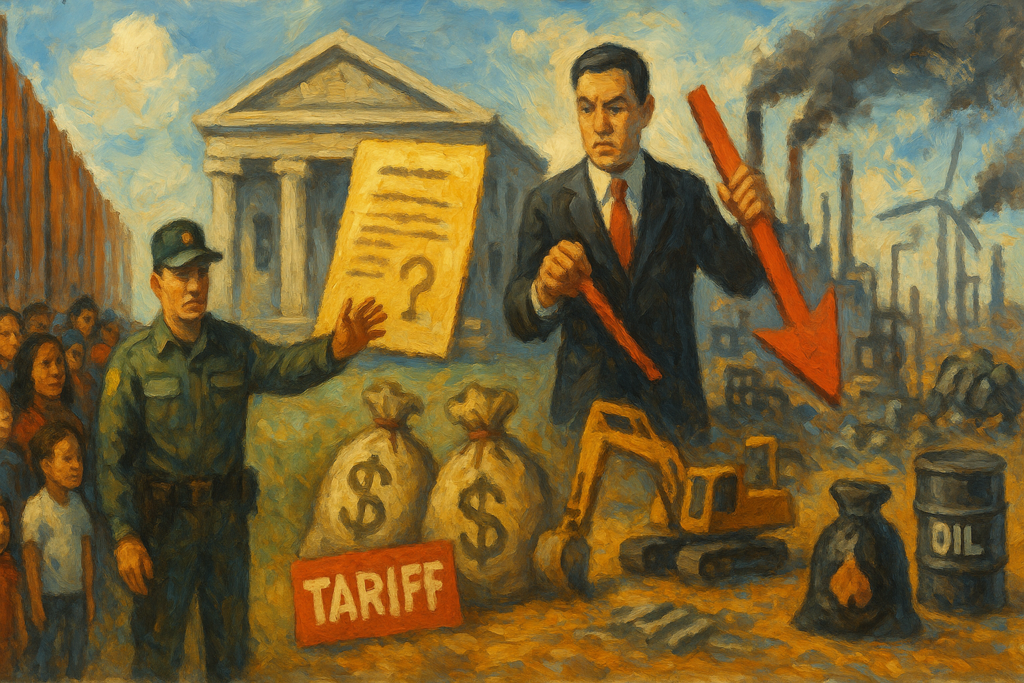
In a single week, the federal government declared a border emergency, moved to end birthright citizenship, and leaned on an old wartime law to deport migrants, even as tariffs began to drag down the economy and public broadcasters faced defunding. Executive orders and emergency powers became the main tools for reshaping immigration, energy, media, and education, while courts, universities, and some states tried to draw lines that could not be crossed.
Over the weekend, the administration intensified its campaign against universities, especially those roiled by pro‑Palestinian protests. Federal officials listed Swarthmore among dozens of schools they said were at risk of losing funds over alleged antisemitic harassment tied to campus encampments. New executive actions went further, targeting diversity programs and accreditation rules that underpin how universities operate. Harvard, facing threats to $9 billion in federal funding, responded by suing, arguing that the demands were unlawful and that the government was using money to dictate campus speech and governance. On the ground, FBI raids on pro‑Palestinian students in Michigan and Yale’s decision to derecognize a protest group showed how federal pressure was filtering down into campus discipline and law enforcement, narrowing the space for student dissent.
At the same time, Republicans in Congress advanced a budget framework aligned with the president’s agenda that would allow them, using special procedures, to pass deep cuts to Medicaid, food assistance, childcare, housing, and other safety‑net programs without needing Democratic votes in the Senate. The framework also extended tax breaks, revealing internal GOP disagreements over how far to go but locking in a path for one‑party social retrenchment. With few formal tools to block the plan, Democratic leaders turned to protest tactics, preparing a 12‑hour sit‑in at the Capitol and marathon floor speeches to dramatize the impact on poor and vulnerable Americans and to frame the first 100 days of the term as a turn toward authoritarian governance.
Immigration enforcement over the weekend underscored how far executive agencies were willing to go. ICE carried out deportations that separated families and removed U.S. citizen children, including a four‑year‑old with cancer sent abroad without medication. In another case, three citizen children, one with Stage 4 cancer, were deported to Honduras with their mothers after a routine check‑in, with no time to arrange care or legal help. These incidents, echoing similar cases in March, suggested a pattern in which citizenship and medical vulnerability were treated as secondary to enforcement targets, raising basic questions about due process and whose rights the state protects.
The weekend also brought moves to reshape the civil service and energy policy. Elon Musk’s Department of Government Efficiency, or DOGE, continued what insiders described as an ideological purge of career officials, promising cost savings that were already outweighed by the unit’s own expenses and the loss of institutional expertise. In parallel, the administration halted most renewable energy permitting, even on private land, while fast‑tracking oil and gas projects and freezing disbursement of many Biden‑era infrastructure funds, especially green projects. These steps redirected federal power away from neutral administration and toward favored industries and allies, setting the stage for later declarations of an “energy emergency.” In the background, Representative Clay Higgins’s call on social media for the arrest of “arrogant elitist black robes” signaled a willingness among some lawmakers to attack judges personally, even as universities and states began turning to those same courts to challenge executive overreach.
By Monday, the immigration crackdown had widened from individual cases to entire jurisdictions and language communities. The president signed multiple executive orders targeting so‑called sanctuary cities, directing the Justice and Homeland Security Departments to publish lists of non‑compliant localities and identify federal funds that could be cut. Parallel orders mandated English proficiency for commercial truck drivers and instructed agencies to enforce English‑only rules more strictly, building on an earlier order declaring English the official language. These measures used funding and licensing to pressure immigrant communities and local governments that resisted federal priorities, reshaping federalism by tying basic resources to cooperation with enforcement and deepening a tiered system of rights based on immigration status and language.
Inside the Justice Department, the civil rights infrastructure that had long protected voting access was abruptly weakened. Trump appointees removed all senior civil servants leading DOJ’s voting section and ordered lawyers to dismiss active cases. Under new civil rights chief Harmeet Dhillon, the division was reoriented toward investigating voter fraud rather than discrimination. This gutted federal capacity to enforce core voting rights laws, especially in states with histories of suppression, and opened the door to politicized hiring in a unit that had been a central safeguard for fair elections.
Monday also highlighted the blending of public power and private gain. The administration quietly ended federal investigations and lawsuits against 89 corporations, many of them major donors to the president’s inaugural fund, raising questions about whether enforcement decisions were being sold. DOGE staff embedded at the Federal Aviation Administration pushed a multimillion‑dollar “Project Lift” to integrate Musk’s Starlink into existing contracts, with employees bound by nondisclosure agreements that limited internal scrutiny. At the same time, Donald Trump announced that top holders of his $TRUMP cryptocurrency would receive a private club dinner and possible VIP White House tour, spiking the token’s value and generating fees for his companies. Senators Adam Schiff and Elizabeth Warren asked the Office of Government Ethics to investigate whether this amounted to bribery or unconstitutional emoluments. Donald Trump Jr. and donor Omeed Malik launched the “Executive Branch” club in Georgetown, charging more than half a million dollars for membership and promising intimate access to advisers and cabinet officials. Together, these moves turned proximity to the presidency into a financial product and club benefit, testing whether ethics systems could constrain self‑dealing.
Regulatory enforcement in other areas also eased under industry pressure. The Agriculture Department withdrew a Biden‑era salmonella rule for poultry after lobbying from producers, despite public health estimates of more than a million infections annually. The administration signaled a pause in Foreign Corrupt Practices Act prosecutions, which had targeted U.S. companies for bribery abroad, and ended investigations into dozens of corporations. These steps shifted risk onto consumers and investors while signaling that well‑connected firms could expect leniency. In the media sphere, the White House expanded “alternative” press briefings featuring right‑wing influencers who asked leading questions attacking mainstream outlets and echoing administration narratives. This came as public broadcasters faced looming funding threats and mainstream reporters were attacked online, building a parallel media ecosystem that amplified friendly voices while marginalizing critical ones.
On Tuesday, courts began to push back more visibly against the administration’s use of old laws for new crackdowns. A federal appeals court rejected the government’s bid to resume deportations in Colorado under the 1798 Alien Enemies Act, and other judges scrutinized its use against Venezuelan migrants. These rulings, combined with earlier stays, signaled judicial skepticism about stretching a wartime statute—designed for conflicts with foreign powers—to justify mass removals of non‑citizens in peacetime. The decisions did not end the strategy, but they forced the administration to defend it case by case and foreshadowed a longer legal battle over the scope of executive authority in immigration.
The same day, the administration deepened its rollback of climate science and race‑conscious programs. Nearly 400 scientists and experts working on the congressionally mandated National Climate Assessment were abruptly dismissed, throwing the future of the 2028 report into doubt and weakening the scientific basis for climate preparedness at all levels of government. Cuts to NOAA and FEMA climate work and missed international reporting deadlines compounded the effect. Meanwhile, the Education and Health and Human Services Departments opened an investigation into whether the Harvard Law Review’s article selection process illegally favored authors of color, framing diversity efforts as discrimination against white men. The Education Department also launched a probe into Chicago’s Black Student Success Plan after a conservative complaint, warning that federal funds could be at risk. These cases extended a broader effort to recast race‑focused programs as civil‑rights violations, potentially chilling efforts to address longstanding inequities.
Congress, for its part, showed little appetite to restrain executive power. House Republicans inserted a rule blocking “resolutions of inquiry,” effectively preventing Democrats from forcing votes on investigating Defense Secretary Pete Hegseth’s use of encrypted messaging for sensitive discussions. In the Senate, GOP leaders signaled they would not support Democratic attempts to rein in the president’s tariff powers, arguing that the administration needed time to negotiate better trade deals. These decisions left key aspects of national security and trade policy largely insulated from legislative oversight, pushing disputes into the courts and the public arena. Senate Democrats, lacking votes to change policy, prepared extended floor speeches cataloguing what they described as the failures and authoritarian tendencies of the first 100 days, using the chamber as a stage to shape public opinion rather than a venue for effective bargaining.
Wednesday brought some of the week’s most consequential moves on who counts as American. The president declared a national emergency at the southern border, enabling troop deployments and hardline enforcement as part of a promised mass deportation program. In tandem, he signed an executive order attempting to end automatic citizenship for some U.S.‑born children of undocumented and certain legal immigrants, directly challenging the Fourteenth Amendment’s guarantee of birthright citizenship. A federal judge quickly blocked the order as “blatantly unconstitutional,” but the attempt itself signaled a willingness to test constitutional limits on membership in the political community and to normalize emergency powers at the border as a routine policy tool.
Clemency powers were used just as aggressively. The president issued broad pardons and commutations for individuals charged in connection with the January 6 attack, directing DOJ to drop remaining cases and fulfilling a campaign promise to those who had sought to overturn the transfer of power. Separately, former pardon attorney Liz Oyer revealed that recent pardons of white‑collar criminals and a cryptocurrency exchange had erased more than $1 billion in debts and fines. These actions used the pardon power to shield political allies and wealthy offenders from consequences, while ordinary defendants and victims saw the law applied unevenly, weakening the principle that no one is above the law.
Courts continued to intervene in individual immigration cases even as the administration escalated. A federal judge in Vermont ordered the release of Mohsen Mahdawi, a Palestinian green‑card holder and Columbia student, finding that his detention and deportation order would chill protected speech. The Supreme Court issued an emergency order blocking the deportation of 19‑year‑old Venezuelan Javier Salazar under the Alien Enemies Act, emphasizing due process concerns. In Puerto Rico, Justice Ketanji Brown Jackson delivered a rare public speech condemning administration rhetoric designed to intimidate judges, citing increased threats and professional retaliation. Her remarks, combined with earlier calls by allies to arrest judges and the president’s own attacks on “communist radical‑left judges” at a Michigan rally, underscored a growing clash between the executive branch and the judiciary over both specific policies and the basic independence of the courts.
The administration also moved to dismantle diversity, equity, and inclusion initiatives and environmental justice programs across the federal government and private sector. The president derided DEI as “bullshit” and rescinded executive orders that had prioritized environmental justice, closed related offices, and halted grants aimed at reducing pollution in marginalized communities. Internationally, the U.S. withdrew from the Paris Agreement and related climate funds and missed key greenhouse‑gas reporting deadlines, weakening global climate cooperation. These steps narrowed the tools available to address systemic discrimination and environmental racism and removed external pressure for responsible climate policy. Meanwhile, new data showed initial unemployment claims rising to 241,000, the highest since February, and a 0.3 percent GDP contraction in the first quarter—the first in three years. Analysts linked the downturn to tariff‑driven distortions, including a surge in pre‑tariff buying followed by a slowdown. In a televised Cabinet meeting, the president insisted the downturn was his predecessor’s fault and claimed any future declines would also be attributed to the prior administration, complicating democratic accountability for economic management.
On Thursday, the focus shifted to the structure of the federal government itself. A suite of executive orders reclassified tens of thousands of federal employees as political appointees, reviving a Schedule F‑style system that makes it easier to hire and fire based on loyalty rather than merit. Independent regulators such as the Securities and Exchange Commission and Federal Trade Commission were made formally answerable to the White House for policy priorities and budgets, eroding their traditional arm’s‑length status. Additional orders expanded DOGE’s authority over contracts and payments and made it easier to dismiss probationary federal workers. In practice, these changes weakened the neutral civil service and concentrated power in the executive, making it easier to reward allies and punish opponents through regulation and enforcement and harder for career officials to resist unlawful or unethical directives.
Education and religion became intertwined arenas of contest. The president signed an order to begin dismantling the Department of Education, attempting to bypass Congress’s role in closing a cabinet agency and signaling a desire to shift authority to states and private actors more aligned with his agenda. In Oklahoma, Superintendent Ryan Walters pushed through a new social studies curriculum that dramatically increased references to Christianity, omitted the separation of church and state, and required students to analyze debunked 2020 election‑fraud claims. The standards were rushed to a vote with last‑minute changes and minimal review, and the legislature declined to block them. At the federal level, the president hosted a National Prayer Day event in the Rose Garden, declaring that America must be “One Nation Under God” to be great and touting a White House Faith Office. He then signed an order creating a Religious Liberty Commission, staffed by presidential appointees and tied to that office, to advise on policy and recommend executive actions. While framed as protecting religious freedom, embedding a faith‑aligned commission inside the policy process and promoting explicitly Christian‑nationalist curricula in public schools challenged long‑standing understandings of church–state separation and reshaped what future citizens learn about history, religion, and democracy.
Energy and trade policy continued to be driven through emergency authorities. Building on earlier moves, the administration declared an “energy emergency” to open more land and ocean areas for drilling, revived older coal plants to meet data‑center and electric‑vehicle demand, boosted deep‑sea mining, and ordered DOJ to stop enforcing state climate laws it deemed unconstitutional. Combined with a halt on new solar and wind projects on federal lands and steep tariffs on imported solar panels, these steps entrenched fossil fuels and made the clean‑energy transition more costly and uncertain. The economic fallout from tariffs became harder to ignore: UPS announced plans to lay off about 20,000 workers and close 73 facilities by June, explicitly citing lower shipping volumes tied to tariffs. The GDP contraction and rising unemployment claims were confirmed, yet congressional Republicans blocked efforts to challenge the tariff emergency, and the president continued to frame the downturn as his predecessor’s fault. In the media sphere, an executive order directed the Corporation for Public Broadcasting and all executive agencies to end direct and indirect funding for NPR and PBS, accusing them of partisan bias. PBS’s president called the move unlawful and vowed to challenge it, while the FCC—now led by an architect of a conservative policy blueprint for the federal government—opened investigations into both outlets, aligning regulatory scrutiny with the White House’s defunding push. The administration also fired Doug Emhoff and other senior Biden‑era officials from the board overseeing the U.S. Holocaust Memorial Museum, part of a broader effort to reshape institutions that curate historical memory.
By Friday, the consolidation of executive power was especially visible in justice and information policy. Under Attorney General Pam Bondi, DOJ abruptly closed its cryptocurrency unit, which had been prosecuting schemes involving North Korean hackers, after criticism from crypto leaders aligned with the president. It also paused prosecutions under the Foreign Corrupt Practices Act for six months, following earlier orders to halt such cases. Combined with pardons that erased more than $1 billion in white‑collar debts, these shifts signaled a broad retreat from policing complex financial crimes that touch powerful interests, making it easier for well‑connected actors to operate with impunity. The administration’s media strategy came into full view: a state‑run “White House Wire” site on official servers aggregated only positive coverage and friendly commentary, while executive orders and FCC investigations moved to cut off funding for NPR and PBS. DOJ’s rollback of source protections and the creation of a “weaponization working group” that framed investigations into the president as political persecution fit into a pattern of starving independent outlets, elevating loyal voices, and casting accountability reporting as illegitimate.
DOGE’s reach expanded further into domestic governance. A DOGE operative with no prior government experience was embedded at the Department of Housing and Urban Development to use artificial intelligence to analyze and potentially rewrite regulations, a process career staff described as redundant and opaque. The Interior Department prepared a “reduction in force” that could cut 1,500 National Park Service jobs, part of broader DOGE‑driven downsizing. Meanwhile, the administration filed an emergency appeal asking the Supreme Court to let DOGE access sensitive Social Security records, after an appeals court upheld an injunction blocking it. Allowing a politically directed, lightly accountable unit to rewrite rules, cut staff, and access nationwide personal data raised concerns about algorithmic opacity and the difficulty of monitoring or reversing such changes once embedded in the bureaucracy.
The tug‑of‑war over the Alien Enemies Act and deportation strategy continued. Judge Fernando Rodriguez Jr. in Texas permanently barred the use of the law to deport Venezuelans in his district, ruling that it applies only in wartime or invasion, not to alleged gang members. Other courts and the Supreme Court had already issued stays or required more process in individual cases. At the same time, the administration continued to defend its use of the statute and sought Supreme Court help to revoke Temporary Protected Status for more than 300,000 Venezuelans, underscoring its commitment to the strategy despite mounting legal setbacks. Federal interventions also had a chilling effect in other areas: Puerto Rico voluntarily dismissed its climate lawsuit against oil companies after DOJ sued other states to block similar cases, illustrating how national litigation choices can deter subnational efforts to seek accountability.
On campuses, the pressure that began over the weekend translated into concrete sanctions. Swarthmore College issued interim suspensions and campus bans for nine students involved in a pro‑Palestinian encampment, imposing penalties before full conduct hearings. The suspensions followed federal threats to cut funding over campus protests and FBI raids on student activists, suggesting that universities were increasingly responding to political and legal pressure by narrowing space for protest. Elsewhere, a settlement between Maine and USDA showed both the power and limits of state resistance. After the department froze child nutrition funds to pressure Maine to bar transgender girls from girls’ sports, the state sued. The administration agreed to restore funding and Maine dropped the case, with USDA pledging not to interfere again without proper procedures. The deal protected the program in the short term but left open the broader question of whether and how federal agencies can condition essential funds on state civil‑rights positions. Internationally, an executive order closing the de minimis tariff loophole took effect, hitting Chinese exporters and reshaping e‑commerce flows. The administration’s withdrawal from the Paris Agreement and climate funds, combined with high solar tariffs and expanded drilling, drew concern from allies and environmental groups. Abroad, reports of deepfakes in Indian elections and Chinese officials’ resale of surveillance data highlighted how other governments are also grappling with technology‑driven threats to democracy and privacy.
Taken together, the week showed an administration using executive orders, emergency declarations, and structural changes to redefine who belongs, who decides, and who can speak. Immigration policy hardened through family‑separating deportations, a border emergency, revived use of the Alien Enemies Act, and an attempted narrowing of birthright citizenship, even as courts in several cases insisted on due process and constitutional limits. Economic management was driven from the White House through tariffs and fossil‑fuel favoritism, contributing to rising unemployment and the first GDP contraction in years, while Congress mostly declined to assert its powers. Public education, media, and memory institutions became contested terrain, with Oklahoma’s Christian‑nationalist curriculum, the dismantling of DEI and environmental justice programs, and efforts to defund NPR, PBS, and reshape the Holocaust Museum board all pointing toward an ideological remaking of the public sphere. Yet Harvard’s lawsuit, Justice Jackson’s speech, state litigation like Maine’s, and a series of judicial rulings on deportations and data access showed that other institutions were not passive. The struggle over the boundaries of executive power, and over the information and narratives that sustain democratic life, remained active and unresolved.