This week’s throughlines
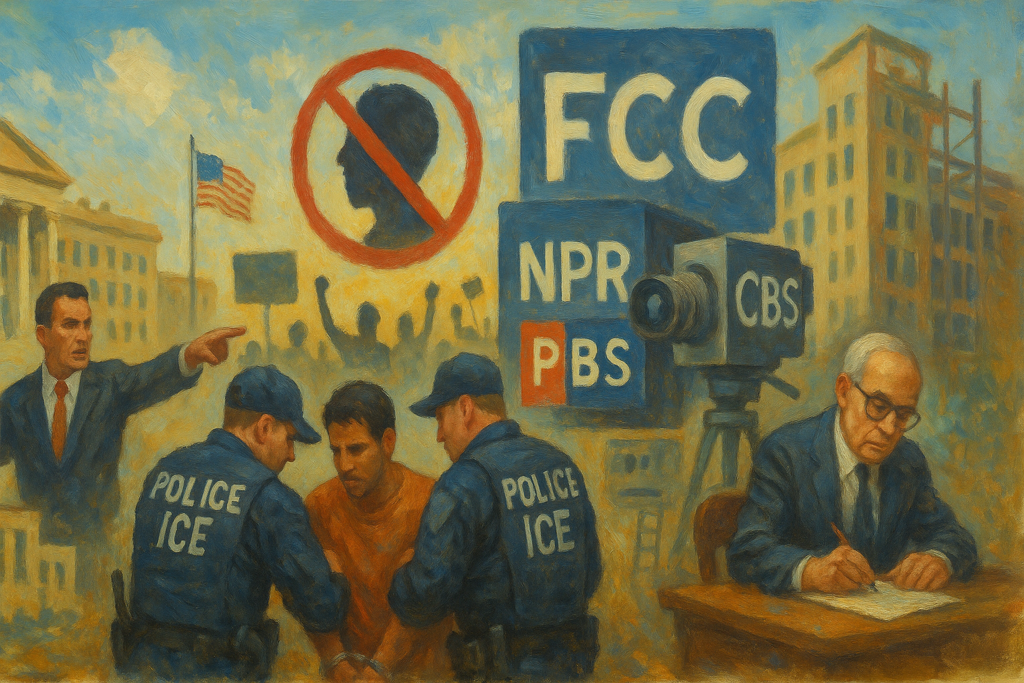
- Public media and press pressure intensified through the week — The week began with appellate setbacks for Voice of America staff, expanded into an executive order targeting NPR and PBS, then moved into regulatory and editorial pressure on CBS and a deal to feed VOA content from One America News.
- Executive control over the civil service and independent agencies widened — Leadership removals, planned workforce cuts, dropped watchdog inquiries, and new attacks on environmental, safety, and disaster-response agencies showed a continuing effort to weaken independent capacity inside government.
- Immigration enforcement became more openly coercive toward rights and local officials — The week linked anti-due-process rhetoric, threats against state officials, self-deportation incentives, detention fights involving students and activists, and the arrest of Newark’s mayor, capped by talk of suspending habeas corpus.
- Universities and protest spaces faced growing political and police pressure — Federal funding threats, congressional hearings, and repeated police actions against pro-Palestinian campus protests showed a tightening link between institutional discipline and national political pressure.
- Courts repeatedly checked, slowed, or reframed executive action — Judges struck down retaliatory orders, protected election certification, ordered releases from immigration detention, and partially restored relief in media and federal workforce cases, even as some emergency rulings favored the administration.
The week opened with a sharper view of how the administration is remaking the machinery of government, the information Americans receive, and the boundaries of protest and due process. Across seven days, civil servants were pushed out or left in limbo, public broadcasters were defunded or shuttered, immigration enforcement was expanded and centralized, and police and federal agents were deployed against campus encampments and even a sitting mayor. Courts and some state governments offered partial resistance, but the overall direction was toward a more concentrated, more politicized use of executive power.
Over the weekend, the scale of the federal workforce shake‑up came into clearer focus. Plans surfaced to cut 1,200 jobs at the CIA and slow hiring at other intelligence agencies, even as the Department of Labor reported that it had already lost about a fifth of its staff and expected further reductions and grant losses. These developments followed earlier mass firings of probationary federal workers and suggested that what might have looked like isolated personnel decisions were part of a broader effort to hollow out agencies responsible for national security, worker protections, and regulatory enforcement. The effects were visible in the skies as well: chronic shortages of air‑traffic controllers at Newark, driven by attrition since Trump returned to office, were causing major delays and raising safety concerns, underscoring how staffing decisions translate into everyday risk.
The courts, however, signaled they were not prepared to accept all uses of executive power. Judge Beryl Howell permanently struck down an executive order that had singled out the law firm Perkins Coie, barring its lawyers from federal work and even from entering federal buildings. Howell called the order unconstitutional retaliation, making clear that presidents cannot use contracting authority to punish specific legal adversaries. On the same day, Justice Ketanji Brown Jackson publicly warned about political attacks on judges, and roughly 1,500 lawyers gathered outside the federal courthouse in Manhattan, holding pocket Constitutions and protesting threats to the rule of law. Together, these actions marked a line in the sand around judicial independence and access to counsel, even as other institutions bent more readily to executive pressure.
The weekend also brought a coordinated push against public and international media. An appeals court stayed a lower‑court order that would have reinstated more than 1,000 Voice of America employees, allowing the administration’s dismantling of the U.S. Agency for Global Media to proceed for the moment. In parallel, Trump signed an executive order cutting NPR and PBS off from Corporation for Public Broadcasting funds, a move that threatens the survival of many local stations, especially in rural areas where alternatives are scarce. These steps foreshadowed the midweek order that would formally shutter VoA operations and steer its content toward a partisan contractor, and they fit into a pattern of weakening independent news sources while favoring outlets more aligned with the administration.
Signals about accountability for political violence also shifted. Trump pardoned Enrique Tarrio, the Proud Boys leader serving a 22‑year sentence for seditious conspiracy related to the January 6 attack, and his administration reached a settlement in principle with the family of Ashli Babbitt, who was killed while breaching the Capitol. Both moves were celebrated by allied groups and framed as correcting injustices against loyalists. In practice, they marked a willingness to relieve or compensate those who had targeted democratic institutions, potentially weakening deterrence against future assaults on Congress and the electoral process.
On the cultural front, the administration moved to redirect arts funding and reshape public symbols. The National Endowment for the Arts terminated dozens of grants and shifted its priorities toward projects that fit Trump’s rhetoric of “American heritage,” while the 2026 budget proposal called for eliminating the NEA entirely. In Congress, House Republicans held a hearing on renaming the Gulf of Mexico as the “Gulf of America,” advancing a rebranding that would later pass the House. These efforts, alongside Trump’s use of AI‑generated imagery and personal attacks on political opponents, showed how arts policy and naming fights are being used to elevate a narrower national narrative and marginalize other histories.
Trade policy, too, was wielded as a political and cultural tool. Existing 25% tariffs on auto parts drew renewed criticism for raising repair costs and feeding inflation, even as new GDP data were framed in ways that mischaracterized imports as a drag on growth. Over the weekend, Trump announced plans for a 100% tariff on foreign films, justifying it as a national security measure to protect the U.S. movie industry. A Senate effort to roll back some tariffs failed on a 49–49 vote, with Vice President JD Vance breaking the tie. These moves previewed the tariff escalations and partial reversals that would ripple through markets later in the week, and reinforced the sense that trade policy was being used as a blunt instrument to reward or punish industries and countries.
The weekend also previewed the week’s conflicts over immigration and protest. Trump’s “border czar,” Tom Homan, publicly threatened to have Wisconsin Governor Tony Evers arrested after Evers advised state workers to consult lawyers before responding to ICE requests. Evers insisted he had not told anyone to break the law, but the threat illustrated how federal immigration power was being used to intimidate state officials who sought to assert their own legal obligations. On campus, Swarthmore College called in local police to dismantle a four‑day pro‑Palestinian encampment calling for divestment from Cisco over its ties to Israel. Officers cleared the camp and arrested nine activists, including current and former students, setting a precedent for police‑led responses to campus protest that other universities would soon follow.
By Monday, the administration’s willingness to question basic constitutional protections was on open display. In a televised interview, Trump said he was unsure whether everyone in the United States is entitled to due process, suggesting that honoring constitutional guarantees could hinder his ability to remove people he deemed undesirable. Two days later, Homeland Security Secretary Kristi Noem refused to affirm in a House hearing that the Constitution guarantees due process to everyone. Due process—the right to fair procedures before the government can deprive someone of life, liberty, or property—is a core protection for citizens and non‑citizens alike. When senior officials cast doubt on its universality, they lower the bar for policies that sidestep courts and erode legal protections, especially in immigration and security contexts.
At the same time, Trump signed two executive orders that tightened executive control over science and industry. One halted federal funding for certain gain‑of‑function biological research conducted abroad, especially in countries deemed to have weak oversight, and called for a strategy to govern risky research that does not rely on federal funds. The other ordered agencies to streamline environmental and regulatory requirements to speed domestic production of “critical medicines,” directing the EPA and Army Corps to ease approvals for new pharmaceutical facilities. Framed as security and supply‑chain resilience measures, these orders shifted power over scientific priorities and environmental safeguards toward the White House, raising concerns about politicization and weakened protections against environmental and safety harms.
Courts, meanwhile, continued to act as a counterweight in some areas. A federal court ordered North Carolina officials to certify Democrat Allison Riggs as the winner of a closely contested state supreme court race, rejecting Republican Jefferson Griffin’s attempt to retroactively discard tens of thousands of ballots. The ruling emphasized that changing election rules after the fact violates voters’ constitutional rights, reinforcing the principle that the rules of an election cannot be rewritten once ballots are cast. In Michigan, Attorney General Dana Nessel dropped charges against seven pro‑Palestinian protesters arrested at a University of Michigan encampment just before a hearing on alleged bias, even as her office continued other protest‑related cases. These decisions showed courts and some state officials acting as backstops against both post‑hoc voter disenfranchisement and potentially biased protest prosecutions.
The Supreme Court moved in the opposite direction on LGBTQ rights. It granted the administration’s request to stay lower‑court injunctions blocking a Defense Department policy that bans people with a current or past diagnosis of gender dysphoria from serving in the military. The unsigned order, with three liberal justices dissenting, allowed the ban to take effect while litigation continues and could lead to the discharge of thousands of transgender service members. Later in the week, the administration would extend this retrenchment to civilian federal workplaces, signaling a coordinated narrowing of legal protections for transgender people.
Monday also highlighted deepening entanglements between public office and private business. World Liberty Financial, a Trump‑family crypto firm, played a central role in a $2 billion investment by Abu Dhabi–owned MGX into Binance, using a little‑used Trump‑branded stablecoin. At the same time, the Trump Organization announced a new Trump International Hotel & Tower in Dubai with a Saudi‑linked partner and a $5.5 billion golf‑club project in Qatar involving a Qatari government‑owned company, apparently violating Trump’s own ethics agreement. Reporting noted that foreign nationals barred from donating to U.S. campaigns had invested in Trump‑linked crypto ventures. When a sitting president’s family businesses are intertwined with foreign state‑owned entities and opaque financial products, it becomes difficult to distinguish public policy from private profit, and foreign governments gain new channels to seek influence.
Not all policy flowed from Washington. Hawaii’s legislature passed, and its governor backed, a bill raising lodging and cruise‑ship taxes to fund climate resilience projects like beach replenishment and wildfire prevention. In New York, Governor Kathy Hochul advanced middle‑class tax cuts, inflation refund checks, and universal free school meals for 2.7 million students. These state initiatives contrasted with federal cuts to environmental and social programs, illustrating how subnational governments can use fiscal tools to address climate risk and household strain, even as they create uneven protections depending on where people live.
On Tuesday, federal leverage over universities and scientific agencies intensified. Education Secretary Linda McMahon informed Harvard that it would lose federal research grants and aid—$2.2 billion already frozen, with another $1 billion threatened—unless it complied with a list of administration demands tied to campus protests over Gaza. The administration also floated revoking Harvard’s tax‑exempt status, prompting the university to sue. In Congress, the House Committee on Education and the Workforce held hearings on antisemitism featuring presidents from Haverford, DePaul, and Cal Poly, amid criticism from Jewish faculty that the proceedings were politically motivated and aimed at silencing pro‑Palestinian voices. The combination of funding threats, tax‑status pressure, and public hearings showed how federal tools were being used to push universities to police dissent.
Environmental and scientific capacity took another hit as the administration announced a $300 million cut to the EPA’s 2026 budget, staff reductions to 1980s levels, and the dissolution of the Office of Research and Development, forcing 1,500 staff to reapply for just 400 positions. Critics warned that these changes would undermine independent science and turn the EPA into a more overtly political agency. The cuts came alongside earlier efforts to weaken NIH and NASA, reinforcing a pattern of shrinking science‑based bodies that provide long‑term public health and environmental oversight.
Elon Musk’s Department of Government Efficiency, or DOGE—a new office charged with cutting federal spending—faced its own legal challenges. At least eleven lawsuits were filed alleging that DOGE had violated the 1974 Privacy Act by improperly consolidating personal data on millions of Americans, bypassing established protections and security clearances. Coming on the heels of DOGE’s role in orchestrating mass federal firings and deep cuts at USAID, the suits raised broader concerns about how this lightly overseen entity was wielding both data and personnel power, and what that meant for privacy and surveillance.
On campuses, the pattern of protest crackdowns continued. Police arrested more than two dozen pro‑Palestinian protesters at the University of Washington after they occupied an engineering building and set dumpsters on fire while demanding that the university cut ties with Boeing. The protesters faced charges including trespassing and property destruction. The decision to call in police echoed Swarthmore’s approach and foreshadowed the larger operation at Columbia later in the week. At the same time, reporting revealed that TeleMessage, an app used by administration officials, had been hacked, compromising sensitive Customs and Border Protection and banking data and forcing a suspension of service. The breach, following an earlier incident in which a journalist was accidentally added to a Signal group about U.S. military actions in Yemen, underscored how fragile official communications can be in a high‑stakes security environment.
Media independence came under fresh pressure as well. The FCC, led by Chairman Brendan Carr, launched an unprecedented “news distortion” investigation into CBS News over a 60 Minutes interview with Vice President Kamala Harris, echoing Trump’s lawsuit accusing CBS of election interference. The probe raised the possibility of license revocation, a powerful threat for a broadcast network. Inside CBS’s parent company, Paramount Global, long‑time 60 Minutes producer Bill Owens resigned after owner Shari Redstone intervened in Trump coverage during sensitive merger talks, and internal memos showed Paramount altering diversity policies and delaying a political initiative to avoid angering regulators. The combination of regulatory scrutiny and corporate caution signaled how licensing power and merger approvals can be used to influence coverage and encourage self‑censorship.
Trade tensions with China and other partners continued to ripple through supply chains. Companies like Mattel and Ford reported higher costs and price increases tied to tariffs, while a 10% global tariff and higher sector‑specific rates imposed on “Liberation Day” jolted equity and bond markets. Later in the week, Trump would unilaterally cut a 145% tariff on China to 80% ahead of Geneva talks, without clear concessions from Beijing, and Treasury Secretary Scott Bessent would dodge questions about who ultimately pays these tariffs. For businesses and consumers, the shifting rates functioned as unpredictable taxes, complicating planning and raising questions about whether trade policy was driven by strategy or short‑term politics.
By Wednesday, the administration’s approach to media control and immigration enforcement had fully crystallized. Trump’s earlier executive order dismantling the U.S. Agency for Global Media took full effect, taking Voice of America off the air and placing roughly 1,300 employees on leave. Grants to Radio Free Europe and Radio Free Asia were canceled. While a federal judge temporarily blocked parts of the dismantling and the administration appealed, VoA leadership announced a contract with hard‑right One America News to provide newsfeed and video services, justified as a cost‑saving measure. VoA journalists, locked out of their newsroom, challenged the changes in court, and bureau chief Patsy Widakuswara sued over the funding cutoff. A government‑funded international broadcaster that once aimed to provide credible news abroad was being turned into a vehicle for aligned narratives.
On immigration, the administration moved to centralize and expand enforcement. It pursued a budget reconciliation bill to pour tens of billions into ICE, including $45 billion for detention centers and $14.4 billion for transportation and removals over five years, which would make ICE the most heavily funded U.S. law‑enforcement agency. Thousands of agents from the DEA, FBI, IRS, and other agencies were deputized to assist ICE, and headquarters approval was required for any release of detained immigrants, leading to overcrowded facilities beyond what Congress had funded. A new initiative offered $1,000 and free airfare to undocumented immigrants who self‑deport, downplaying the long bans on reentry that would follow. Reporting showed that deportation flights to El Salvador included legally present migrants, and that Venezuela had only refused returns after Trump invoked the Alien Enemies Act, a World War I‑era law that allows the government to detain or remove nationals of hostile countries. These moves took on added weight in light of Trump’s and Noem’s earlier comments questioning universal due process, and Stephen Miller’s later suggestion that the administration might consider suspending habeas corpus—the right to challenge unlawful detention—if courts resisted its policies.
An intelligence memo released the same day undercut one of the administration’s key justifications. The Office of the Director of National Intelligence declassified an assessment stating that U.S. agencies did not believe the Venezuelan government was colluding with the Tren de Aragua gang, contradicting claims used to invoke the Alien Enemies Act against Venezuelan migrants. Rather than prompt a policy rethink, the revelation was followed by Attorney General Pam Bondi using critical reporting by major newspapers to justify rolling back press protections in leak investigations, and by Director of National Intelligence Tulsi Gabbard publicly attacking the Wall Street Journal over its coverage of Greenland. The sequence raised concerns about the politicization of national security information and the use of leak probes to deter scrutiny.
Courts again offered a contrasting example in the case of Rümeysa Öztürk, a Turkish doctoral student at Tufts. After she wrote an op‑ed criticizing her university’s response to the Israel–Gaza conflict, she was detained by ICE and held for six weeks in a Louisiana facility. A federal appeals court ordered her transfer to Vermont, citing potential violations of her free‑speech and due‑process rights, and the next day a district judge ordered her release, explicitly referencing the First Amendment and due process. In a week when immigration powers were being expanded and centralized, her case showed that courts could still enforce constitutional limits when detention appeared to be used as punishment for protected speech.
In Congress, there were small signs of pushback on the scientific front. At the first Senate Appropriations Committee hearing of the year, Republican Senator Susan Collins criticized the administration for cutting biomedical research funding, canceling grants, and laying off workers in key health agencies in defiance of appropriations language. Her remarks highlighted Congress’s power of the purse as one of the few tools available to challenge unilateral cuts to science and health infrastructure. Meanwhile, the House passed a bill to rename the Gulf of Mexico the “Gulf of America,” advancing a symbolic project that, while unlikely to become law, reflected how legislative time was being used to pursue nationalist naming efforts alongside more substantive fights.
Thursday brought the civil service and regulatory dismantling into even sharper relief. Building on February’s “Valentine’s Day massacre” of probationary federal workers, the administration implemented a government‑wide hiring freeze that included air‑traffic controllers, despite known staffing crises. An earlier executive order had expanded agency discretion to fire probationary employees, and the Office of Special Counsel dropped its inquiry into whether the mass firings were unlawful after Trump fired its previous head. Supreme Court interventions had left many workers in limbo—rehired, put on leave, then dismissed again—while DOGE’s much‑touted spending cuts turned out to be far smaller than promised. The result was a politicized, unstable civil service less able to provide neutral expertise or resist improper orders.
Aviation safety bore the brunt of these choices. After months of chronic controller shortages and major delays at Newark, the hiring freeze halted efforts to fill critical positions. The administration also stopped the work of an outside expert panel reviewing the air‑traffic control system following a deadly collision between an American Airlines jet and a U.S. Army helicopter, and removed the vice chair of the National Transportation Safety Board, an independent safety watchdog. Combined with earlier FAA decisions to expand SpaceX launches from Boca Chica despite documented environmental damage, these moves suggested a pattern of prioritizing political and corporate interests over independent safety oversight.
Other consumer and science agencies faced similar treatment. The administration began dismantling the Consumer Product Safety Commission, asserting presidential authority to reshape the executive branch and raising fears about oversight of everyday products like toys and cribs. It proposed a 25% cut to NASA’s budget while funding Mars‑focused initiatives, even as EPA and NIH staffing had already been slashed. The cumulative effect was to shift federal priorities away from broad consumer and scientific protection toward narrower, more politically chosen projects.
DOGE’s data practices and the administration’s appetite for emergency powers converged in new ways. Privacy Act lawsuits accused DOGE of illegally consolidating personal data on millions of Americans, bypassing established safeguards. In the same period, senior adviser Stephen Miller said the administration was considering suspending the writ of habeas corpus—constitutionally allowed only in cases of invasion or insurrection—depending on how courts responded to its policies. In practical terms, suspending habeas would mean people could be detained without a meaningful way to challenge the legality of their detention in court. Combined with large‑scale data aggregation and expanded immigration detention, the suggestion raised the specter of a more surveillance‑heavy state with fewer avenues for redress.
On the ground, protest and local governance collided with federal power. At Columbia University, NYPD officers arrested about 75 pro‑Palestinian protesters who had occupied the main library building to demand divestment from companies profiting from Israel’s actions in Gaza. The university’s acting president requested police intervention after warnings of disciplinary action, continuing the pattern of institutions turning to law enforcement to manage political conflict. In Newark, Mayor Ras Baraka was arrested by federal agents and charged with trespassing during a peaceful protest outside the Delaney Hall ICE detention center, where he was asserting local jurisdiction over an ICE operation he said violated city law. The arrest of a sitting mayor for challenging federal enforcement on his own city’s streets underscored how immigration policy was straining federal‑local relations.
Abroad, DOGE‑driven cuts to USAID funding and staff had immediate human consequences. Life‑saving food and medicines expired in warehouses, and grants to a Mozambican hospital working to prevent mother‑to‑child HIV transmission were canceled. At the same time, institutional investors significantly increased holdings in Trump Media despite its losses, and large tariffs on trading partners shifted political risk onto markets and consumers. The contrast suggested that austerity was falling on vulnerable populations while capital flowed toward ventures closely tied to the president.
Friday closed the week with further codification of civil‑rights rollbacks and deregulatory priorities, alongside some state‑level pushback. The General Services Administration rescinded a Federal Management Regulation bulletin that had clarified nondiscrimination protections in the federal workplace for gender identity, implementing an earlier executive order that redefined sex in binary terms. Coming on the heels of the Supreme Court’s decision to let the transgender military ban take effect, the move narrowed legal recognition and protections for transgender people in both military and civilian federal employment, signaling a coordinated policy shift.
Immigration and social policy were linked in a new way as Trump issued an executive order establishing the National Center for Warrior Independence at the West Los Angeles VA campus, aiming to house up to 6,000 homeless veterans by 2028. The order directed the VA to coordinate with other departments to redirect funds from services for “illegal aliens” to support the center and mandated new accountability measures within the VA. While addressing a real crisis in veteran homelessness, the initiative explicitly framed aid to one group as coming at the expense of another, reinforcing a hierarchy of deservingness and using social policy to deepen divisions over citizenship and belonging.
Two additional executive orders advanced the administration’s deregulatory agenda. One directed agencies to review and report on criminal regulatory offenses, discouraging strict‑liability crimes—where intent does not need to be proven—and encouraging civil enforcement instead. The other instructed the Archivist and Government Publishing Office to reduce delays and modernize systems at the Office of the Federal Register, including reviewing publication fees, with an eye toward speeding implementation of new rules. While framed as fairness and efficiency, these changes could limit tools for prosecuting corporate misconduct and accelerate the rollout of deregulatory measures, shifting the balance between public protections and corporate accountability without the visibility of major legislation.
Outside Washington, some institutions pushed back. Indiana enacted a first‑in‑the‑nation law threatening to strip nonprofit hospitals of their tax‑exempt status if they continued to charge high prices, directing the state budget office to set benchmarks by 2029. The law responded to public outrage over hospital pricing and could force significant reductions at systems like Parkview Health, showing a state willing to use tax policy to challenge concentrated corporate power. Separately, the American Bar Association sued Trump over the termination of federal grants and earlier threats to its law‑school accreditation role, particularly around diversity, equity, and inclusion efforts. The suit challenged whether the executive can financially punish a major professional body over policy disagreements, extending the week’s theme of legal institutions testing the limits of retaliatory executive action.
Taken together, the week’s developments traced a consistent pattern: the federal civil service and regulatory agencies were thinned and reshaped, public and international media were brought under tighter political and economic pressure, immigration enforcement was expanded while core legal protections were questioned, and protest spaces on campuses and in cities were narrowed through police and federal intervention. Courts, state governments, and professional organizations mounted selective resistance—securing elections, freeing a detained student, challenging grant terminations, and experimenting with their own regulatory tools—but they did so against a backdrop of accelerating executive efforts to centralize power. For democratic life, the stakes lay less in any single order or arrest than in the cumulative shift toward a state that is leaner in neutral expertise, harsher in enforcement, more controlled in its information flows, and more willing to test the outer edges of constitutional constraint.