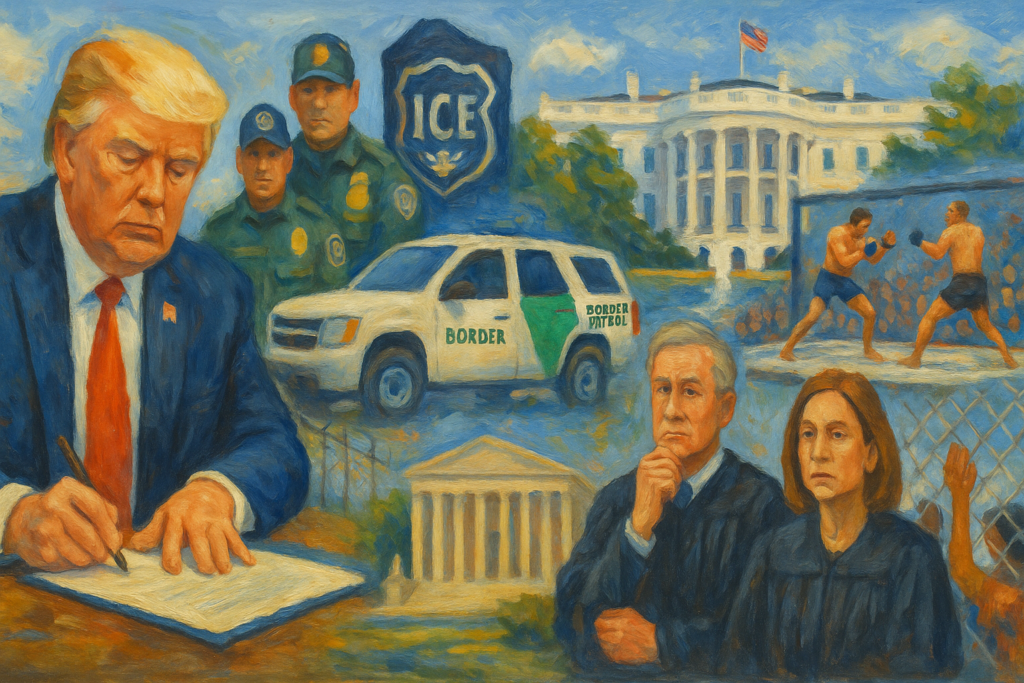
This week’s throughlines
- Immigration enforcement capacity expanded while legal and civic resistance intensified — The week began with a huge new immigration enforcement funding law, then moved through detention protests, lawsuits over retaliatory ICE actions and border construction, criminal cases tied to anti-ICE protest, detainee transfers out of a notorious facility, and a late-week cancellation of one planned mega-detention center.
- Public institutions became sites of symbolic control, privatization, and spending fights — The administration's use of public space and public money ran through the week: courts blocked changes at the Kennedy Center, the White House hosted a UFC spectacle tied to private business interests, a no-bid contract went to a symbolic renovation project, and the administration redirected appropriated funds to a White House ballroom after Congress had refused to fund it.
- Courts repeatedly became the main brake on executive overreach — Judges intervened across multiple domains: public history in national parks, protest permits, election administration, retaliatory detention, and records access. Even where the administration appealed or pressed ahead elsewhere, the judiciary remained a central arena for limiting or testing executive claims.
- Pressure on elections and civic participation widened from legislation to law enforcement — North Carolina lawmakers advanced multiple voting restrictions while federal investigators raided and later seized devices from an Ohio voter-registration network. Together, the moves suggested pressure on both the rules of voting and the organizations that help people participate.
- Political control over expertise and oversight deepened late in the week — By Wednesday and Thursday, the administration had narrowed disability-rights enforcement, proposed shifting research grant decisions toward political appointees, and installed a loyalist without intelligence experience as acting director of national intelligence.
The week began with the clearest assertion of power in a single act: President Trump signed a roughly $70 billion immigration enforcement law that will pour new money into ICE, Border Patrol, and the Department of Homeland Security through the end of his term. The law greatly expands detention and deportation capacity, but does so without the new oversight measures critics had sought for detention facilities and enforcement practices. That combination mattered. This was not simply another immigration bill. It was a large transfer of money and operational freedom to agencies already under scrutiny, and it set the terms for much of what followed.
Over the weekend, courts also moved quickly to limit a different kind of executive reach: the administration’s effort to reshape public institutions and public history by directive. Federal judges blocked Trump’s plan to close the Kennedy Center for renovations, ordered his name removed from the building, and required the restoration of history and science materials removed from national monuments under an earlier order. Taken together, those rulings said that national cultural sites and the public record they present are not simply instruments of presidential preference. They also established one of the week’s recurring themes: courts remained active, but each ruling opened the door to appeals, follow-up litigation, and renewed efforts to press the same underlying agenda by other means.
A third weekend story looked smaller at first glance but fit a pattern that became harder to ignore as the days passed. A judge refused to block a UFC event on White House grounds, allowing the administration to proceed despite legal and ethics objections. The event was surrounded by other ties between the government and the promotion, including a State Department partnership and plans to pay some fighter bonuses in a Trump-linked cryptocurrency. The issue was not only taste or spectacle. It was the use of federal property, official prestige, and public symbolism in ways that appeared to benefit private allies and family-linked business interests.
At the state level, North Carolina Republicans opened a broad new push to tighten election rules. Lawmakers introduced a sweeping bill that would restrict turnout efforts, reduce some transparency, increase partisan leverage over election administration, and ban ranked-choice voting. A separate proposal would cut a full week from early voting, while the newly partisan state board advanced additional rules that critics said would undermine confidence in election administration. These were not isolated procedural changes. They formed an early state-level counterpart to the week’s federal story: control over the machinery of participation was itself becoming a central political objective.
The weekend also brought a set of coercive encounters between state power and civic resistance. The FBI raided an Ohio voter-registration group. Detainees at Delaney Hall continued a hunger and labor strike over alleged neglect. In Mississippi, a police officer responding to a shoplifting call killed a one-year-old child, prompting demands for body-camera footage and accountability. These events were distinct, but together they gave the week an unmistakable tone. Civic groups, detainees, and local communities were not only contesting official action; they were doing so under conditions of fear, opacity, and force.
By Monday, the legal fights had multiplied. After the ruling requiring restoration of removed national park materials, the administration and allied defendants appealed, while a separate complaint against Interior Secretary Doug Burgum opened another front over public lands and agency action. The struggle over public memory was no longer a single case. It was becoming a broader campaign over whether courts can require federal agencies to preserve fuller, less politically curated accounts of the nation’s past.
Monday also brought a wave of lawsuits challenging what plaintiffs described as retaliatory or ideological uses of federal power. New complaints targeted an allegedly retaliatory ICE arrest in Connecticut, the IRS’s removal of union materials from workplace bulletin boards, and NIH grant terminations that researchers said were discriminatory and politically driven. Another court order extended protection for impeachment-themed protest displays near federal property. The common thread was not policy disagreement alone. Across immigration, labor, protest, and research, people were turning to courts to argue that agencies were punishing speech, association, or inquiry that conflicted with the administration’s priorities.
One of the week’s most serious allegations arrived the same day, when California Governor Gavin Newsom said Trump had directed the Justice Department to investigate him, his wife, and associates. Newsom said his office was seeking records about the inquiry. The claim remained an allegation, not a proven fact, but it sharpened a concern already visible elsewhere in the week: whether investigative tools were being used, or threatened, in ways that blurred the line between law enforcement and political retaliation. Meanwhile, the new immigration law and the White House UFC event continued to reverberate, not as one-day stories but as signs of the administration’s governing style—heavy on enforcement, heavy on symbolism, and comfortable mixing public authority with personal branding.
Tuesday brought the immigration story into sharper relief. Federal prosecutors charged 15 people in Minnesota with conspiracy in connection with opposition to immigration enforcement, alleging blockades and encrypted coordination. On the same day, ICE said it was relocating detainees from the “Alligator Alcatraz” facility in Florida because of hurricane season, without fully disclosing who had been moved or where. The pairing was striking. Resistance to immigration enforcement was being framed in criminal-conspiracy terms, while the detention system itself remained unstable and opaque. The administration was expanding capacity at the top even as conditions on the ground continued to generate emergency moves, legal challenges, and distrust.
Another Tuesday decision extended the week’s pattern of symbolic spending and insider favoritism. The administration awarded a $14.2 million no-bid contract to repaint and waterproof the Lincoln Memorial reflecting pool, with the goal of turning it “American flag blue” before the country’s 250th birthday. The contractor had previously worked on a pool at one of Trump’s golf clubs. That did not make the contract unlawful on its face, but it intensified conflict-of-interest concerns and reinforced the sense that public money was being used for highly visible, politically resonant projects with unusually weak procurement safeguards.
Tuesday also produced a labor challenge with broader implications for the federal workforce. The United Power Trades Organization sued over an executive order that stripped bargaining rights from Defense Department workers by excluding the entire department from federal labor-management rules. The union argued that the order exceeded presidential authority and lacked the tailored findings the law requires. In a week full of disputes over executive reach, the case asked how far a president can go in removing workplace protections from large parts of the civil service.
A foreign-policy shift unfolded in the background but still mattered for domestic checks on power. Reports described a draft U.S.-Iran framework that would halt hostilities, reopen shipping through the Strait of Hormuz, lift sanctions, and eventually withdraw U.S. forces. The speed of the turn—from conflict to dealmaking—underscored how quickly war powers, sanctions policy, and troop commitments can be redirected by the executive branch, often leaving Congress and the public to react after the fact.
Wednesday was one of the week’s busiest days and showed that resistance to executive pressure was real, if selective. In Washington, the House advanced a war powers resolution aimed at limiting presidential authority in Iran. In Georgia, Republican officials declined to redraw the state’s congressional map despite pressure after a Supreme Court decision weakening the Voting Rights Act. Neither move reversed the administration’s broader direction, but both showed that not every institution was prepared to follow the preferred line.
At the same time, the Labor Department opened a new front in state-federal pressure. Acting Labor Secretary Keith Sonderling warned states and territories that federal administrative funds for unemployment programs could be withheld over alleged fraud and abuse, highlighting several Democratic-led states without providing supporting evidence. The threat turned routine federal funding into a political lever. Even without immediate cuts, such warnings can force states to divert attention and resources toward defending themselves against claims that have not been substantiated in public.
In Mississippi, the shooting of one-year-old Kohen Wiley led to protests, the officer’s placement on administrative leave, and then a forceful police response to demonstrators demanding body-camera footage and accountability. Tear gas met a movement asking for transparency after a child’s death. The sequence captured a familiar institutional pattern: an initial acknowledgment of scrutiny, followed by tactics that deepened public anger and mistrust rather than easing it.
Immigration detention remained under pressure as well. Plaintiffs returned to court seeking permanent closure of the “Alligator Alcatraz” facility, arguing that the site lacked proper permits and environmental review even after detainees had been moved out. The administration also released the text of an interim deal with Iran, presenting it as the framework for ending the conflict and stabilizing shipping and energy markets. The foreign-policy announcement was significant, but domestically the more revealing point was how the administration used publication of the deal to control the narrative of a sudden strategic reversal.
Thursday concentrated many of the week’s clearest institutional stakes. The Justice Department’s Office of Legal Counsel issued a memo arguing that federal disability law does not require states to provide services in the most integrated setting, challenging the long-standing understanding associated with Olmstead. No new statute was passed, and no court had yet adopted the view. But such memos matter because they can reshape enforcement across the executive branch. Disability advocates warned that the reinterpretation could weaken federal efforts against unnecessary institutionalization, showing how civil-rights protections can be narrowed through internal legal reasoning as well as through legislation.
That same day, the administration redirected $352 million that Congress had designated for Secret Service-related purposes to build a White House ballroom, despite earlier claims that private donations would cover the project. Coming after the White House UFC event and the no-bid reflecting-pool contract, the move made the week’s patronage-and-prestige pattern hard to dismiss as a string of oddities. Public property had been used for spectacle; a national memorial had been turned into a symbolic branding project; now money appropriated for one purpose was being steered toward a grand construction project at the White House. Beneath the aesthetics lay a constitutional question about Congress’s control over spending.
Thursday also brought one of the week’s strongest judicial rebukes. A federal judge ordered the release of Salah Sarsour, president of Wisconsin’s largest mosque, concluding that he was likely being held by ICE in retaliation for advocacy on Palestinian rights. The ruling sharply criticized the administration’s national-security rationale and treated the detention as a probable First Amendment violation. It was a reminder that courts can still intervene when immigration power appears to be used to punish protected speech, even in an area where the executive branch traditionally claims broad discretion.
Other court actions the same day showed both the reach and the limits of judicial review. A judge allowed near-term challenges to a federal election order affecting the 2026 midterms to proceed, and a new Freedom of Information Act suit accused the Labor Department of withholding contractor diversity records. But the Third Circuit vacated a preliminary injunction over removed exhibits at Philadelphia’s President’s House site, even as another judge refused to pause the separate order restoring national park materials. The courts were plainly central to the week’s story, but they were not delivering a single, stable answer. Some checks held, others narrowed, and nearly all remained vulnerable to appeal.
By Friday, the week’s themes had converged. The Department of Homeland Security canceled plans to convert a warehouse in Social Circle, Georgia, into a 10,000-bed immigration detention center. The reversal followed local opposition and litigation, making it one of the clearest examples of federal retreat under public and legal pressure. It did not undo the larger enforcement buildup launched at the start of the week, but it showed that local resistance still had practical force, especially when paired with court action.
Friday also brought a sharper turn toward political control over expert systems. The administration advanced a proposal that would place federal research grants more directly under political appointees and presidential priorities, drawing strong opposition from scientists. On the same day, Trump installed Bill Pulte, a loyalist with no intelligence background, as acting director of national intelligence. Together, the moves extended the week’s struggle from immigration, public history, and spending into science and national security. The issue was not simply personnel or management style. It was whether institutions built to produce independent knowledge would be subordinated more directly to political loyalty and presidential preference.
North Carolina’s state-level fights widened as the week closed. Opposition intensified to HB 958, while another bill drew criticism as a threat to Black representation and a separate proposal sought to criminalize homelessness. What had begun as a voting-rules story broadened into a larger contest over representation, local power, and the use of law against vulnerable groups. At the same time, federal investigators in Ohio seized devices from a voting-rights group and expanded their inquiry to the national organization America Votes, while the Minnesota anti-ICE case continued to harden into a warning to protest movements. And after the interim text released earlier in the week, Trump signed a memorandum of understanding with Iran that reportedly lifted sanctions and reopened oil sales, capping the abrupt shift from war footing to normalization.
Taken together, the week showed a government expanding coercive capacity, testing the boundaries of spending and administration, and pressing more deeply into institutions that shape public memory, scientific knowledge, and civic participation. Courts remained one of the main checks, but their interventions were uneven and often provisional. Congress and state officials showed flashes of resistance, and local opposition in Georgia forced a meaningful retreat on detention expansion. Still, the larger pattern ran in the other direction: more enforcement power, more pressure on independent institutions, and greater willingness to use public office, public money, and public space for political advantage and personal prestige.