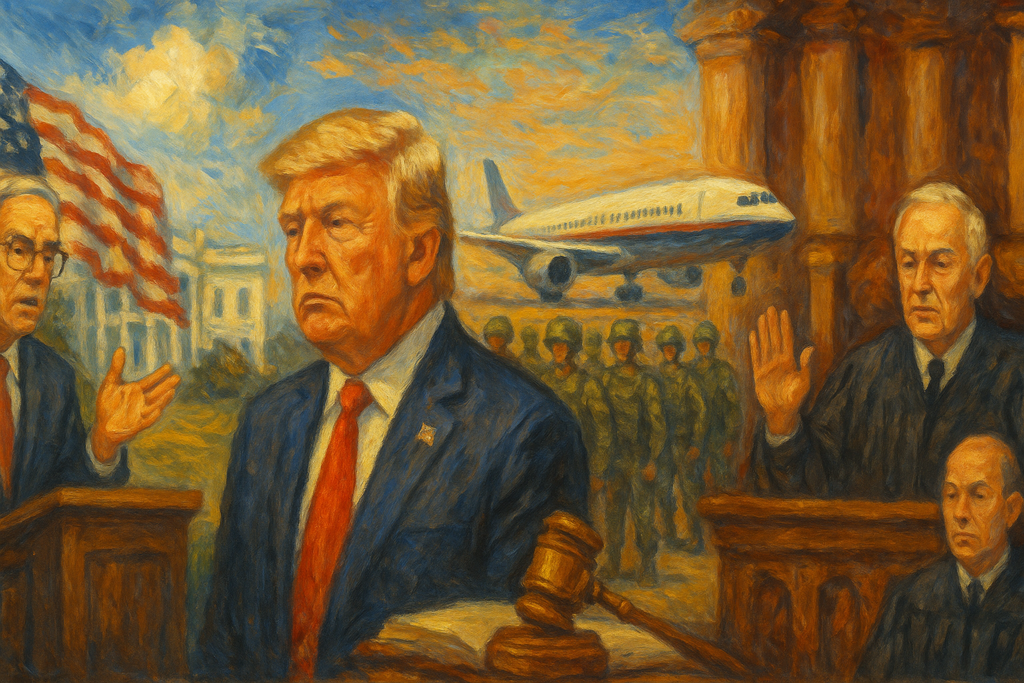
This week’s throughlines
- Immigration enforcement collided with courts and free-speech protections — The administration kept expanding immigration pressure through detention, deportation plans, self-deportation incentives, and resource shifts, while judges repeatedly intervened to require notice, due process, or release.
- Foreign entanglement and private benefit became a central political story — The planned acceptance of a Qatari jet grew from a weekend report into a weeklong controversy tied to legal justifications, Senate retaliation, and overlapping U.S.-Qatar commercial and defense deals.
- Pressure on institutions spread from agencies to media and universities — The administration and aligned actors moved against agency independence, public media, intelligence analysis, campus dissent, and civil-rights enforcement, while some courts and outside institutions pushed back.
- Congress pursued a sweeping budget fight with major social consequences — Republicans pushed a reconciliation package pairing tax cuts with Medicaid, SNAP, and other reductions, while internal GOP divisions and public protest complicated the effort.
The week opened with two stories that framed everything that followed. One was about power: a senior White House aide publicly musing about suspending habeas corpus, the centuries‑old guarantee that the government must justify detaining a person. The other was about money: revelations that Qatar’s ruling family planned to provide a $400 million luxury jet for use as Air Force One and later as part of Donald Trump’s presidential library, even as Trump‑branded projects expanded across the Gulf. Together, they set up a week in which emergency powers and personal enrichment repeatedly intersected with immigration enforcement, foreign policy, and the basic workings of law and government.
Over the weekend, deputy chief of staff Stephen Miller floated the idea that the administration might suspend habeas corpus in response to migrant crossings, casting the border as an emergency that could justify extraordinary detention powers. Republican senators largely declined to repudiate the suggestion, and Trump himself later questioned whether Americans have a right to due process at all. The silence from his party signaled that talk of setting aside one of the Constitution’s core protections was no longer unthinkable rhetoric but part of the governing conversation.
At the same time, the Qatar jet story broke into public view. Reports described a plan under which Qatar’s royal family would provide a Boeing 747‑8, nominally as a donation to the Defense Department, but with arrangements that would ultimately leave the plane in Trump’s control for his post‑presidential library. The news landed alongside word of a $5.5 billion Trump golf project in Qatar and a broader $243 billion defense and aviation package under negotiation between the two countries. Trump’s lawyers and Attorney General Pam Bondi insisted the gift was legal, but the scale and structure of the deal raised sharp questions about the Emoluments Clause and whether foreign governments were effectively buying favor by tying state contracts to the president’s private business.
The weekend also underscored how Trump’s foreign business expansion had accelerated during his second term. New reporting counted 20 Trump‑branded projects underway in nine countries, with developers in places like Qatar seeking permits and financing from the same governments that were negotiating arms and aviation deals with Washington. That overlap made it harder to distinguish between U.S. foreign policy and the president’s commercial interests, especially in the Gulf, where authoritarian partners control both state contracts and the regulatory approvals his projects needed.
Domestically, immigration enforcement and dissent collided in visible ways. Newark Mayor Ras Baraka was arrested by Homeland Security agents while protesting outside a privately run ICE detention facility, and DHS spokespeople suggested that three House Democrats who joined the oversight visit could themselves face arrest for allegedly assaulting officers—claims contradicted by video. In Tennessee, state troopers turned more than a hundred motorists over to ICE after targeted traffic stops. These actions sent a message that local officials and lawmakers who challenged detention practices could be treated as potential criminals, blurring the line between oversight and obstruction in the eyes of federal enforcers.
Universities and the military became fronts in the administration’s culture and information battles. At Columbia University, police arrested student protesters over Gaza and briefly suspended student journalists covering the events. The Pentagon, for its part, ordered military academies to strip race and gender from admissions decisions and directed bases and Defense Department schools worldwide to remove hundreds of books on diversity, equity, and gender from their libraries. These moves narrowed what students, cadets, and military families could read and study about identity and power, reshaping the information environment for future officers and public servants.
The White House also moved to control its own narrative more directly. It launched “White House Wire,” a government‑run news site, and began posting AI‑generated political imagery and stylized videos of deportation flights. By producing synthetic visuals of enforcement actions and distributing them through official channels, the administration could bypass traditional media filters and present curated images that blurred the line between documentation and propaganda. This push came as wire services were being squeezed out of access to Air Force One and as Voice of America’s independence was under pressure, foreshadowing later in the week.
Economic policy over the weekend reflected the same volatility that has marked Trump’s second term. He announced a 100% tariff on all foreign‑produced movies, casting it as a way to “save Hollywood,” even as details remained vague. At the same time, he agreed to sharply reduce previously imposed tariffs on Chinese goods—from 145% down to roughly 30%—with China reciprocating and a 90‑day pause on many tariffs taking effect. The rapid pivot from escalation to partial retreat unsettled markets and underscored how trade policy was being used as a political lever rather than a predictable economic tool. In health policy, Trump and Health Secretary Robert F. Kennedy Jr. unveiled aggressive executive orders to tie U.S. drug prices to those abroad and threaten imports or price controls if companies did not comply, inviting legal challenges and raising questions about who would bear the costs.
By Monday, the governing pattern behind these moves came into clearer focus. A broad account of Trump’s early second‑term agenda described sweeping cuts across federal agencies, even as deportations and detentions sometimes proceeded in defiance of court orders. The Department of Energy announced the elimination of 47 appliance efficiency rules, and the administration moved to rescind limits on toxic “forever chemicals” in drinking water. These steps weakened regulatory capacity in health, safety, and environmental protection at the same time the executive branch was asserting more unilateral power over enforcement, especially in immigration.
Law enforcement priorities were formally reordered. The administration directed the FBI to devote roughly one‑third of its resources to assisting ICE, explicitly deprioritizing white‑collar and financial crime investigations. Agents were told to spend a third of their time on immigration crackdowns, shifting investigative capacity away from complex corporate wrongdoing and toward policing migrants. In parallel, Trump nominated Casey Means, an unlicensed physician with public anti‑vaccine positions, to serve as surgeon general on the recommendation of RFK Jr., and fired Shira Perlmutter, head of the U.S. Copyright Office, shortly after she released a cautious report on AI and copyright. Coming after the earlier removal of the Librarian of Congress, these moves showed how specialized, technical roles were being filled or vacated based on ideological alignment rather than expertise.
Defense and fiscal priorities moved in the opposite direction from domestic regulation. Trump proposed a $1.01 trillion military budget for 2026, a $119 billion increase, while House Armed Services members advanced a $150 billion defense hike through reconciliation. SpaceX secured a $6 billion Pentagon contract and emerged as frontrunner for a $25 billion “Golden Dome” missile shield, even after Trump fired the would‑be inspector general for the project. Bipartisan support for defense spending contrasted sharply with planned cuts to social programs, reinforcing a pattern in which ever‑larger sums flowed to politically connected contractors while oversight mechanisms were weakened.
Courts and regulators, meanwhile, sent mixed signals. A federal judge rejected a bid to block the IRS from sharing immigrants’ tax records with ICE, allowing a controversial data‑sharing practice to continue. Another judge, however, temporarily blocked the administration from canceling Justice Department grants to the American Bar Association for domestic and sexual violence training, citing concerns about retaliation. Inside the Justice Department, the civil rights division, hollowed out by resignations and reassignments, pleaded with attorneys to stay or return. Technical agencies continued their quieter work: the Election Assistance Commission sought comment on new voting system testing and financial reporting rules, procurement officials updated Buy American and acquisition regulations, and the FDA issued a series of patent‑term and color‑additive notices. These routine actions showed how the machinery of elections, markets, and drug regulation kept turning even as high‑profile conflicts dominated attention.
On Tuesday, immigration and the courts moved to the center of the stage. In Pennsylvania, a Trump‑appointed judge ruled that the administration could use the 1798 Alien Enemies Act to accelerate deportations of Venezuelans accused of gang ties, provided they received 21 days’ notice. The administration pushed for even shorter timelines, seeking to repurpose an 18th‑century wartime law for modern immigration enforcement. Within days, the Supreme Court stepped in, issuing a 7–2 decision in A.A.R.P. v. Trump that blocked deportations under the proclamation and insisted on meaningful due process. The episode highlighted both the executive’s willingness to reach for rarely used statutes and the Court’s role in setting limits.
The administration also used other levers to pressure institutions that resisted its immigration agenda. Twenty Democratic‑led states sued to block threatened cuts to billions in federal grants for jurisdictions that limited cooperation with ICE, arguing that the federal government was overstepping its authority. At the same time, a federal grand jury indicted Milwaukee County Judge Hannah Dugan for allegedly helping an undocumented defendant avoid ICE in her courtroom—an unprecedented move widely seen as a warning to judges. Dugan moved to dismiss the case on judicial immunity grounds, turning a local incident into a test of how far the executive could go in disciplining the judiciary.
Congress began to push back on the Qatar jet deal. Senate Democratic leader Chuck Schumer announced a blanket hold on Justice Department nominees until Attorney General Bondi explained how the arrangement complied with the Constitution. By tying confirmations to transparency on foreign gifts, the Senate used one of its remaining tools to probe potential emoluments violations. The hold forced Republicans to spend scarce floor time on individual confirmations and signaled that at least some in Congress were willing to confront the blending of foreign statecraft and presidential enrichment.
Universities remained under pressure. The administration cut an additional $450 million in federal grants to Harvard, prompting the university to expand its First Amendment lawsuit alleging retaliation for campus speech and governance decisions. Separately, a Russian scientist at Harvard was charged with smuggling frog embryos, a case her lawyer called meritless and timed to influence deportation proceedings. These actions unfolded as the State Department prepared to direct universities to report foreign students involved in certain protests, foreshadowing a more formal role for campus administrators in immigration surveillance. On the regulatory front, the EPA delayed reporting deadlines for PFAS, a class of toxic chemicals, pushing back data collection to 2026–2027 even as the administration formalized a 90‑day pause in high tariffs on Chinese goods. Both moves reflected a pattern of easing certain pressures under economic strain, whether on manufacturers or on trade partners.
Wednesday brought a dense cluster of developments that underscored the week’s themes. At the Supreme Court, justices heard consolidated challenges to Trump’s executive order denying U.S. citizenship to children born on American soil unless a parent is a citizen or permanent resident. The administration also asked the Court to curb lower courts’ ability to issue nationwide injunctions against presidential orders. Even conservative justices posed skeptical questions, suggesting an uphill battle for the government. The outcome will determine both the scope of the 14th Amendment’s birthright citizenship guarantee and how easily presidents can sidestep broad judicial blocks in the future.
Elsewhere in the judiciary, a Trump‑appointed district judge, Aileen Cannon, dismissed the classified documents case against Trump over his handling of materials at Mar‑a‑Lago. She ruled that Special Counsel Jack Smith had been unlawfully appointed because he exercised the powers of a principal officer without Senate confirmation. Smith appealed, but the case remained unresolved when Trump returned to office, effectively shielding him from trial on mishandling national security documents. The decision relied on a novel reading of appointment law and raised questions about whether legal doctrines were being stretched to protect a former president, with implications for future special counsel investigations.
Courts also acted as a shield for some of those targeted in the administration’s immigration and speech campaigns. Federal judges in Virginia and elsewhere ordered the release of several international students and scholars—Badar Khan Suri, Rümeysa Öztürk, Mohsen Mahdawi—who had been detained by ICE after their visas were revoked over pro‑Palestinian activism. Judges found the government’s evidence lacking and emphasized the public interest in protecting free speech. A related case in New Jersey involving Columbia student Mahmoud Khalil was pending, but his lawyers were optimistic after these rulings. These decisions pushed back against efforts to use immigration law as a tool to punish political expression and set precedents for protecting non‑citizens’ expressive rights.
On Capitol Hill, House committees released pieces of a reconciliation bill that would extend the 2017 Trump tax cuts, increase the child tax credit while excluding roughly 17 million low‑income children and many mixed‑status families, and impose work requirements and major cuts on Medicaid and SNAP. The package also proposed phasing out key green tax credits from the Inflation Reduction Act and ending several climate incentives. Four New York Republicans formed a bloc demanding higher state and local tax deductions, threatening the bill’s passage. The proposal thus combined long‑term tax advantages for wealthier households with shrinking health, food, and climate support for millions, reshaping the social contract even as internal party tensions simmered.
Health Secretary RFK Jr. appeared before House and Senate panels to defend a budget that would cut scientific and biomedical research and add work requirements to Medicaid, potentially costing millions their coverage. Lawmakers pressed him on his long‑standing vaccine skepticism as the U.S. surpassed 1,000 measles cases across 30 states. He was evasive, and he disclosed that a court order had temporarily halted further planning in a controversial health department reorganization. The testimony underscored how federal health policy was being aligned with vaccine skepticism and austerity at a moment of rising preventable disease.
The rhetoric around immigration hardened further. In testimony to the House Homeland Security Committee, DHS Secretary Kristi Noem suggested that migrants at the southern border could be classified as a “rebellion or invasion,” potentially justifying suspension of habeas corpus. She refused to answer questions about deportations of U.S. citizens. Her remarks echoed Miller’s earlier suggestion and foreshadowed executive orders that would target non‑citizens based on ideology. At the same time, the Justice Department’s new “weaponization” working group, led by Ed Martin, announced plans to investigate and potentially charge prosecutors who had brought cases against Trump, including Jack Smith and local district attorneys. DHS and the Secret Service opened investigations into former FBI Director James Comey over an Instagram post of seashells arranged as “8647,” which Trump allies claimed was a coded assassination threat. Noem announced an investigation into Comey based on a social media claim by Donald Trump Jr. Turning investigative powers on prosecutors and former officials who had challenged the president blurred the line between legal accountability and political revenge.
Other institutions signaled the stakes in quieter ways. The South Carolina Supreme Court unanimously upheld the state’s six‑week abortion ban, rejecting arguments over the definition of “fetal heartbeat,” while Capitol Police arrested 25 disability rights activists protesting Medicaid cuts inside a House committee room. And at Harvard Law School, scholars confirmed that a document long thought to be a copy was in fact an original 1300 Magna Carta, one of only seven surviving. The charter, a foundational text for the rule of law and due process, resurfaced in public discussion just as U.S. leaders questioned those very principles and courts weighed the scope of birthright citizenship and emergency powers.
On Thursday, the ambitious reconciliation package ran into the limits of intra‑party consensus. The House Budget Committee voted down the bill, 16–21, after hard‑right members demanded even deeper spending cuts. The measure would have extended Trump’s tax cuts, funded mass deportations, eliminated taxes on tips and overtime, and slashed Medicaid and other social programs. A separate committee also rejected a related package. The collapse exposed serious fractures within the Republican caucus and delayed the administration’s fiscal agenda, prolonging uncertainty over taxes, spending, and deportation funding.
Outside the committee rooms, protests over the proposed Medicaid cuts intensified. During a House Energy and Commerce hearing, disability rights activists from ADAPT and other groups demonstrated against the changes, leading to 25 arrests inside the Capitol. In a separate Senate hearing, Ben & Jerry’s co‑founder Ben Cohen was arrested while protesting both the Gaza blockade and domestic Medicaid cuts as RFK Jr. testified. Democrats accused Republicans of trying to rush through life‑altering changes without adequate public scrutiny. The arrests showed how procedural rules and security powers inside Congress could be used to limit visible opposition to major policy shifts.
The administration’s approach to immigration and dissent grew more explicit. Executive orders 14161 and 14188, which had been issued earlier, came into sharper focus: they allow deportation or denial of entry to foreigners based on broadly defined political and cultural views, including expansive definitions of antisemitism that encompass criticism of Israeli policy. These orders sat alongside efforts to use the Alien Enemies Act and to pressure universities to report foreign students involved in certain protests, creating a layered system of ideological screening. In the intelligence community, Director of National Intelligence Tulsi Gabbard fired the acting chair and deputy of the National Intelligence Council after they produced a report contradicting Trump’s claims about Venezuelan gang involvement, reinforcing a pattern of purging analysts whose assessments conflicted with preferred narratives.
Foreign money and authoritarian partnerships remained a through‑line. Top U.S. executives from firms like BlackRock, Blackstone, and Uber attended a lunch in Saudi Arabia with Trump and Crown Prince Mohammed bin Salman, followed by an investment forum touting large deals. This renewed engagement came even as a U.S. intelligence assessment concluded that MBS personally approved Jamal Khashoggi’s murder. Many of the executives had donated heavily to Trump’s inauguration, raising questions about access and influence. The scene echoed the Qatar jet and golf project: foreign governments with poor human‑rights records offering lucrative deals that intertwined state contracts with the president’s personal and political networks.
Economic warning lights flashed as Moody’s downgraded the U.S. sovereign credit rating for the first time since 1917, citing widening deficits driven by rising interest payments, entitlement spending, and weak revenues. The downgrade followed the House Budget Committee’s rejection of the reconciliation bill and came amid volatile tariff policy with China. It is expected to raise borrowing costs and could constrain future fiscal options, a concrete signal that markets doubt the sustainability of current fiscal and tax policies. Yet even as Moody’s acted, the Supreme Court issued another 7–2 ruling blocking the administration’s attempt to deport alleged Venezuelan gang members with only 24 hours’ notice, insisting on more robust due process, and a federal judge in South Dakota granted a preliminary injunction protecting Indian PhD graduate Priya Saxena from deportation over a minor traffic violation. These decisions reaffirmed that, even in immigration, the executive could not bypass basic procedural protections without judicial scrutiny.
Friday capped the week with a series of moves that tied together information control, campus surveillance, and the militarization of immigration enforcement. The administration terminated nearly 600 contractors at Voice of America—more than a third of its workforce—most of them journalists from authoritarian countries whose visas are tied to their jobs. The firings defied a recent court order requiring the government to maintain strong news operations at VOA. Officials cited “the government’s convenience,” effectively weakening a key U.S. instrument for independent news abroad and leaving many reporters facing deportation. The cuts came after the launch of “White House Wire” and the use of AI‑generated imagery, underscoring a shift from supporting independent journalism to favoring state‑aligned messaging.
On campuses, the State Department directed university officials to report international students and scholars involved in protests or activities it deemed antisemitic or terrorist‑related. Administrators warned that the directive was burdensome and could chill speech. Court filings revealed that ICE had already obtained a search warrant for Columbia University housing by claiming it needed evidence that the university was “harboring aliens,” then used the warrant to try to arrest two students, Yunseo Chung and Ranjani Srinivasan, over pro‑Palestinian activism. Attorneys argued the warrant was obtained under false pretenses, and Chung, a legal permanent resident, sued, alleging misuse of the “harboring” statute to punish political activity. These developments turned campus administrators into de facto intelligence gatherers and showed how immigration tools could be repurposed for political policing.
The militarization of immigration enforcement advanced another step. A DHS spokesperson confirmed that the agency had requested 20,000 National Guard members to assist with immigration enforcement, potentially marking the first large‑scale use of Guard troops for this purpose. The request followed weeks of rhetoric describing migrants as an “invasion” and open talk of suspending habeas corpus. Deploying military forces for domestic immigration enforcement blurred civil‑military boundaries and raised the risk of rights violations in what had traditionally been civilian policing and administrative processes.
Voices outside government tried to name what was happening. At a concert in Manchester, Bruce Springsteen criticized the U.S. political climate, citing abandonment of allies, ideological pressure on universities, and deportations without due process. His remarks echoed concerns raised by conservative Judge J. Michael Luttig, who warned that Trump is weaponizing the federal government against political enemies. When both a conservative jurist and a prominent artist describe similar patterns, it suggests that worries about the rule of law and democratic backsliding are not confined to one party or niche. Even as these debates played out, parts of the environmental bureaucracy continued in a more traditional mode: the EPA announced a joint meeting on regional air pollution, proposed Superfund settlements, and released environmental impact notices, offering one of the few arenas where public, participatory processes still resembled their pre‑Trump form.
Taken together, the week’s events showed a government testing how far it could stretch old statutes, emergency framings, and administrative discretion to reshape who is protected by law and who is targeted by it. Courts acted at times as a shield—freeing detained students, blocking rapid deportations, preserving some civil society grants—and at other times as a weapon or a refuge for the powerful, as in the dismissal of the Mar‑a‑Lago case and the indictment of a sitting judge. Foreign money and authoritarian partners deepened their ties to U.S. policy through jets, golf courses, arms deals, and investment forums, even as domestic institutions were pressed to monitor, punish, or silence dissent. Against that backdrop, the rediscovery of an original Magna Carta and the warnings of figures like Luttig and Springsteen served as reminders that constraints on arbitrary power have deep historical roots—and that their continued force depends not on parchment alone, but on how today’s institutions choose to respond.