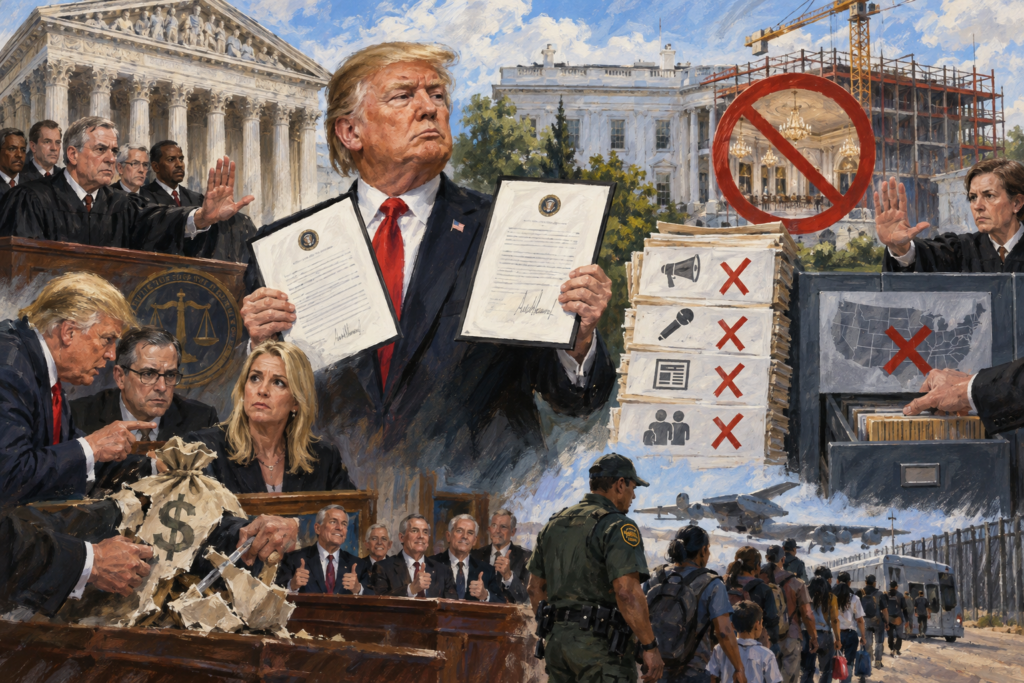
This week’s throughlines
- Executive defiance of judicial rulings, followed by reformulated attempts to achieve the same end — After the Supreme Court struck down Trump's original birthright citizenship order in Trump v. Barbara, the administration issued two new executive orders attempting to achieve similar restrictions through narrower categories and a birth-tourism framework, testing how far executive power can stretch after a direct judicial defeat.
- Presidential pressure on prosecutors and nominees as a tool of informal control — Throughout the week, Trump publicly attacked US Attorney Jeanine Pirro over a dismissed vandalism case and pressured his own attorney general nominee Todd Blanche over the fate of a controversial 'anti-weaponization' fund, illustrating how informal presidential pressure substitutes for formal process in shaping Justice Department behavior.
- Courts as the week's most consistent check on executive overreach — Across tariffs, the White House ballroom, voter roll access, and First Amendment cases, federal courts repeatedly ruled against the administration, with one analysis finding judges sided against the executive in 75 of 93 First Amendment disputes and rejected DOJ voter-roll lawsuits for a 21st consecutive time.
- Immigration enforcement escalating toward record scale and harsher tactics — ICE arrests hit a record monthly high in July, TPS protections ended for Haitians and South Sudanese, hunger strikers were force-fed under court order, military family members and academics were detained, and a body-camera policy was adopted that lets the agency withhold footage of deaths—together describing a system expanding in scope while narrowing in accountability.
- Direct democracy and judicial independence defended at the ballot box — Voters in Missouri and Kansas rejected Republican-backed measures that would have made citizen constitutional amendments nearly impossible to pass and replaced judicial nominating commissions with direct elections, pushing back against efforts to concentrate partisan control over courts and lawmaking.
The first week of August unfolded as a study in the uses and limits of presidential power: a week in which the executive repeatedly tested boundaries set by courts, Congress, and the Constitution, sometimes retreating under pressure and sometimes pressing forward in open defiance. By week's end, record immigration enforcement figures, a contested attorney general confirmation, and a presidential answer to a Supreme Court defeat had converged into a single narrative about how far executive authority could be stretched before something gave way.

**The Weekend**

The administration escalated a fight with the Smithsonian, issuing an executive order that accused the National Museum of American History of "extreme political activism" and mandated warning signage—part of a broader campaign reportedly shaped by activist David Barton's influence over how the administration wanted national history told. At the same time, a brewing standoff over the attorney general nomination surfaced publicly: with Senators John Cornyn and Thom Tillis blocking Todd Blanche's confirmation over a disputed $1.8 billion "anti-weaponization" fund, Trump threatened to simply keep Blanche on as acting attorney general indefinitely, sidestepping the Senate's confirmation role altogether. Elsewhere, Trump Media's new "Truth API" service began selling early access to the president's market-moving posts for up to $100,000 a month, drawing requests from senators for an SEC investigation into whether the arrangement converted presidential communication into a vehicle for personal profit. Health Secretary Robert F. Kennedy Jr., amid a 35-year high in measles cases, urged parents to vaccinate their children while simultaneously calling vaccination a "personal choice" and repeating false claims linking vaccines to autism—a split message that did little to steady public confidence during an active outbreak. A mass shooting in Twin Falls, Idaho, that killed three people added a somber note to the weekend, while Texas's decision to pause new data center construction, following New York's earlier move, hinted at a shifting national posture toward AI infrastructure investment.

**Monday**

The week's legal and institutional fault lines began to widen. A coalition of 25 states, joined separately by 23 more states and the governors of Kentucky and Pennsylvania, filed suit in the Court of International Trade challenging tariffs that now covered 99.4 percent of all U.S. imports, arguing the duties exceeded statutory authority and defied an earlier Supreme Court tariff ruling. The same day, court records revealed that DHS and ICE had sought and obtained orders to force-feed at least ten detained immigrants since 2025, including an Afghan man restrained for nearly six months, frequently without legal representation present during the proceedings—a practice widely classified internationally as a form of torture. The Justice Department, meanwhile, announced a record 25 new denaturalization complaints, bringing the total since January 2025 to 123, part of what officials called the largest coordinated denaturalization effort in the department's history. In North Carolina, the state Senate passed a voter suppression bill without debating Democratic amendments; one senator invoked post-Reconstruction history before walking out, and protesters chanting in the gallery were removed from the chamber. James Comey's defense team filed motions alleging vindictive and selective prosecution, citing irregularities in the grand jury process, even as judges in multiple courts were separately reported describing Justice Department attorneys' conduct as "unlawful," "unethical," and "dishonest"—criticism tied partly to the collapsing Reflecting Pool vandalism case. That collapse fed directly into a presidential outburst: Trump spread false claims about the alleged vandalism on Truth Social, then attacked U.S. Attorney Jeanine Pirro by name for dropping the related charges, accusing her of having "folded like an umbrella."

**Tuesday**

The day brought a mixed set of judicial outcomes. In Arizona, federal contractors building border wall segments used broad statutory waivers to bypass the Endangered Species Act, felling cottonwood trees that housed nesting threatened birds—an example of executive authority overriding environmental law without legislative or judicial review. In a sharply different direction, a federal judge dismissed seditious conspiracy charges against Oath Keepers members tied to January 6, at the Justice Department's own request; the judge expressed regret that the case would not reach a different conclusion, a notable acknowledgment from the bench. Reporting also surfaced that ICE had detained a Johns Hopkins researcher and a University of Maryland pharmacy instructor, both holding valid work authorization, at U.S. airports, exposing inconsistencies in supposed enforcement priorities before both were released. Separately, new reporting found that billions of dollars in tariff refunds were flowing primarily to corporations rather than to the consumers who had actually borne the higher costs. Investigators also released surveillance and bodycam footage from the Twin Falls shooting, confirming the gunman had acted alone and that bystander intervention likely limited the casualty count.

**Wednesday**

The day offered a notable counterpoint to the week's pattern of executive assertion. In Missouri, voters overwhelmingly rejected a measure that would have required constitutional amendments to win majorities in every congressional district—a change that would have made future citizen-led amendments nearly impossible. In Kansas, voters rejected, for a second time, a proposal to replace judicial nominating commissions with direct elections for state Supreme Court justices. Both results preserved mechanisms that have protected reproductive rights, Medicaid expansion, and judicial independence from partisan restructuring. The same day, the White House revived its effort to remove Federal Reserve Governor Lisa Cook, sending her a letter demanding a response to previously dismissed fraud allegations within three weeks, despite a Supreme Court ruling in June that had already allowed her to remain in her position. New Mexico's attorney general filed suit against the Justice Department, alleging it had reneged on a 2019 agreement to share unredacted investigative materials tied to Jeffrey Epstein's Zorro Ranch activities, obstructing the state's efforts to identify victims and co-conspirators. Trump's own legal team, meanwhile, moved to block a court order requiring him to disclose detailed financial records in his $10 billion defamation suit against the BBC, calling the demands "shockingly broad." And following a Supreme Court decision backing the administration, a judge lifted the stay protecting Temporary Protected Status for roughly 350,000 Haitian nationals; ICE began summoning Haitians in Ohio for ankle-monitor enforcement restricting their movement to within 75 miles of home.

**Thursday**

Thursday was the week's fulcrum. Weeks after the Supreme Court ruled 6–3 in Trump v. Barbara that Trump's original birthright citizenship order was unconstitutional, the president signed two new executive orders attempting to achieve similar ends through narrower categories, including a "birth tourism" framework, and called the Court's earlier decision "very unfortunate." The move amounted to a direct test of how far an administration could go in reformulating a policy after a definitive constitutional ruling against it. The same day, the Republican-led Senate Homeland Security Committee voted along party lines to hold Dr. Anthony Fauci in contempt of Congress after he invoked Fifth Amendment protections more than one hundred times during testimony; the committee had also controversially obtained a backup copy of his personal phone. Trump separately signed a proclamation imposing a 15 percent tariff and minimum import prices on polysilicon, a critical material for semiconductors and solar panels, citing national security and the collapse of domestic production capacity. ICE and TSA expanded airport enforcement operations, aiming for 2,000 daily immigration arrests and targeting people with pending visa and asylum applications, prompting some airlines to refuse cooperation absent judicial warrants. Journalist Georgia Fort, indicted for documenting a protest at a Minnesota church where an ICE official served as pastor, moved to dismiss her case, with her attorneys citing false statements in the search warrant applications and arguing the prosecution amounted to retaliation for her reporting. Trump also threatened "long term jail sentences" for officials who leaked information about U.S. munitions shortages tied to the Iran conflict, even as he denied the shortages existed. And the Justice Department's own internal watchdog, its Office of Professional Responsibility, was revealed to have received a record 1,666 misconduct complaints in 2025 even as its staff shrank from 29 to 16 and its director was fired without replacement.

**Friday**

Friday closed the week with resolution on several fronts. Todd Blanche's path to confirmation as attorney general finally cleared after Senator Bill Cassidy withdrew his opposition; the final holdout had been resolved only after Blanche agreed to terminate the disputed $1.8 billion anti-weaponization fund that had stalled his nomination for weeks, converting Monday's threat of unilateral acting authority into a negotiated, if contested, confirmation. The Washington Post reported that ICE arrests had hit a record monthly high of 43,000 in July, the largest total of Trump's second term, bringing detentions to more than 238,000 people over the year's first seven months, a pace apparently unaffected by recent controversies over fatal shootings involving agents. An Associated Press investigation separately found that at least 52 parents and spouses of active-duty service members had been detained since January 2025, with at least six deported, after a 2025 policy eliminated the longstanding bipartisan exemption protecting military families from deportation. ICE also announced a body-camera policy requiring every field officer to wear one by September, but the policy grants the agency's director discretion to delay or withhold footage of officer-involved deaths if release is not deemed "in the best interests of the agency," a provision drawing scrutiny following two recent fatal shootings that had gone unrecorded. An appeals court, meanwhile, reaffirmed that the White House ballroom project required congressional approval, finding no precedent for a president unilaterally demolishing taxpayer-funded portions of the White House—even as construction continued on the ground with a 250-person crew working around the clock. A Reuters analysis found that federal judges, including ten Republican appointees, had ruled against the administration in 75 of 93 cases raising First Amendment claims, spanning law firm retaliation, journalist restrictions, university funding cuts, and protest-related force. And reporting from Popular Information exposed a Senate Republican dark-money group operating a network of fake local news sites in competitive states, including a demonstrably false attack ad against Senator Jon Ossoff that had already reached 78 million impressions.

Taken as a whole, the week traced a recognizable pattern: executive assertion met by institutional resistance, followed in some cases by retreat and in others by renewed defiance. The Supreme Court's rejection of the original birthright citizenship order did not end the effort to restrict it; it simply prompted a reformulated one. The standoff over the Justice Department's slush fund did not disappear—it was traded away to secure a confirmation vote. Courts continued to serve as the most consistent check on executive overreach, ruling against the administration in the overwhelming majority of First Amendment cases and blocking unilateral action on tariffs, voter rolls, and the White House grounds itself. Yet enforcement agencies continued to expand their reach into airports, hospitals, and military families' lives, often with diminishing transparency about the consequences. And twice during the week, voters in Missouri and Kansas demonstrated that constitutional guardrails built to resist concentrated power still retain their own kind of durability—proof that the contest over how authority is exercised in American life was not confined to Washington, but being decided, ballot by ballot, in the states as well.