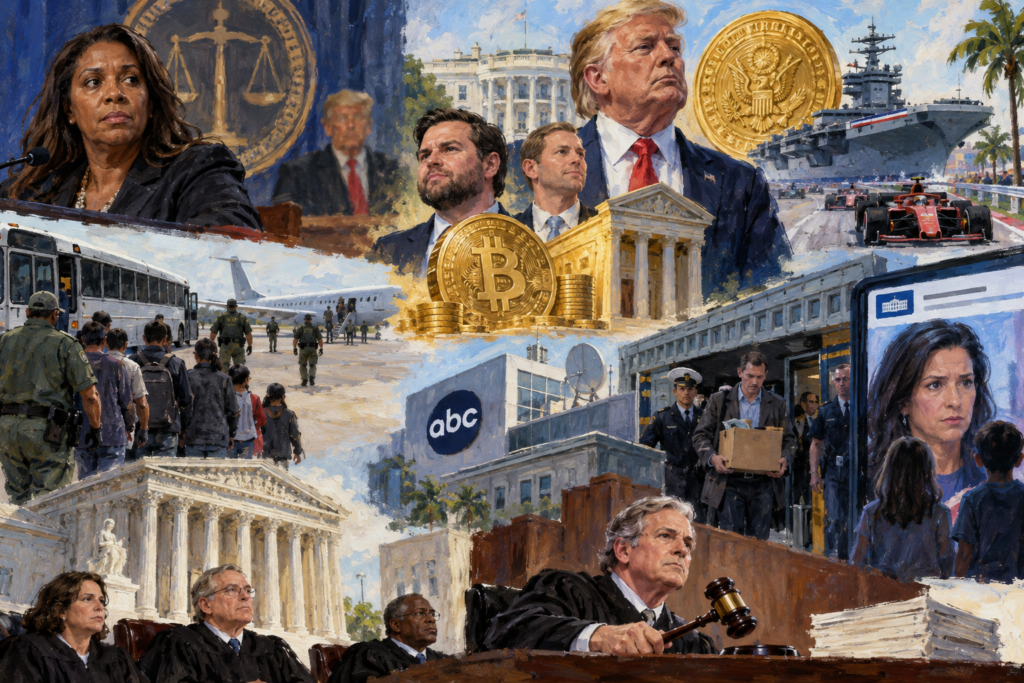
This week’s throughlines
- Executive power asserted itself across courts, allies, and institutions with diminishing deference to constraint — From the Attorney General's refusal to pledge DOJ independence, to unilateral tariff and military exercise reversals with South Korea, to threats against Oman and claims over the Strait of Hormuz, the administration repeatedly demonstrated a preference for unchecked presidential discretion over institutional or alliance-based limits.
- A press freedom crisis deepened through legal retaliation, personnel purges, and personal attacks — ABC/Disney sued the FCC over alleged retaliatory licensing demands, the Pentagon fired three Stars and Stripes journalists for reporting on ship conditions, and White House accounts attacked a CNN reporter by invoking her children—three separate fronts in an escalating conflict between the administration and independent media.
- Self-dealing and transparency rollbacks accumulated quietly alongside the louder stories — A Trump family crypto venture received a bank charter, a congressionally mandated anti-money-laundering registry was dismantled and its data destroyed, and the president continued to monetize advance access to his own statements—all while facing little immediate institutional check beyond congressional bill introductions.
- Courts and local governments provided intermittent but real pushback — The Supreme Court declined to reopen the Carroll verdict, a federal appeals court protected houses of worship from immigration raids, Nevada election officials resisted pressure to purge voter rolls on thin evidence, and dozens of towns rejected surveillance contracts—even as the Chief Justice simultaneously let the ballroom project proceed.
The week began with a blunt admission. Attorney General Todd Blanche, appearing on NBC's Meet the Press shortly after his confirmation, told interviewer Kristen Welker that "no attorney general should ever pledge" independence from the president. It was a small sentence with large implications, and it echoed through the days that followed, as the Justice Department kept pressing states for voter roll data it had already lost in court twenty-two times, and as prosecutors prepared to defend one of the more peculiar cases in recent memory: a charge against former FBI Director James Comey over an Instagram photo of seashells arranged to spell "8647."

That same weekend, immigration enforcement intensified in ways that stretched due process past its usual limits. ICE agents began arresting people inside courthouses, the same practice a judge had already found created a chilling effect on anyone seeking legal recourse. Newly appointed immigration judges—some explicitly cast as "deportation judges"—ran mass hearings with as little as fifteen days' notice, generating tens of thousands of in-absentia removal orders for people who never had a real chance to appear. A Texas Tribune investigation added another data point: children held in detention well past the twenty-day legal limit. Taken together, the weekend's immigration news described a system optimized for speed and volume, with notice and hearing rights treated as obstacles rather than safeguards.

Financial self-dealing surfaced too. Late Friday, the Office of the Comptroller of the Currency granted a preliminary bank charter to World Liberty Financial, a crypto venture tied to the Trump and Witkoff families that has already funneled more than $1.6 billion to them; Trump himself had personally made close to $600 million selling stablecoins through the venture. A federal regulator, appointed by the president, had just approved a banking charter enriching the president's own family—a transaction that would later prompt Senator Elizabeth Warren to introduce legislation barring presidents from owning banks. Alongside this, Trump staged a photo-op crediting himself for a drug-price drop that had actually resulted from Biden-era Medicare negotiations, claimed inflation was falling, asserted the U.S. controlled the Strait of Hormuz, and posted a long list of exaggerated statistics on crime and prices. He also found time to redirect military engineering: a new national security memorandum ordered the Navy to revert to older steam catapults on aircraft carriers, and he floated redesigning the carrier command island and adding golden seals to the White House ballroom—personal taste overriding professional judgment on hardware meant to last decades.

By Monday, the Supreme Court delivered a piece of news that cut the other way. The justices rejected Trump's petition for rehearing in the E. Jean Carroll case, leaving the $5 million jury verdict against him intact despite his repeated efforts to undo it. It was a reminder that at least one court remained unmoved by presidential pressure on a matter already settled by a jury.

The press freedom story, which would run through much of the week, opened that same day. ABC filed a First Amendment lawsuit against the FCC, accusing Chair Brendan Carr of demanding early license renewal for its eight stations in retaliation for editorial decisions Trump disliked, including coverage involving Jimmy Kimmel. Monday also brought a sharper, more personal confrontation: at a Georgia rally, Senator Jon Ossoff criticized Trump's reliance on aide Natalie Harp and his handling of military matters. The White House answered not with substance but with insults—communications director Steve Cheung responded crudely, and when a CNN reporter asked Trump to address Ossoff's criticism, the official White House Rapid Response account attacked the reporter directly, invoking her children. It was official government communication turned into a tool of intimidation against a journalist doing her job. Monday closed with Trump, in an Oval Office press conference, threatening to "bomb the shit out of" Oman if it interfered with reopening the Strait of Hormuz, while declaring his intent to claim the strait as U.S. territory—a statement at odds with basic principles of international law and alliance diplomacy, delivered alongside a defense of reduced military exercises with South Korea.

Tuesday deepened both threads. Disney and ABC formally filed their complaint against the FCC, this time in granular detail: more than 600 document requests, 13,000 pages of demands, and allegations of a chilling effect reaching even entertainment programming like The View. The Pentagon, separately, ordered thirty universities—including Harvard, MIT, and Johns Hopkins—to terminate foreign academic partnerships within two weeks or risk losing federal funding, a move that used financial leverage to reach into questions of academic judgment normally left to the institutions themselves. Internationally, Secretary of State Marco Rubio announced sanctions against the president and a senior prosecutor of the International Criminal Court over its Gaza investigations, saying the goal was to "disable" the court's operations. And in a story that received less immediate attention but carried long-term weight, Christian nationalist figures with influence in the administration floated repealing the Nineteenth Amendment in favor of household voting arrangements in which women would defer to men at the ballot box—a proposal, not formal policy, but one voiced by people with real proximity to power.

Wednesday was quieter by comparison. The national debt passed $40 trillion, with interest payments now exceeding the defense budget, a fiscal marker that would connect later in the week to rising consumer costs. Rhode Island's governor ordered a statewide pause on new license plate readers pending a sixty-day privacy review, a small but notable instance of state government responsiveness to surveillance concerns. Transportation Secretary Sean Duffy's six-episode YouTube series, filmed over seven months of his tenure, premiered to just over 5,000 views—an odd footnote about how cabinet officials were spending their time and the department's platforms. And the Ossoff feud continued on cable news, with the senator defending his earlier remarks about Natalie Harp, a sign that the personal clash from Monday had not faded.

Thursday brought the week's most consequential cluster of developments. Chief Justice John Roberts stayed a lower court order that had halted construction of Trump's 90,000-square-foot White House ballroom, a project already 65 percent complete and expected to cost more than $400 million. A federal appeals court had found the project likely required congressional approval, but the stay allowed work to continue while that question remains under review—a procedural pause, not a final resolution, though one that let a disputed exercise of executive authority over public property keep moving forward in the meantime. The same day, documents obtained through FOIA litigation showed FCC Chair Brendan Carr had been in direct communication with White House officials and Sinclair Broadcast Group while overseeing the very license decisions ABC was now suing over—evidence that strengthened the broadcaster's claim that its regulator was acting as a political instrument rather than a neutral arbiter. The Justice Department, meanwhile, argued in court that Comey's seashell Instagram post could reasonably be read as a threat against the president, defending a prosecution his lawyers call vindictive and unconstitutional—a case that traced directly back to Blanche's weekend remarks about loyalty over independence. And at the Pentagon, Spokesman John Ullyot resigned after three months, criticizing Defense Secretary Pete Hegseth for involving his wife in sensitive official duties; Senator Chris Coons, from the other party, separately called the arrangement "not normal," a rare moment of bipartisan unease over how classified information was being handled at the department's senior levels. Thursday closed with more evidence of the presidency blending with private commerce: a donor-funded White House renovation tour, and continued sales of early access to Trump's Truth Social posts for as much as $100,000 a month.

Friday arrived with a cluster of institutional course corrections alongside new instances of pressure on the press. The Pentagon fired the publisher, editor, and a reporter at Stars and Stripes, the military-funded news outlet, after it reported on poor conditions aboard the USS Abraham Lincoln—conditions Trump had separately dismissed as "fake news." The firings were a distinct mechanism from the ABC/FCC lawsuit: not regulatory pressure on a private broadcaster, but direct personnel retaliation inside a military-run newsroom, aimed at journalists covering the welfare of service members. On the accountability side, the Department of Homeland Security walked back a sweeping claim it had made about noncitizen voting in Nevada. After meeting with state officials, DHS acknowledged it could confirm only 185 noncitizens on Nevada's voter rolls, a steep retreat from an earlier claimed figure of nearly 16,000, and part of a broader assertion of 278,000 such registrations across four states that had never been substantiated. It was a specific, checkable claim that collapsed on contact with actual data.

The courts, too, did not move in a single direction. A federal appeals court upheld protections limiting immigration enforcement at houses of worship, a clear check on enforcement overreach. But a federal judge also ruled that a Defense Production Act order allowed a disputed California oil pipeline to keep operating over the state's objections, and the Justice Department's Office of Legal Counsel concluded the Constitution requires presidential control over the Foreign Service Grievance Board—two rulings that, in different ways, validated expansive federal authority over state and institutional prerogatives. Treasury Secretary Scott Bessent formally eliminated beneficial-ownership disclosure requirements for shell companies, completing a rollback that began earlier when FinCEN dismantled and destroyed the underlying registry—removing a congressionally mandated anti-corruption tool with little public notice. And the week's economic pressures became more tangible: gasoline hit $4.11 a gallon, school lunch costs rose 11 percent, and a more-than-40-percent cut to food safety inspection funding was linked to the largest cyclospora outbreak in U.S. history. Asked about the terms of a new beef trade deal, Trump told reporters simply, "I don't want to say," closing the week with a small but telling refusal of disclosure.

Seen as a whole, the week showed executive power testing its limits on several fronts at once—legal, financial, military, and rhetorical—while the institutions meant to check that power produced a mixed but not uniformly deferential record. A jury's verdict against the president stood. A regulator's coordination with the White House came to light through litigation, not official transparency. A specific, inflated claim about voter fraud fell apart once state officials asked for evidence. Journalists at a Pentagon-funded outlet lost their jobs for reporting facts the administration found inconvenient, even as a different broadcaster pressed its own case through the federal courts. None of these outcomes was final; the ballroom project proceeds under a stay, not a verdict, and the ABC/FCC lawsuit remains unresolved. But the pattern of the week was legible: pressure applied broadly and often successfully, met by scattered, real, and sometimes effective resistance from courts, state officials, and local governments unwilling to simply accept the administration's claims at face value.