This week’s throughlines
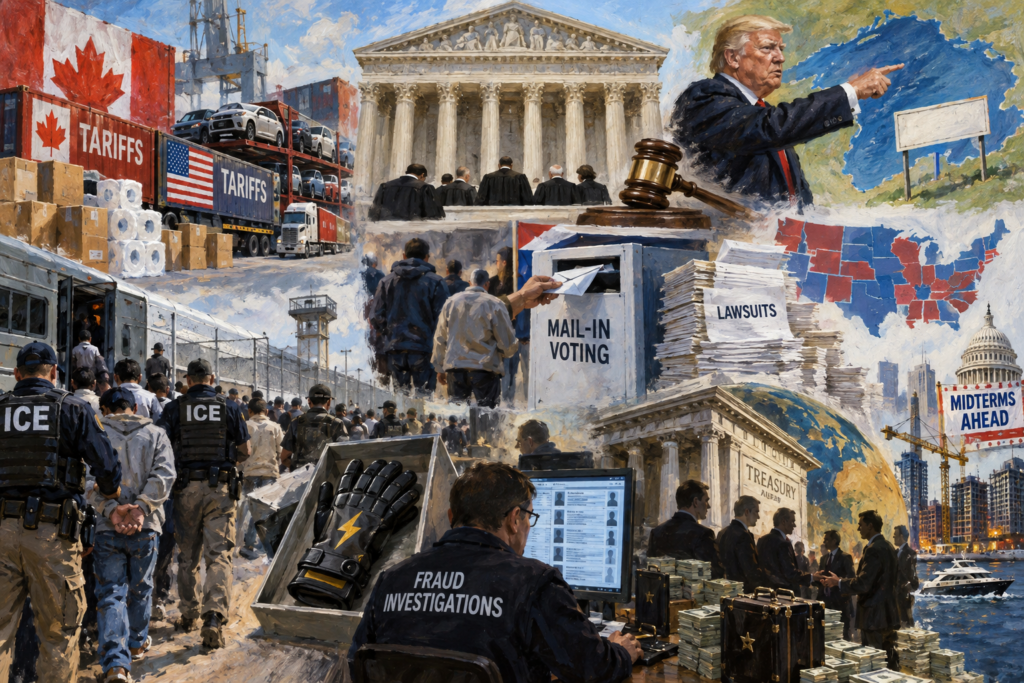
- Trade war with Canada moved from negotiation collapse to full retaliatory escalation — What began as stalled talks on Friday night expanded through the week into tariffs on autos, steel, dairy, and household goods, matching retaliatory measures from Canada, and a symbolic executive order renaming a shared lake — all without resolving the underlying dispute.
- Mail-in voting restrictions moved through a volatile legal sequence just weeks before the midterms — A Supreme Court procedural win for the administration on Monday set off a chain of USPS rule implementation, a temporary judicial block, a vacated injunction, a new multi-state lawsuit, and a last-minute 14-day stay — leaving voting rules unsettled heading into ballot season.
- Immigration enforcement widened in scale, tactics, and political entanglement — Record monthly detentions, a new contract for controversial shock gloves, expanded local-police deputization, and the diversion of fraud investigators toward voter-data screening together show an enforcement apparatus growing faster than its oversight.
- Financial entanglements between presidential power and private gain surfaced repeatedly — A Treasury Department struggling to manage bond markets, a $900 million settlement benefiting a donor's firm, newly scrutinized stock trades during the Iran war, and new reporting on cryptocurrency earnings backed by a foreign official together depict an administration whose economic levers and personal finances are difficult to separate.
- Local governments pushed back against surveillance even as federal enforcement expanded — A string of city and county votes to end license-plate tracking contracts ran in parallel with, and in tension against, the week's expansion of federal immigration surveillance and enforcement capacity.
This was a week defined by escalation on multiple fronts at once: a trade relationship with Canada that broke down entirely and then kept getting worse, a mail-in voting fight that swung back and forth through the courts almost daily, and a string of financial entanglements that tied presidential power to private gain in increasingly concrete ways. Against that backdrop, immigration enforcement expanded to record levels even as a wave of local governments moved in the opposite direction, severing their own surveillance contracts. By week's end, thousands gathered on the National Mall to invoke a march held six decades earlier — a reminder that institutional pressure was being met, unevenly, by civic response.

**The Weekend**

The week began with a Friday-night collapse. Canadian Prime Minister Mark Carney walked away from nearly-finished trade talks over last-minute American demands touching trucking rules, sovereignty, and language protections. Within hours, 50% U.S. tariffs took effect on $20 billion of Canadian goods, and Carney announced Canada would match them dollar for dollar. It was the opening move in a dispute that would harden through the week rather than cool.

The rest of the weekend offered a study in contrasts. In Washington, federal grounds around the Capitol and National Mall were reconfigured for a presidentially organized IndyCar race — manhole covers welded down, flights rerouted, artwork at the National Gallery specially protected — a considerable diversion of public infrastructure toward a branded entertainment spectacle. In South Carolina, Trump turned a Senate primary into a personal loyalty test, rallying for Darline Graham against Ralph Norman and backing her with $827,000 from his super PAC, after a string of losses by his endorsed candidates elsewhere. Cracks within his own coalition surfaced publicly, too: Marjorie Taylor Greene called him a "Trojan horse," prompting Trump to label her, along with Tucker Carlson and Thomas Massie, "losers" on social media. A separate decision to suspend tariffs on imported ground beef to ease consumer prices drew fury from cattle ranchers, some lifelong supporters, who said they had lost faith in him. Meanwhile, Treasury Secretary Scott Bessent intervened directly in the Japanese yen market and doubled a long-term bond buyback program — moves financial analysts compared to a faltering military campaign, a sign that market confidence was already under real strain. And a Stars and Stripes reporter, Liz Korte, was fired by Defense Secretary Hegseth after writing about the hardships facing military families displaced by the Iran war, a firing that would return as a lawsuit later in the week.

**Monday**

Monday delivered the week's most consequential single ruling. A divided Supreme Court, voting 6-3, lifted an injunction that had blocked Trump's executive order restricting mail-in voting, finding the states' challenge procedurally premature rather than addressing the order's merits. That technical distinction mattered enormously in practice: it cleared the way for the U.S. Postal Service to begin implementing new ballot rules just weeks before the midterms, launching a legal tug-of-war that would run through the entire week.

The same day, immigration enforcement widened its reach in two distinct ways. The wife of an active-duty Army sergeant stationed at Fort Bliss was deported to Honduras despite having no criminal record, one of more than fifty identified cases of military family members swept up after prior protections were rolled back. And the Department of Homeland Security advanced plans to spend up to $20 million equipping ICE officers with electric-shock gloves, over objections from civil rights groups citing documented abuse. Separately, USCIS fraud-detection officers were pulled off asylum processing and redirected toward screening South African refugees and investigating alleged noncitizen voters — the first sign of a pattern that would become explicit two days later. Nevada and regional water agencies sued the Interior Department over a new Colorado River allocation plan cutting the state's share by roughly 71% while sparing upper-basin states, and a report that Hakeem Jeffries had met privately with Jared Kushner drew a pointed public warning from Speaker Mike Johnson.

**Tuesday**

Tuesday's developments were fewer but sharply pointed. The EPA proposed making Clean Air Act emissions disclosure voluntary for datacenters, cutting public visibility into pollution tied to disease just as datacenter construction accelerates nationwide. In a separate and unusually direct maneuver, Trump's lawyers suggested the Kennedy Center might need to be demolished unless courts allowed renovation and naming plans tied to the president to proceed — leverage applied to a national cultural institution whose fundraising and ticket sales had collapsed after his name was added to the building.

The trade dispute with Canada widened further: 50% tariffs hit Canadian toilet paper, tissue, and dairy, with autos and steel tariffs announced for January 2027, and Canada responded by targeting nearly 900 American products effective September 8. The mail-voting fight continued its churn as well, with a district judge finding that USPS had already violated a prior injunction by proceeding with rulemaking, though the judge stopped short of ordering further remedy.

**Wednesday**

Wednesday was the most institutionally dense day of the week. Trump declared a national emergency restricting foreign-made equipment in the U.S. bulk-power system, a move granting broad executive control over energy infrastructure procurement with little legislative involvement. A divided Third Circuit panel ruled that criminal charges against Rep. LaMonica McIver, stemming from a congressional oversight visit to an immigration facility, could proceed, rejecting her speech-and-debate defense — a decision with direct consequences for how far members of Congress can go in challenging executive agencies without facing prosecution themselves. In an unusual breach of judicial convention, sitting Justice Clarence Thomas sat for roughly 9.5 hours of one-on-one podcast interviews with Senator Ted Cruz.

The reassignment of fraud-detection officers toward voter-data screening, first visible on Monday, became fully explicit: hundreds of USCIS officers were formally redirected to examine voter rolls for possible noncitizen registrations, halting routine immigration-fraud work less than three months before the midterms. In Texas, a federal judge declined to order the extradition of an ICE agent charged in Minnesota with shooting a Venezuelan man, and the state's governor separately refused the request, allowing the agent's release.

Against this backdrop of expanding federal authority, a notably different story unfolded at the local level. On the same day, city councils and county commissions in Asheville, Kendall County, Wylie, and Pflugerville all voted to terminate or decline renewal of license-plate surveillance contracts with Flock Safety, one jurisdiction acting after discovering 1.6 million unauthorized data searches. The Justice Department, meanwhile, signaled it would appeal rather than comply with a judge's order requiring further unredaction of the Epstein files.

**Thursday**

Thursday paired symbolism with substance. Trump signed an executive order directing federal agencies to rename Lake Ontario "Lake America," a gesture aimed squarely at Canada amid the active trade dispute; Canada rejected it outright, and several U.S. governors dismissed the move as well.

Far more consequential was a set of financial disclosures: the administration had canceled offshore wind leases and directed $1.2 billion to the German firm RWE in exchange for abandoning them, with $900 million of that sum used to acquire a stake in a Louisiana LNG project owned by a private equity fund run by a Trump inaugural donor — a transaction now under congressional investigation.

Immigration enforcement intensified in Danbury, Connecticut, where immigrant-rights groups reported dozens of arrests over several days, including parents detained in front of school-bus stops, part of a national pattern in which arrest numbers were hitting record highs even as the share involving violent criminal history shrank. Three Stars and Stripes employees, including colleagues of the reporter fired the previous weekend, sued the Department of Defense and Secretary Hegseth over what they described as retaliation for covering conditions aboard the USS Abraham Lincoln. Former Border Patrol Commander Greg Bovino said publicly that his security detail had been pulled and suggested officials may want him dead, framing it as retaliation for his criticism of the administration. Three Secret Service officials, including the communications director, were placed on leave amid an investigation reportedly connected to FBI Director Kash Patel's search for a media leak source. And HHS Secretary Robert F. Kennedy Jr. suggested Pennsylvania's documented measles deaths might have been fabricated by a governor's staffer, even as new documents surfaced showing he had given false congressional testimony about a 2019 trip to Samoa tied to vaccine skepticism.

**Friday**

The week closed with a measure of legal whiplash resolved, for the moment, in favor of voters: a federal judge temporarily blocked USPS from enforcing the new mail-voting rule for fourteen days pending further review, one day after 24 states and the District of Columbia sued arguing the rule usurped state and congressional authority over elections. It was the latest swing in a dispute that had moved from Supreme Court clearance to rule implementation to a judge finding a violation to a fresh injunction within the span of a single week, leaving voters and election officials with genuine uncertainty just ahead of the midterms.

That uncertainty stood alongside a very different kind of public response: thousands gathered on the National Mall for a "Defend the Vote" march echoing the 1963 March on Washington, with speakers including Rep. Alexandria Ocasio-Cortez framing the midterms as a referendum on eroding rights.

New reporting added further weight to the week's financial throughline, finding that Trump had earned at least $1.4 billion from cryptocurrency products in 2025, funded partly by foreign governments and entities under investigation, while a separate report revealed a $500 million investment in his family's crypto venture from a UAE national security official — arriving as the UAE was separately seeking access to American AI chips. ICE closed the week by confirming it had detained a record 49,571 people in a single month, a majority without criminal convictions, while awarding a $16.7 million no-bid contract for the electric-shock gloves first proposed days earlier, despite objections from sitting senators. Private prison operator GEO Group donated $1.4 million to a Trump-aligned super PAC shortly after winning DHS detention contracts worth more than $160 million annually, while Meta agreed separately to pay $17.1 billion to settle claims that it had endangered children through addictive platform design.

The week's final note was almost incidental: at a NASA ceremony meant to honor the Artemis II astronauts, Trump delivered a lengthy, self-focused political speech that was met with silence from an audience of scientists and military families.

**Taken as a whole**

The week showed executive power reaching simultaneously into trade policy, electoral administration, energy infrastructure, cultural institutions, and even geography, while oversight mechanisms struggled to keep pace. Courts split a difference between enabling and restraining a contested voting rule within days of each other; Congress saw one of its own members face prosecution for conducting oversight; and financial arrangements linking the presidency to campaign donors and foreign investors grew more concrete and more documented. Yet the week also recorded real friction against that expansion — from ranchers and allies breaking publicly with the president, to city councils severing surveillance contracts, to tens of thousands marching under a banner recalling 1963. Neither current fully prevailed by Friday; both left a mark on the record.