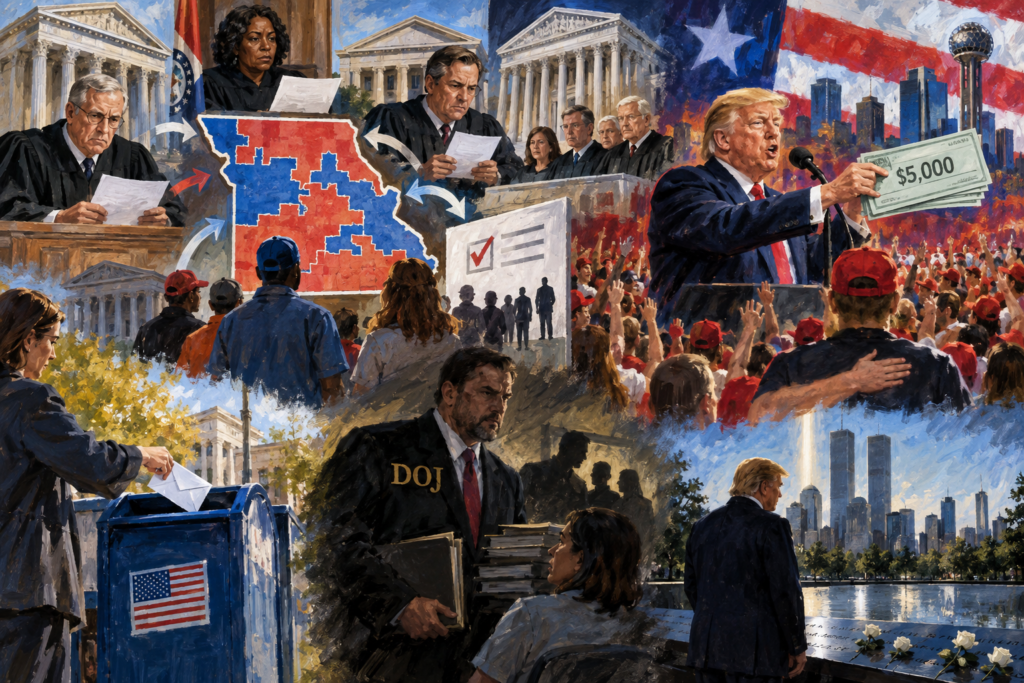
This week’s throughlines
- A redistricting fight across four courts tested whether partisan maps could override state constitutional protections — Missouri's gerrymandered congressional map bounced between a state supreme court, a federal district judge, the Eighth Circuit, and the US Supreme Court within days, ending with the Court blocking the partisan map and a state official held in contempt for defiance. Parallel impeachment threats against judges in Missouri and Utah, including Utah's successful court-packing, showed the same pressure applied nationally.
- Executive promises and claims of unilateral authority escalated through the week's convention speeches — Trump's $5,000 dividend pledge moved from a campaign promise to a claim that congressional approval might not even be needed, while Republican allies from DeSantis to Chip Roy publicly doubted its feasibility, revealing intra-party unease about unchecked executive spending claims.
- National memory and commemoration were repeatedly bent toward political ends — From AI-generated conquest imagery to fabricated 9/11 heroism to using a Pentagon memorial to justify the Iran war, the administration treated shared history and tragedy as material for personal and political narrative rather than fact.
- Voting infrastructure and data privacy came under quiet but sustained pressure — Mail-voting restrictions were repeatedly blocked by courts even as DOJ sent investigation-tinged letters to election officials, while Musk-funded operations built surveillance-enabled voter registration tools operating outside the transparent federal system.
# The Map, the Money, and the Memorial
### Week 86 – September 5–11, 2026

This was a week defined by three separate contests over the same basic question: who gets to decide what is true, what is fair, and what is owed. A congressional map in Missouri bounced between four courts in a matter of days. A president promised every American adult a $5,000 check, then suggested he might not need Congress to deliver it. And on the 25th anniversary of September 11th, the same president repeated a fabricated story about his own heroism at Ground Zero, appeared to fall asleep at a Pentagon memorial, and skipped the main ceremony in New York. Underneath it all, courts spent the week pushing back — not always successfully, but persistently — against an executive branch testing how far its reach could extend.

**The Weekend**

The weekend opened with a split verdict from the judiciary. A federal judge allowed the Pentagon to proceed with firing journalists from Stars and Stripes in a First Amendment dispute, a loss for press independence inside the military. At nearly the same time, another judge extended an injunction blocking the administration's mail-in voting restrictions, weeks before the midterms — a restriction the Department of Justice immediately signaled it would keep fighting. A separate ruling forced disclosure of who had structured a disputed $1.8 billion fund meant to compensate people the administration considered victims of political "lawfare." The plan had been quietly abandoned amid bipartisan criticism, but its origins were now subject to judicial scrutiny. Meanwhile, the Justice Department's pressure campaign against hospitals providing gender-affirming care to minors continued, adding a New York hospital to a growing list that had dropped the service under investigative threat rather than through legislation or formal rulemaking.

In a preview of the week's final chapter, Rudy Giuliani used a Newsmax appearance to disparage New York Mayor Zohran Mamdani's Muslim faith, suggesting he skip the 9/11 memorial entirely — a religiously charged attempt to exclude a sitting official from a solemn civic occasion. It was also over the weekend that the president began telling reporters and Fox News he had personally led rescue efforts at Ground Zero and been evacuated by firefighters from a collapsing building — claims fact-checkers and eyewitnesses say are simply false. That story would not stay still; it would grow across the week.

**Monday**

Monday brought less visible but still consequential developments. Rep. Chellie Pingree publicly called on Congress and the Cabinet to exercise their oversight powers rather than continue enabling the president's conduct — an unusual public airing of fitness-for-office concerns from inside the legislative branch. The Department of Health and Human Services released a non-peer-reviewed report attempting to link "gender ideology" to left-wing political violence, a document experts said violated federal information-quality standards and extended the administration's pressure campaign against transgender healthcare into the realm of pseudoscience.

The president, meanwhile, posted a flurry of AI-generated images — renamed American territories, a depicted strike on Iran's Kharg Island, himself rendered as a superhero — alongside a claim that he had made "hundreds of billions" trading stocks from the Oval Office. The mixture of governance communication with fantasy imagery, paired with an offhand acknowledgment of personal stock trading from the seat of the presidency, pointed toward questions the week would not resolve.

**Tuesday**

By Tuesday, the week's central story began in earnest. Missouri's state supreme court ruled that Trump-backed congressional maps must go before voters in a referendum. Hours later, a federal judge issued a temporary restraining order requiring the maps be used anyway. Then Justice Kavanaugh denied an emergency request to employ the same maps — three rulings, three different outcomes, within about 72 hours, days before an election. It was a vivid illustration of how fragile redistricting protections had become.

The same day, the president signed a cluster of executive orders and proclamations: redistributing Defense Production Act energy authority to the Interior Secretary, ordering new veterans' data-sharing systems, and imposing tariffs and import bans on Canadian alcohol, dairy, and vehicles, escalating a trade dispute with a longtime ally. Separately, reporting revealed that Elon Musk's America PAC-funded voter data operation, votesafe.org, had expanded through affiliated groups — including one that had sent outdated registration forms to deceased voters, and a Heritage Foundation-linked group that spent $650,000 promoting a white-labeled version during Fox News coverage without disclosing the Musk connection. Unlike the federal vote.gov, the site collects and monetizes detailed personal and psychological data, raising concerns about a hidden surveillance infrastructure built around voter registration itself.

At a Tunnel to Towers Foundation ceremony, the president repeated his fabricated 9/11 rescue story, adding new details that CNN and other outlets documented as impossible given his actual location that day. Elsewhere, Smithsonian secretary Lonnie Bunch III — the institution's first Black leader — announced his retirement after sustained administration attacks on the museum's content. New York's city government, under Mayor Mamdani, released 170,000 pages of long-withheld 9/11 health records showing officials had known post-9/11 air quality was toxic while publicly calling it safe. In Germany, the far-right, anti-immigrant AfD party won a major state election in Saxony-Anhalt, drawing public praise from Vice President Vance and Elon Musk. And Houthi attacks on Saudi oil facilities began pushing global energy prices upward, a trend that would intensify through the week.

**Wednesday**

Wednesday's Dallas convention speech became the week's loudest moment. The president pledged $5,000 "dividend" payments to every American adult, contingent on Republicans retaining Congress in the midterms, without explaining how it would be funded. In the same speech, he proposed renaming New Mexico "New America" and other landmarks after himself. The reaction from within his own party was immediate: former Freedom Caucus chair Bob Good, Rep. Chip Roy, Governor DeSantis, and donor Joe Lonsdale all raised doubts about the plan's legality, feasibility, or basic arithmetic, even as Vice President Vance defended it on Fox News using tariff revenue figures that were quickly fact-checked as inaccurate.

The same day, the administration proposed adding a citizenship question to the census and eliminating race and ethnicity data collection used since 1790 — a change that could exclude millions from apportionment counts and reshape the constitutional basis for representation. A documentary reported that DOGE had accessed and shared sensitive Social Security data, prompting Nobel laureate Geoffrey Hinton to warn that the access pattern resembled what would be needed to manipulate elections through AI-enabled targeting.

The Missouri redistricting fight continued without pause, as a federal judge issued a new order requiring use of the Trump-backed map just hours after Kavanaugh's denial, prompting immediate appeals. Democratic lawmakers countered with their own economic messaging event in Dallas, Governor Pritzker launched a $20 million PAC aimed at House races, and Epstein survivors staged a "reading room" near the convention site. Overnight, the United States and Iran exchanged direct military strikes near the Strait of Hormuz — American forces destroyed five Iranian oil tankers, and Iran retaliated against U.S. ships, tankers, and a base in Jordan — pushing oil above $100 a barrel without congressional authorization for the engagement.

**Thursday**

Thursday brought the Missouri saga to what looked like a resolution, at least for a moment. The Eighth Circuit declined to block the Trump-backed map, prompting an emergency Supreme Court appeal — and the Court ultimately sided against the Republican-backed map, ordering the use of 2022 districts instead. Separately, the First Circuit, in a unanimous ruling from a panel of Biden appointees, held that the president lacked authority to regulate state election policy and declined to stay the injunction against his mail-voting order — the second appellate rejection of the policy in a matter of weeks.

Even as courts pushed back, the Justice Department sent letters to at least 30 senior state election officials ordering them to retain all 2024 election records, implying investigation without clarifying scope — a maneuver civil rights advocates read as a pressure tactic rather than a genuine inquiry. Separately, LULAC, Common Cause, UnidosUS, and the city of Denver sued over a DHS policy authorizing armed ICE agents at polling places in the 2026 elections.

Energy markets kept worsening: Houthi forces seized the port of Mocha, a critical shipping chokepoint, and combined with the Iran conflict, oil hit $109 a barrel while diesel reached a record $6.00 a gallon. The EPA, meanwhile, proposed rule changes easing pollution permitting requirements for AI data centers, eliminating public-participation steps for smaller emissions sources. And the president announced a unilateral tariff-free beef import policy from Brazil without industry consultation, even as reports surfaced of $45,000 in cash gifts to young female staffers and $20,000 to a co-defendant, raising ethics questions.

**Friday**

Friday was the 25th anniversary of September 11th, and it became the week's most pointed convergence of memory and politics. At a Pentagon memorial, the president repeated his fabricated Ground Zero rescue story once more, this time tying the legacy of 9/11 directly to justifying the ongoing conflict with Iran. He was photographed appearing to fall asleep during the ceremony, skipped the primary memorial service in New York altogether, and was publicly criticized by 9/11 widow Terry Strada for prioritizing business ties with Saudi Arabia over accountability to victims' families.

The same day, at the close of his convention appearances, the president had supporters recite a pledge of personal loyalty to him, including language about being willing to "cheat like hell" — a moment Governor Newsom described as replacing the Pledge of Allegiance with allegiance to one man. In a Fox interview, the president also suggested he might not need congressional approval to deliver the $5,000 checks promised days earlier.

The Missouri redistricting fight reached its conclusion: the state's supreme court held Secretary of State Hoskins in contempt for defying the earlier order and rejected his attempt to block the referendum on primary day, while the U.S. Supreme Court blocked the federal ruling that had revived the gerrymandered map. Threatened impeachments of state justices went unrealized in Missouri, even as a parallel court-packing effort succeeded in Utah.

Elsewhere, reporting revealed the Justice Department's ongoing investigation of COVID-era scientists including Anthony Fauci, and the completion of the first deportation ever carried out through the Alien Terrorist Removal Court, a venue that permits secret evidence the subject never sees. A separate report described Border Patrol's use of "Predictive Intelligence Targeting Teams" to analyze Americans' financial activity in directing local police stops, without individualized suspicion. Smaller stories closed out the week: Corey Lewandowski's reported offer to help Qatari officials with visas in exchange for private employment while at DHS, and Secretary of State Rubio's hiring of a speechwriter previously fired for retweeting a Nazi symbol.

**The Week in Sum**

Taken as a whole, the week showed an executive branch testing the outer edges of its authority on several fronts at once — electoral maps, campaign finance norms, historical memory, data privacy, and military engagement — while the judiciary, including appellate panels and justices not typically aligned with voting-rights advocates, repeatedly drew lines the administration could not cross. The Missouri map returned to its pre-gerrymander form. Mail-in voting protections held. But the week also left behind evidence of what courts cannot easily reach: a presidential pledge of personal loyalty from a political rally, a fabricated story of heroism repeated at a national memorial, and a trillion-dollar promise whose legality even allies could not explain. Twenty-five years after September 11th, the argument was no longer only about what the government could do — it was about what the public would be asked to believe.