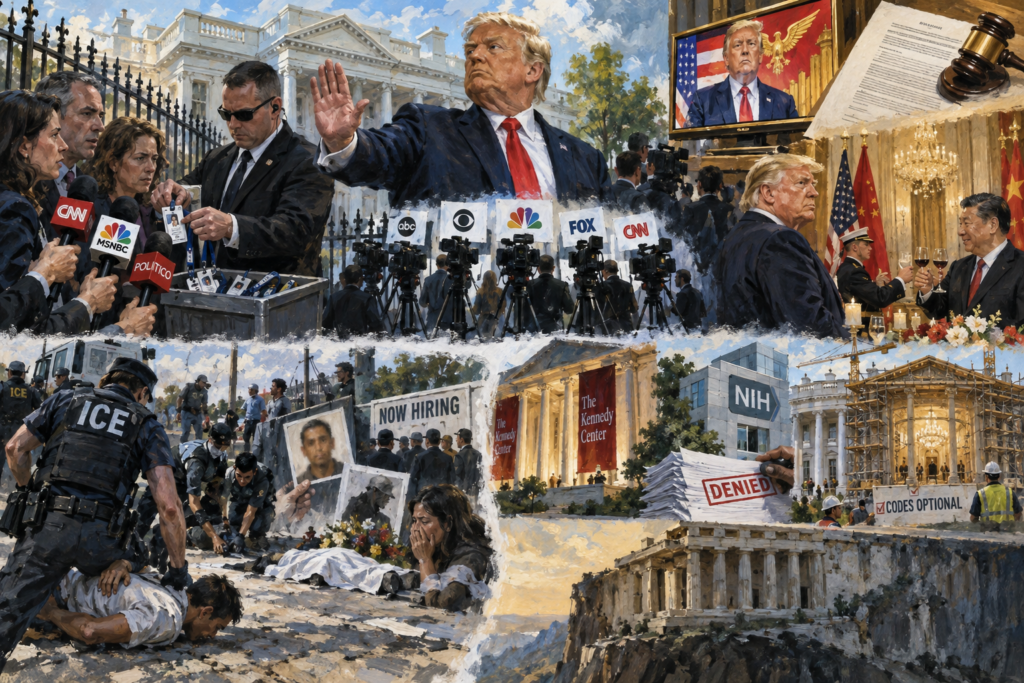
This week’s throughlines
- Press access became a direct constitutional confrontation — A Saturday ban on three news outlets escalated through credential seizures, a five-network boycott, a state-run media alternative, a federal lawsuit, a restraining order, and repeated administration defiance of that order through the following Friday.
- Immigration enforcement produced escalating casualties amid rushed hiring — A death, a shooting, and a mistaken-identity beating of a US citizen occurred within roughly 48 hours, traced partly to 10,000 newly hired agents processed with minimal vetting, while courts and a GAO audit separately found the underlying deportation and detention programs unlawful, wasteful, or inhumane.
- Public institutions and funds were redirected toward personal or political control — The Kennedy Center, NIH grant review, a triumphal-arch military project, and a White House ballroom exempted from fire codes each showed public assets being repurposed around presidential preference rather than institutional process.
- Courts intervened repeatedly, with mixed enforcement — Federal and state courts ruled against the administration on press access, third-country deportations, and ballot seizure, and reinstated a wrongly convicted voter's acquittal — but the administration continued deportations pending appeal and briefly defied the press-access order outright.
- Republican unease surfaced across multiple fronts — GOP senators publicly broke with the president on Trump Jr.'s finances, ICE tactics, tariff and diesel policy, a cash-payment scheme, and the press ban itself, while a war-powers resolution to end the Iran conflict narrowly failed despite some Republican support.
This week began with a president deciding, on a Friday evening, that three news organizations no longer had a place in his White House — and it ended, seven days later, with his administration blocking those same reporters from a state dinner hours after a federal judge had ordered their access restored. In between came a sprawl of enforcement violence, quiet institutional takeovers, and a Republican Party visibly uneasy with where its own leader was taking it. Courts intervened again and again over the course of the week; the administration's typical response was to appeal, delay, or simply ignore them.

The week's central story began over the weekend of September 19 and 20, when Trump announced that CNN, MSNBC, and Politico were banned "effective immediately" from the White House, citing what he described as unfair coverage. By Saturday morning the announcement had become policy: Secret Service agents were turning reporters away at the gates and confiscating their hard passes, reportedly catching the White House's own press office off guard. Trump suggested the ban might soon widen to include the New York Times and Washington Post. That same weekend, a nationwide accounting found that the administration had cut, frozen, or delayed roughly $177 billion in federal grants across all fifty states — nearly a tenth of federal discretionary spending — disrupting maternal health, nutrition, disaster relief, and education programs regardless of which states or communities depended on them. Other institutional moves surfaced alongside it: thousands protested outside the Kennedy Center as Trump-allied board members voted to close it following a minor ceiling incident that Democratic board members called a pretext; Trump moved to install a political-appointee board with veto power over NIH biomedical grants despite a congressional provision meant to block exactly that; and he floated converting a planned triumphal arch into a military complex for drones and snipers, citing an unverified request from the armed forces. Early cracks in Republican unity also appeared, with Rep. María Elvira Salazar warning that mass deportation was costing Trump support among Hispanic voters, and Senators Cassidy and Grassley separately criticizing a $5,000 payment scheme and a diesel export policy. And on September 20, immigration enforcement turned violent in three separate incidents within a single day: a Guatemalan man died fleeing an ICE traffic stop in Michigan, a Venezuelan DoorDash driver was shot and wounded by an agent in Austin, and a Black U.S. citizen mistaken for a fugitive was beaten by agents in Evanston, Illinois.

By Monday, the press dispute had become a lawsuit and then a full industry response. CNN, MS Now, and Politico sued the administration over the ban, alleging violations of the First and Fifth Amendments, with a hearing set before Trump-appointed Judge Timothy Kelly. In an unusual show of solidarity, ABC, CBS, CNN, Fox News, and NBC suspended their shared pool coverage of the president altogether, leaving at least one presidential event without press audio. The White House answered not by backing down but by launching "Trump TV," a curated YouTube stream, alongside a renewed push for its official app as a direct-to-citizen news channel — an attempt to route around independent journalism entirely rather than negotiate with it. The same day, a federal appeals panel ruled that the administration's practice of deporting migrants to third countries with no connection to them violated due process; DHS said it would continue the policy anyway during the appeal, having already sent more than 25,000 people to dozens of countries under paid bilateral arrangements. ICE violence continued as well, with agents tackling and pepper-spraying an independent photographer covering a Minneapolis protest, even as further reporting detailed the mistaken-detention injuries in Evanston. In smaller but telling episodes, Trump praised New York City Mayor Mamdani during a UN meeting despite Mamdani's pending lawsuit against the administration, and farm-state anger simmered over below-market beef imports and a dubious potash deal with sanctioned Belarus.

Tuesday shifted focus briefly away from the press fight, though not away from institutional strain. Eight states sued the Interior Department over settlements that canceled East Coast offshore wind leases in exchange for hundreds of millions in Judgment Fund payments to developers, arguing the deals misused settlement authority to redirect energy policy without congressional sign-off. In Mississippi, a grand jury declined to charge anyone in the July death of Nolan Wells, a Black teenager, despite the family's independent autopsy documenting unexplained blunt-force injuries. Reporting also filled in more detail on the Austin shooting victim from the weekend: an asylum seeker with a valid work permit who was discharged to ICE custody with a bullet still in his body, left in pain overnight until public outcry forced his return to a hospital — the officer involved was a recent hire without the body camera the administration had promised all agents would wear. Separately, ProPublica reported that the FBI had built a corruption case against Senator Susan Collins over an alleged pay-to-play defense-contracting scheme, only for the probe to be shut down after the administration dismantled specialized public-corruption units the previous year. A food-safety recall of more than 167,000 pounds of uninspected, mislabeled meat followed closely on the heels of Trump's push to loosen restrictions on foreign meat imports. And at the UN, Secretary-General António Guterres warned of an "extraordinary transfer of power" from governments to private corporations and individuals — a global framing that echoed much of what was unfolding domestically that same week.

Wednesday brought the first notable crack in Republican solidarity over the president's family. Senator John Curtis called for a Senate subpoena of Donald Trump Jr. over reports that a Putin-aligned Russian oligarch had helped fund his wedding, applying the same standard Republicans had once used against Hunter Biden. Election-related concerns sharpened as well: the DSCC, DCCC, DGA, and congressional leaders sued DHS, ICE, and the FBI over a reported policy to station armed federal officers at polling places, arguing it would violate election law and intimidate voters, especially naturalized citizens. Meanwhile, California and eleven other states quietly settled their antitrust challenge to the $110 billion Paramount-Warner Bros. merger, securing no divestitures and only a toothless "Editorial Independence Board" controlled by the acquiring family, plus a labor exemption critics called a union-buster — a settlement that handed major media consolidation to a politically aligned owner in the same week the White House was fighting to control press access elsewhere. That fight continued on its own track: reporting indicated Trump had revoked press credentials again after an aide showed him critical coverage, even as the administration kept promoting its own app and CNN's Kaitlan Collins asserted her right to cover UN events independent of White House credentialing. Elsewhere, more than a million people were removed from Affordable Care Act coverage over fraud concerns, and Governor Newsom signed a law making it a felony to seize ballots from county election offices — a direct response to an earlier sheriff's confiscation of over 650,000 ballots.

Thursday delivered the week's sharpest turn. Judge Timothy Kelly ruled that the administration had likely violated due process and First Amendment protections, ordering credentials restored for 78 journalists for two weeks and finding the government's national-security rationale pretextual. Yet that same morning, White House staff denied access to reporters covering Trump's event with Chinese President Xi Jinping, forcing an emergency motion before access was finally granted — a direct test of whether a court order could actually bind the executive's daily conduct. Elsewhere, the Justice Department's Civil Rights Division dismissed more than fifty long-running school desegregation cases, closing federal oversight mechanisms that in some instances had existed for decades. New reporting detailed a broader pattern behind a historic settlement: DoorDash's $131.5 million payment to New York City for underpaying more than 260,000 workers was the latest in a string of wage-theft settlements stretching back to 2020 across multiple states. On immigration, the State Department pledged at least $410 million toward third-country deportations even as the Solicitor General asked the Supreme Court to permit the practice to resume following the appellate ruling against it. And at home, the administration signed $300 million in contracts for a White House ballroom routed through an office exempt from federal building codes, after the original architect resigned over safety concerns — Trump reportedly responded, "I am the code." Republican unease continued in smaller ways, with Senator John Kennedy criticizing the press ban while still agreeing with its underlying premise, and reporting emerging that RFK Jr. had diverted Office of Minority Health funds toward personal security while accepting gifts tied to his policy interests.

By Friday, the press-access confrontation reached its clearest point of defiance. Hours after Judge Kelly's order, the administration barred CNN and MS Now editorial staff from a state dinner honoring President Xi, permitting only limited technical crews — and Trump posted a digitally altered photo of himself with Xi that replaced a State Department official's likeness with that of a Trump aide, without disclosure. The Senate, meanwhile, voted down a House-passed resolution to end the 200-day military conflict with Iran, 49-50, despite support from four Republican senators, after 19 U.S. service members had been killed and more than 750 injured in the conflict. Election-related news cut in two directions: the California Supreme Court ordered the return of the more than 650,000 ballots a sheriff had unlawfully seized, and Texas's highest criminal court let stand the acquittal of Crystal Mason, previously convicted for an innocent voting mistake — while a DHS whistleblower alleged that federal agents had used citizens' Social Security numbers to impersonate voters and check their registration histories, prompting senators to request a state investigation, and Nevada's secretary of state separately rejected a DHS list falsely claiming 185 registered voters were noncitizens. Justice Ketanji Brown Jackson publicly warned that the Supreme Court's use of its emergency docket risked becoming an "end-run" around ordinary review, issued hours after the administration filed yet another emergency deportation request; separately, a federal judge found ICE detention conditions in Manhattan "inhumane and unconstitutional" and ordered remedial action. The week closed with a nonpartisan GAO audit finding ICE had wasted tens of millions of dollars without a coherent strategic plan for a $45 billion appropriation, and Senator John Cornyn publicly declining to fundraise for Texas Senate nominee Ken Paxton, warning that weak candidates cost parties their majorities.

Taken as a whole, the week put a fine point on a familiar but hardening dynamic: courts, state officials, and even members of the president's own party pushed back repeatedly against the exercise of executive power, while the administration's most common response was not to comply but to appeal, delay, or simply proceed as though the ruling had not been made. A press ban became a lawsuit, a lawsuit became a court order, and the order was defied at the very next opportunity. A deportation policy was found unlawful and continued anyway, backed by new funding, while the government asked the Supreme Court to bless it retroactively. Public institutions — a cultural landmark, a biomedical funding agency, a construction project exempt from fire codes — were reshaped around personal preference rather than established process. And an immigration enforcement system expanded through rapid, poorly vetted hiring produced, within one week, a death, a shooting, a beating, and a judicial finding of unconstitutional detention conditions. None of these threads resolved by Friday. What the week showed, instead, was the shape of the argument now underway over how much institutional resistance — legal, legislative, or simply factual — a modern executive is required to heed.