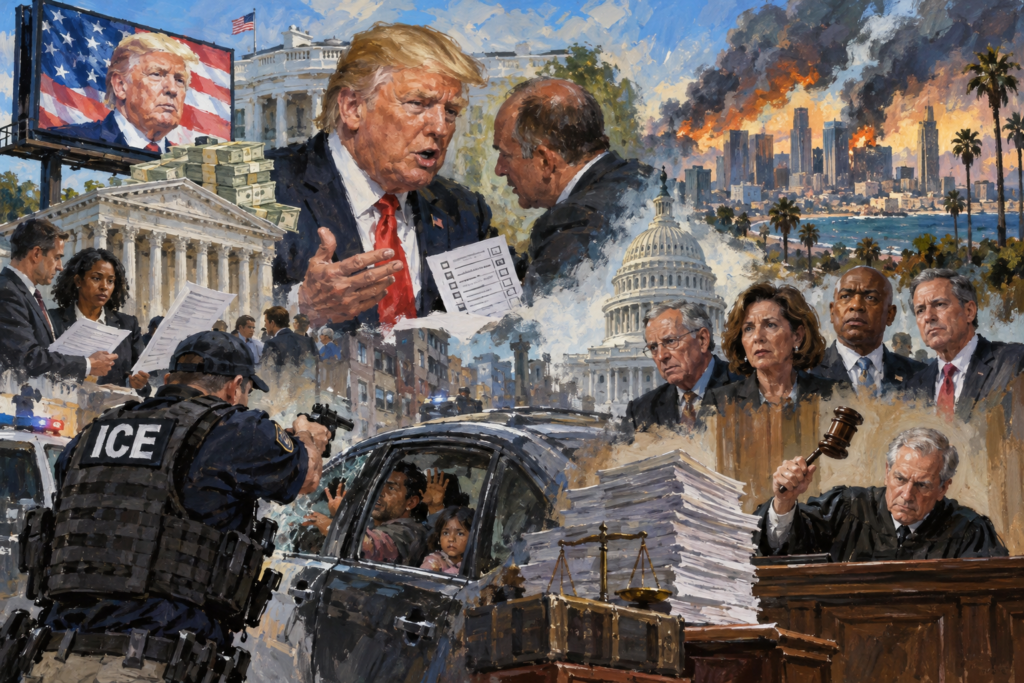
This week’s throughlines
- Public money for political promotion drew mounting legal resistance — Diverted DHS funds for pro-Trump ads, a $5,000 election-year pledge, Medicare fund payments timed to the midterms, and a Mar-a-Lago-adjacent presidential retreat proposal collectively prompted lawsuits from Common Cause and the DNC challenging the use of appropriated funds for self-promotion.
- Election machinery became a direct battleground — A president who met with election deniers to discuss seizing ballots, a DOJ voter-roll scheme struck down by a federal judge, ICE's mass collection of voter records, NAACP litigation over poll monitors, and a wave of post-Callais redistricting together show the electoral system under simultaneous pressure from multiple directions ahead of the midterms.
- Immigration enforcement tactics triggered open confrontation with local government — An ICE shooting of a man with a child in the vehicle in Manhattan, a federal agent's documented history of unlawful arrests, a mayor's public demand for ICE's removal, and DHS's dismissive defense of the shooting marked a sharp escalation in friction between federal enforcement and city leadership.
- Presidential rhetoric moved from defensive to openly expansive — Over the course of the week, Trump's public statements progressed from suggesting American cities were an acceptable wartime loss to explicitly declaring 'I can do whatever I want,' alongside new rhetoric targeting immigrant communities and demanding linguistic conformity from federal agencies.
- Courts pushed back on multiple fronts while capital punishment produced crisis — Judicial rulings blocked the DOJ voter-roll program, compelled disclosure of the legal basis for Caribbean boat strikes, and preserved evidence from a survived execution in Tennessee, even as Texas proceeded with another execution using the same drug and the Pentagon announced a livestreamed military execution.
Three weeks before midterm elections that will determine control of Congress, the week of October 3 through 9 tested nearly every mechanism meant to keep executive power in check — appropriations law, press access, voting rights, and the rules governing lethal force at home and abroad. The week's developments did not arrive as isolated incidents so much as overlapping pressures on the same institutions, each testing whether established limits would hold.

The week opened with reporting that Donald Trump had personally directed the Office of Management and Budget to redirect $20 million in congressionally appropriated Department of Homeland Security funds into television advertisements praising himself. The money had been set aside by Congress for other purposes; its diversion into self-promotional media set up a dispute over appropriations authority that would resurface repeatedly as the week went on. Also over the weekend, the New York Times reported that Jared Kushner and special envoy Steve Witkoff — neither of them diplomats — were negotiating a multibillion-dollar purchase of sanctioned Russian oil assets from Lukoil, a deal that would benefit a major Trump donor and family-linked investors. Civil society groups moved in a different direction: the Power to the People festival paired major musical acts with voter registration drives, and Popular Information launched a free tool allowing voters to trace the funding behind political mailers. Meanwhile, the White House continued barring Politico and CNN from the Air Force One press pool despite a judge's temporary restraining order requiring their reinstatement, and U.S. Southern Command carried out its 70th lethal strike on a Caribbean vessel, killing four more people without public evidence of wrongdoing. In a rare interview, Justice Samuel Alito discussed contemplating retirement annually and the personal toll of the Dobbs decision, raising fresh questions about the Supreme Court's near-term composition.

By Monday, the administration's reach into economic and judicial territory expanded further. Trump signed Executive Order 14435, unilaterally suspending collection of the federal diesel fuel excise tax through year's end and directing agencies to explore making the forgiveness permanent — a move that bypassed the ordinary congressional process for setting tax policy. Senate Democrats Chuck Schumer, Richard Blumenthal, and Ruben Gallego responded on a different front, signaling that if Democrats retake the Senate majority, they would decline to confirm any Trump Supreme Court nominee, explicitly invoking the precedent Mitch McConnell set in blocking Merrick Garland. The Supreme Court itself issued a large batch of procedural orders — denying several stay applications and granting certiorari with vacatur and remand in a string of criminal and immigration cases — while also hearing arguments in Suncor Energy v. Boulder County, a case that could eliminate state-level climate liability litigation nationwide. Separate reporting detailed how public money kept flowing toward the politically connected: defense contractor employees donated heavily to appropriators after funding equipment the Army said it did not need, and Iowa's $1.36 billion incentive package for a steel plant worked out to $777,000 per job — more than thirty times the typical rate — in a deal tied to Trump's own election messaging. Two developments stood out as more consequential than the rest. Tina Peters, an election denier who has promoted the unsupported theory that Commerce Secretary Howard Lutnick could seize voting machines, met with Trump at the White House to discuss the idea. And at a rally in Nebraska, Trump said that if Iran "took out" Los Angeles or San Diego, it would be "a small price to pay" for keeping the country safe from high oil prices — remarks that treated the destruction of major American cities as an acceptable cost.

The fallout from that rally arrived quickly. On Tuesday, Governor Gavin Newsom called the remarks "deranged and dangerous," San Diego Mayor Todd Gloria rejected the suggestion that his city was expendable, and Los Angeles Mayor Karen Bass added her own condemnation — a rare moment of unified state and local pushback against a sitting president's rhetoric about the safety of his own citizens. The same day, Trump escalated his conflict with the press on multiple fronts: he falsely accused the New York Times of doctoring a photograph of his Miami club, called for media outlets to face arrest, and posted cropped images of a rally to dispute documented reporting on sparse attendance. He also complained publicly that Fox News was giving Democratic candidates too much airtime, calling the coverage disloyal — direct pressure on a network to alter its editorial choices. Financial disclosures added another dimension to the week's questions about presidential conflicts of interest: Trump announced he would use a $400 million jet gifted by Qatar as the new Air Force One, even as filings showed he had earned $2.2 billion in his first year back in office, including $1.4 billion from his family's cryptocurrency venture. Separately, the Federal Transit Authority proposed steering infrastructure grants toward areas with higher birthrates and marriage rates, a policy critics linked to "Great Replacement" ideology and a sharp departure from neutral funding criteria. Amid the week's heavier news, a newly formed "NSPM-7 Defendants Union" launched legal clinics to support people prosecuted under Trump's memorandum targeting left-wing protest activity, an organized civil-society response to what organizers called a weaponized "antifa" framing.

Wednesday brought one of the week's more direct statements of executive self-conception. Speaking to reporters, Trump said he could have done "very bad things" to Clinton, Biden, and Obama but chose restraint — then asserted that as president he could do "whatever I want." The same day, Common Cause sued over the $20 million DHS advertising contract featuring Trump, arguing that the OMB reapportionment of Customs and Border Protection funds violated the Purpose Statute and equal protection principles by advantaging Trump-aligned candidates ahead of the midterms. A federal judge separately stayed a DHS policy that had stopped collecting biometric data from detained immigration applicants, finding the agency's rationale arbitrary and likely to prevent people from pursuing their cases — a narrow but concrete restoration of procedural protection. Elsewhere, an FBI sting operation at the Mall of America drew scrutiny after agents supplied an 18-year-old suspect with an AK-47 before arresting him for an alleged planned mass-casualty attack, raising entrapment concerns, and the NAACP sued to block the administration's plan to deploy 1,000 federal monitors to midterm polling sites, arguing the plan lacked statutory authority and risked voter intimidation.

Thursday compressed several of the week's most serious threads into a single day. Tina Peters' attorney described a reported plan in which Trump indicated he would not relinquish power again, with the administration allegedly prepared to seize ballots nationwide for a hand recount — Peters reportedly framed martial law as preferable to civil war. It marked an escalation from her Monday meeting with the president, moving from a shared interest in a voting-machine seizure theory to a described plan for seizing ballots outright. The same day, Judge Sooknanan ruled that the Department of Justice's collection of unredacted state voter rolls for cross-referencing against immigration databases violated federal privacy law and exceeded DOJ's authority — a ruling that came after the program had already removed citizens from voter rolls. The structural consequences of the Supreme Court's earlier decision in Louisiana v. Callais, which weakened Voting Rights Act protections, became more visible as Alabama, Florida, Louisiana, and Tennessee moved quickly to redraw congressional maps in ways critics said were designed to fragment Black voting blocs. The fight over taxpayer-funded political advertising widened further when the DNC filed its own suit over $12 million in pro-Trump ads, even as DOJ's civil rights division sought a federal indictment of former White House aide Cassidy Hutchinson for alleged perjury related to her January 6th testimony — raising concerns about retaliation against a cooperating witness. In Manhattan, ICE agents surrounded a vehicle in Marble Hill and fired multiple rounds, shooting a man named Oscar Belgal in the neck while a five-year-old child sat in the back seat; the agent involved had a documented history of unlawful arrests. The day's death penalty news was equally grave, though unconnected to the shooting: a judge ordered Tennessee to preserve evidence after Christa Pike survived a lethal injection attempt, and hours later Texas executed Jamaal Howard using the same drug, over objections from his legal team. The Pentagon added a further note of alarm, announcing that Defense Secretary Pete Hegseth would oversee a livestreamed public execution of Fort Hood shooter Nidal Hasan on December 3rd — the first U.S. military execution in more than sixty years. Separately, Homeland Security Investigations was revealed to have examined more than 150 voter registration organizations without finding significant evidence of wrongdoing, while ICE had compiled roughly 99 million voter records for a deportation-targeting database, with an election denier playing a leading role in that effort.

The week's final day carried the Manhattan shooting into open political conflict. Mayor Mamdani demanded ICE's removal from New York City, calling its tactics terrorizing, while DHS Secretary Mullin dismissed the criticism and defended the agents involved. New reporting compounded the concern: ProPublica found that ICE had detained U.S. citizens more than 500 times, including at least 70 children, while the administration was separately transferring undocumented children into federal custody while detaining their parents — a practice echoing earlier family separation policies. Press freedom fights spread beyond the White House pool dispute when Disney and ABC challenged the FCC's unusually early review of eight ABC station broadcast licenses, arguing it amounted to retaliation for editorial decisions the administration disfavored. Trump, meanwhile, floated building a Camp David-style presidential retreat at his own West Palm Beach club and announced a deal with Vladimir Putin to supply growing volumes of Russian diesel to the American market — an arrangement Ukrainian President Volodymyr Zelenskyy said would help fund Russia's war effort. The week's death penalty controversy drew a rare bipartisan rebuke when Republican Representative Austin Scott and Senator Thom Tillis joined Democratic Senator Jon Ossoff in condemning the Pentagon's execution livestream plan, comparing it to practices associated with authoritarian states. Trump also turned his rhetoric toward a specific immigrant community, accusing Somali immigrants in Minnesota of "taking over" the state and urging residents to "fight back" following reports of a criminal investigation involving a Somali American suspect. The week closed on a quieter but still telling note, as a Super PAC aired an attack ad targeting a South Carolina Senate candidate over transgender rights, and two political action committees distributed mailers containing claims their own operators acknowledged were false.

Taken as a whole, the week showed democratic institutions absorbing pressure from several directions at once, with mixed results. Courts intervened repeatedly — blocking the DOJ's voter-roll program, narrowing an immigration biometrics policy, and ordering evidence preserved from a botched execution — demonstrating that judicial review remained an active check even as executive assertions of power grew more explicit. State and local officials, from California's governor and mayors to New York's, pushed back publicly and without equivocation. Civil society organizations sued, organized, and built new tools for transparency. But the underlying trend lines were less reassuring: a president openly discussing the seizure of ballots with an election denier, lethal force used against unarmed civilians with inadequate accountability, a geographically expanding effort to redraw electoral maps following a weakened Voting Rights Act, and public money increasingly directed toward political self-promotion all pointed toward a system under sustained strain. Three weeks before voters went to the polls, the question was not whether these tensions would resolve, but whether the courts, the press, and elected officials outside the executive branch could hold the line long enough for the election itself to proceed on fair terms.